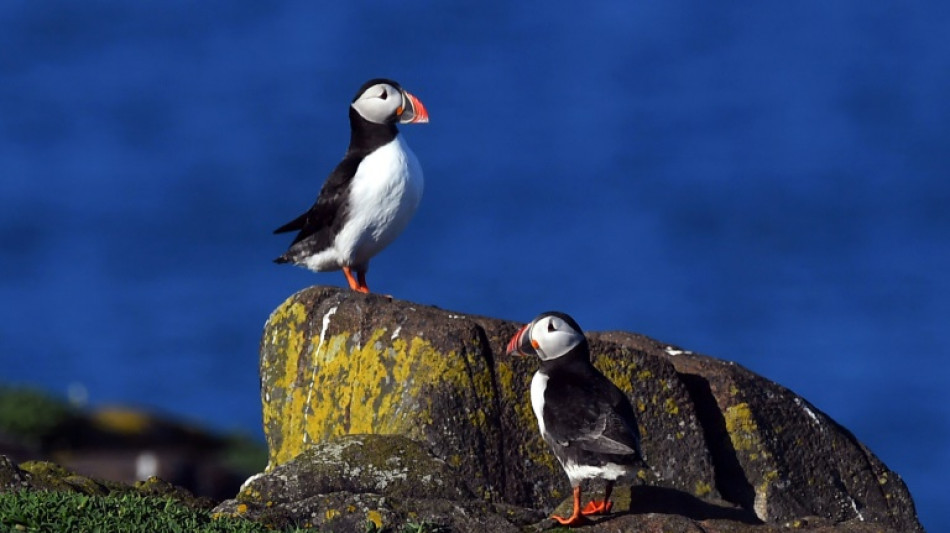
Decline in North Sea puffins causes concern / Photo: © AFP

The Isle of May, off Scotland's east coast, is home to one of the UK's biggest colonies of seabirds. Some 200,000 birds, from kittiwakes to guillemots can flock to the rocky outcrop at the height of the breeding season.
But conservationists are concerned about dwindling numbers of one of the island's most distinctive visitors -- the Atlantic puffin.
"The population was really booming in the 80s and 90s and then suddenly, a crash," David Steel, a manager at the nature reserve, told AFP.
"We lost nearly 30 percent of all puffins in the mid-2000s and since then the population has slowly increased but nothing compared to what it used to be."
Just over 50 miles (80 kilometres) down the coast on the Farne Islands, off Northumberland in northeast England, there are similar concerns.
In both places, global warming, high winds, rains, coastal erosion, pollution and overfishing of its favoured food -- sand eels -- is being blamed for dwindling numbers.
"Climate change is having a big effect with prey items in the sea," affecting sand eels which feed on plankton in the North Sea, said Steel.
"The plankton is moving north as the sea temperature increases. So if there are less sand eels the puffins are going to struggle."
- Census -
On a meadow on one of the Farne Islands, rangers slowly slide their arms into narrow sandy burrows, searching for signs of nesting pairs of puffins, which are known locally as "tommy noddies".
"Quite often you will get a bit of a nip, which is a good sign because it means then that the burrow is occupied," said one of the rangers, Rosie Parsons.
In 2015, the International Union for the Conservation of Nature gave puffins "vulnerable" status, after large declines over much of their European range.
Rising sea temperatures have caused sand eels to move north to cooler waters, forcing the birds to follow but where more extreme weather can be fatal for them.
The traditional enemies of puffins, which grow to just under 30 centimetres (one foot) tall and weigh around 450 grams (around a pound), are seagulls and seals.
Puffins mate for life and lay a single egg in April or May.
Due to their low reproductive rate, populations can take decades to recover from a sudden knock.
A full puffin census is being carried out on the Farne Islands and the Isle of May this year.
Concerns were raised last year when a limited count recorded 36,211 breeding pairs across four of the Farne Islands compared to 42,474 pairs in 2018.
Puffin numbers on the islands peaked at 55,674 pairs in 2003 before a sudden crash to 36,835 in 2008 a due to an extremely low number of sand eels.
Zoologist Richard Bevan, from Newcastle University, hopes the resumed annual count will provide a more accurate estimate of puffins on the islands.
"Up until 2018 surveys were done on the Farnes every five years, which means you don't know what's happening in the four years in between," he told AFP.
Before 2018, teams of researchers would check every burrow they came across on an island and form an estimate from that.
The university then found a way to subsample to form an accurate estimate of the population. This has sped up the count and made the task far less arduous.
- Concern -
Measuring puffin numbers is difficult, said Bevan.
Sometimes it will be easy to spot one of the birds, returning to nests with a sand eel clamped in its beak, but puffins are often underground.
"Often the only way to do it is to stick your arm into a burrow and check," he said.
The 2022 census will give scientists a picture of how the puffin population is being affected by factors such as climate change and local changes in sand eel availability, Bevan says.
"Looking at the data, it is worrying to see that over the last four years we have seen a downward trend," he says.
"However, these are data for a short time period and compared to the population counts in the early 1990s they are still reasonable numbers."
Although there is not an immediate danger of the puffins becoming extinct, the fact that their numbers are falling "triggers concern".
"With a declining population you have to keep your eye on it to make sure that doesn't continue," he said.
"If it does continue we have to be aware of the factors that contribute to it and how we can ameliorate those."
M.McCoy--TFWP