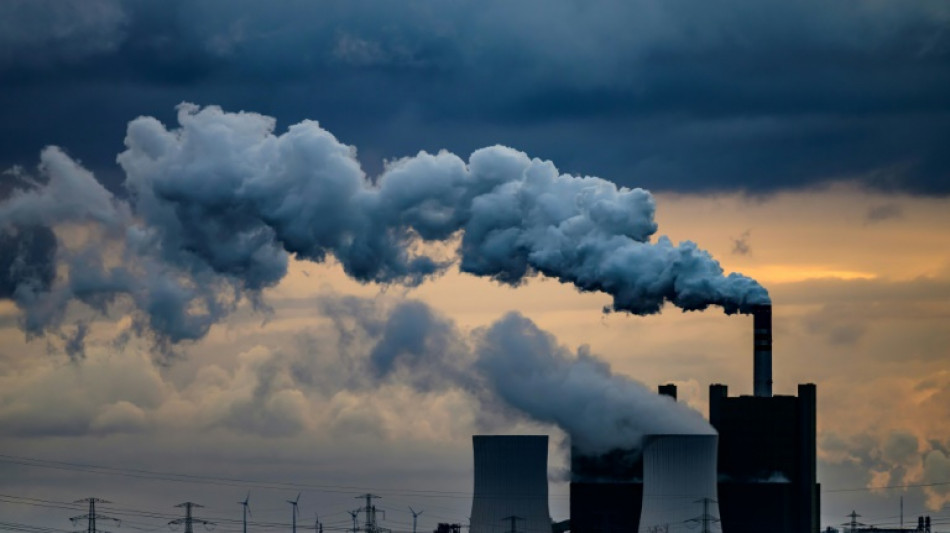
Pace of German emissions cuts slows in 2024: study / Photo: © AFP/File

German greenhouse gas emissions fell again in 2024 but at a slower rate, due to lagging green investment by industry and households, according to a study published Tuesday.
Emissions in Europe's biggest economy fell three percent in 2024, a "marked slowdown" from a 10-percent drop in 2023, according to the Agora Energiewende think tank.
Germany reflects a trend across the EU, where a 3.8-percent drop is expected in 2024, after eight percent in 2023.
However, the study says that the 2024 emissions total of 656 million tonnes does represent a "historic low" and the year's 18 million-tonne drop is larger than the emissions target enshrined in domestic law.
Emissions are down 48 percent from 1990 levels, nearing the EU target of a 55-percent cut by 2030.
But progress continues to lag in sectors such as transport, construction and building use, while industrial emissions actually saw a slight rise of two percent despite Germany's general economic stagnation.
- Investment held back -
Agora Energiewende said that 2023's sharp drop was largely attributable to a slowdown in Germany's ailing industrial sector, where emissions fell 12 percent, and not to long-term changes in production methods.
This seems to be borne out by the latest figures; with the economy predicted not to have shrunk by as much as it did in 2023, industrial emissions have dragged down the overall picture.
Agora Energiewende noted that "in contrast to the electricity sector, no structural progress was visible in industry, building use and transport".
"On the contrary, investments in climate-neutral technologies actually went backwards in comparison with the previous year," the think tank said.
Germany will hold an early general election next month following the recent collapse of Chancellor Olaf Scholz's coalition, and the study notes that economic and political uncertainty is holding back investment by both households and businesses.
Sales of heat pumps were down 44 percent on the previous year, with new electric vehicle registrations down 26 percent.
The slight fall in emissions from building use was only due to milder winter weather resulting in less need for heating.
- Political divide -
Eighty percent of the fall in emissions for 2024 is thanks to record high production of renewable energy and the continued closure of coal-fired power stations.
Germany's energy regulator said Friday that renewable sources such as wind, solar and biomass had risen to 59 percent of electricity generation from 56 percent.
"In the electricity sector, the climate protection measures taken in recent years are increasingly bearing fruit," said Agora Energiewende director Simon Mueller.
He appealed to political parties currently engaged in election campaigning to take the electricity sector as an example of what needs to be done in the rest of the economy.
The extent to which public funds should be used to support the green transition is a key dividing line between Scholz's Social Democrats and the conservative CDU/CSU opposition.
Scholz has advocated an "investment campaign" but CDU/CSU leader Friedrich Merz, currently riding high in opinion polls, has said he is opposed to such an idea.
S.Jordan--TFWP