Oil from Russian tanker spill reaches Sevastopol / Photo: © Russian Emergencies Ministry/AFP

Oil from two ageing and damaged Russian tankers was detected Friday off the coast of Sevastopol, the largest city in Moscow-annexed Crimea, a local official said.
The Volgoneft-212 and the Volgoneft-239 were hit by a storm last month in the Kerch Strait linking Crimea to the southern Russian Krasnodar region, about 250 kilometres (155 miles) from Sevastopol.
One sank and the other ran aground, pouring around 2,400 tonnes of a heavy fuel oil called mazut into the surrounding waters, Russia's transport ministry said.
"A small oil slick reached Sevastopol today," the Moscow-installed head of the city, Mikhail Razvozhayev, said on Telegram, publishing a video of the oil.
He said it was around 1.5 metres (five feet) in width and length.
Sevastopol, with a population of over half a million, is the historic home of the Russian navy's Black Sea fleet. It has been heavily targeted by Ukraine throughout the nearly three-year conflict.
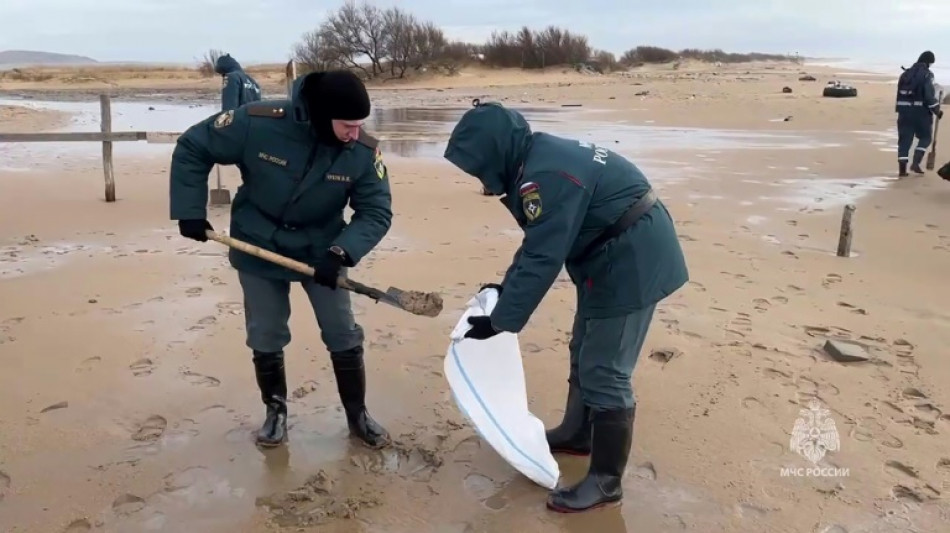
Already last month, Russia's emergencies ministry released photos of clean-up work on a beach in Krasnodarskiy Kray, east of Crimea.
President Vladimir Putin has called the tanker spills an "ecological disaster".
Hundreds of volunteers have been deployed to scoop up contaminated soil from beaches in Crimea and along Russia's southern coast.
- Clean-up hampered by conflict -
The transport ministry said this type of fuel oil was particularly hard to clean because it is dense and heavy and does not float on the surface.
This is the first incident of its kind ever involving M-100 grade mazut, the ministry added.
"There is no proven technology anywhere in the world to remove it from the water column," it said on social media.
"Therefore the main method is collection from the shoreline, when the mazut has been dumped on the coastal zone," it added.
Around 78,000 tonnes of contaminated soil and sand has been removed from beaches so far, Russia's emergency situations ministry said Friday. Up to 200,000 tonnes may need to be removed.
Iryna Babanina, a researcher at the UK-based Conflict and Environment Observatory (CEOBS), said a lack of equipment had hampered Russian clean-up operations.
And while an international convention against pollution covered the Black Sea, "proper actions to address the emergency became impossible during the war", she said.
Because of the conflict, deploying "special vessels, aircrafts and other equipment is impossible", she added.
"Information exchange between countries is also problematic. Only the satellite imagery can provide more or less reliable insight."
- 'Shadow fleet' -
Ukraine has denounced Russia over the spill, accusing it of trying to ship oil products in vessels unfit for harsh winter sea conditions.
Under Western sanctions, Russia has resorted to using a "shadow fleet" of mostly old tankers to export its fuels around the world.
"While we do not know if these exact two ships that sank were the part of shadow oil transportation operations -- and there is scarce information about what and where they were carrying -- the increase of the 'shadow fleet' is an environmental time bomb," Babanina said.
The problem, she added, was that "it's not clear how the safety of such ships is controlled and who is responsible in case of the disaster".
Russia seized the Crimean peninsula in 2014 following a pro-EU revolution in Kyiv.
F.Garcia--TFWP