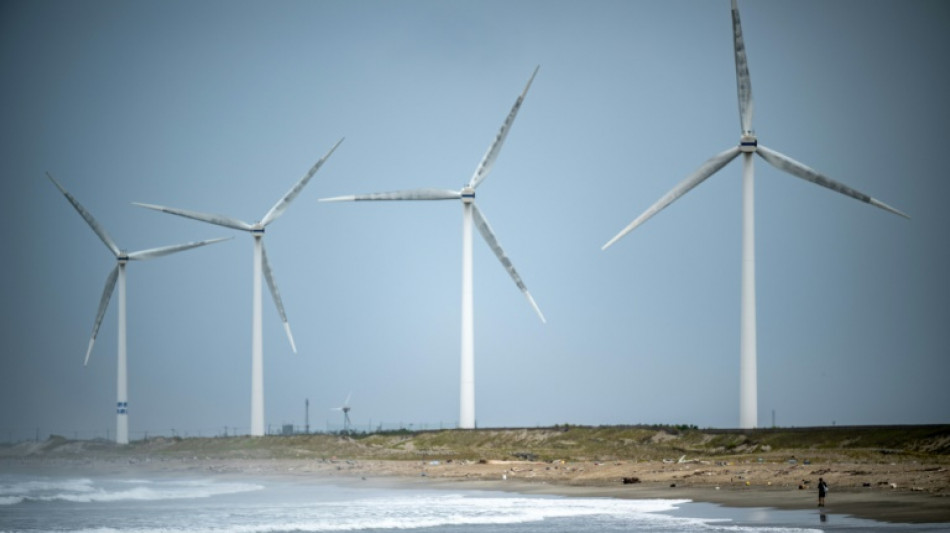
Japan to make renewables top power source by 2040 / Photo: © AFP

Japan wants renewable energy to be its top power source by 2040 in a push to reduce dependence on coal and gas and become carbon neutral by mid-century, government plans showed on Tuesday.
Thirteen years after the 2011 Fukushima disaster, the plan also foresees a major role for nuclear power in helping to meet growing energy demand from artificial intelligence and microchip factories.
The world's fourth-largest economy -- which campaigners say has the dirtiest energy mix in the G7 -- had already set a goal of becoming carbon neutral by 2050.
Under the new plans, renewables such as solar and wind were expected to account for 40 to 50 percent of electricity generation by 2040.
That marks a jump from last year's level of 23 percent and a previous target for 2030 of 38 percent.
Resource-poor Japan "will aim to maximise the use of renewable energy as our main source of power", said the draft Strategic Energy Plan unveiled on Tuesday.
Government experts were reviewing the plan released by the Agency for Natural Resources and Energy and it will be presented to the cabinet for approval.
Japan is aiming to avoid relying heavily on one energy source to ensure "both a stable supply of energy and decarbonisation", the draft said.
Geopolitical concerns affecting energy lines, from the Ukraine war to Middle East unrest, were also behind the shift to renewables and nuclear, it said.
- Nuclear push -
Nearly 70 percent of Japan's power needs in 2023 were met by power plants burning coal, gas and oil -- almost all of which must be imported.
The government wants that figure to fall to 30 to 40 percent by 2040. The previously announced 2030 target was 41 percent, or 42 percent when hydrogen and ammonia were included.
The new plans forecast a 10 to 20 percent jump in overall electricity generation by 2040, from 985 billion kilowatt hours (kWh) in 2023.
"Securing decarbonised sources of electricity is an issue directly related to our country's economic growth," Yoshifumi Murase, the head of the national energy agency, told the government's expert panel on Tuesday.
Unlike the previous plan released three years ago, the draft no longer foresees reducing Japan's reliance on nuclear power "as much as possible" -- a goal set after the 2011 disaster.
The government pulled the plug on nuclear power plants nationwide after the tsunami-triggered Fukushima meltdown.
However, it has gradually been bringing them back online, despite a public backlash in some places, as it seeks to cut emissions.
It expects all its existing reactors to be in operation by 2024, and affirmed the government's plan to develop and use new next-generation nuclear reactors, as its existing facilities get older.
Nuclear accounts for about 20 percent of Japan's energy needs under the 2040 targets, around the same as the current 2030 target.
That would mean more than double the 8.5 percent of overall power generation that nuclear provided in 2023.
Japan, like many countries, sweltered through record-breaking summer temperatures this year.
It also saw its warmest autumn since records began 126 years ago. The famous snowcap of Mount Fuji was absent for the longest recorded period this year, not appearing until early November, compared with the average of early October.
A.Nunez--TFWP