The Fort Worth Press - Scientists artificially inseminate leopard sharks to boost diversity

USD -
AED 3.672503
AFN 64.497874
ALL 81.380528
AMD 369.184597
ANG 1.789884
AOA 918.000281
ARS 1395.488197
AUD 1.381788
AWG 1.8
AZN 1.703045
BAM 1.667512
BBD 2.020641
BDT 123.098172
BGN 1.668102
BHD 0.378875
BIF 2985.894118
BMD 1
BND 1.270084
BOB 6.932419
BRL 4.925799
BSD 1.003253
BTN 94.565375
BWP 13.432689
BYN 2.835207
BYR 19600
BZD 2.017742
CAD 1.364775
CDF 2316.000054
CHF 0.777795
CLF 0.022638
CLP 890.969785
CNY 6.80505
CNH 6.800405
COP 3738.9
CRC 460.209132
CUC 1
CUP 26.5
CVE 94.012576
CZK 20.648299
DJF 178.651968
DKK 6.3499
DOP 59.661791
DZD 132.259755
EGP 52.725899
ERN 15
ETB 156.643406
EUR 0.84978
FJD 2.18395
FKP 0.734821
GBP 0.734295
GEL 2.679834
GGP 0.734821
GHS 11.286699
GIP 0.734821
GMD 72.999831
GNF 8804.55958
GTQ 7.660794
GYD 209.901226
HKD 7.83002
HNL 26.670759
HRK 6.405899
HTG 131.399121
HUF 301.720968
IDR 17354.2
ILS 2.905215
IMP 0.734821
INR 94.417203
IQD 1314.280599
IRR 1312899.999963
ISK 122.193911
JEP 0.734821
JMD 158.020607
JOD 0.708961
JPY 156.666043
KES 129.150164
KGS 87.420494
KHR 4024.093407
KMF 418.999917
KPW 899.950939
KRW 1466.210049
KWD 0.307599
KYD 0.836058
KZT 464.61503
LAK 22016.463537
LBP 89533.723815
LKR 323.055346
LRD 184.10709
LSL 16.368643
LTL 2.95274
LVL 0.60489
LYD 6.345837
MAD 9.195197
MDL 17.26071
MGA 4165.565455
MKD 52.36663
MMK 2099.606786
MNT 3578.902576
MOP 8.092183
MRU 40.138456
MUR 46.81999
MVR 15.454979
MWK 1739.54559
MXN 17.230296
MYR 3.918397
MZN 63.892811
NAD 16.368783
NGN 1361.259834
NIO 36.917043
NOK 9.23621
NPR 151.292686
NZD 1.67593
OMR 0.384501
PAB 1.003253
PEN 3.475021
PGK 4.365952
PHP 60.517979
PKR 279.534225
PLN 3.593095
PYG 6140.362095
QAR 3.656974
RON 4.452016
RSD 99.746014
RUB 74.299966
RWF 1470.817685
SAR 3.780174
SBD 8.032258
SCR 13.772608
SDG 600.55751
SEK 9.21375
SGD 1.26732
SHP 0.746601
SLE 24.597771
SLL 20969.496166
SOS 573.372496
SRD 37.431021
STD 20697.981008
STN 20.887684
SVC 8.778354
SYP 110.543945
SZL 16.363923
THB 32.185992
TJS 9.375794
TMT 3.51
TND 2.910164
TOP 2.40776
TRY 45.364802
TTD 6.786684
TWD 31.356503
TZS 2604.644023
UAH 43.928641
UGX 3752.28603
UYU 40.11647
UZS 12157.202113
VES 496.20906
VND 26309.5
VUV 118.026144
WST 2.704092
XAF 559.236967
XAG 0.012456
XAU 0.000212
XCD 2.70255
XCG 1.808106
XDR 0.695511
XOF 559.267959
XPF 101.680898
YER 238.601874
ZAR 16.395013
ZMK 9001.20103
ZMW 19.111685
ZWL 321.999592
  • RBGPF

    0.0000

    63.18

    0%

  • CMSC

    -0.0400

    22.97

    -0.17%

  • RYCEF

    -0.0500

    17.45

    -0.29%

  • NGG

    -1.9400

    85.91

    -2.26%

  • BCE

    0.3400

    24.57

    +1.38%

  • BCC

    -1.4800

    72.76

    -2.03%

  • JRI

    -0.0200

    13.15

    -0.15%

  • RIO

    -2.4000

    103.11

    -2.33%

  • CMSD

    0.0000

    23.42

    0%

  • RELX

    -1.5900

    34.16

    -4.65%

  • GSK

    -0.0300

    50.5

    -0.06%

  • AZN

    -2.4000

    182.52

    -1.31%

  • BTI

    -1.4800

    58.08

    -2.55%

  • BP

    -0.8200

    43.81

    -1.87%

  • VOD

    -0.4400

    15.69

    -2.8%

Scientists artificially inseminate leopard sharks to boost diversity
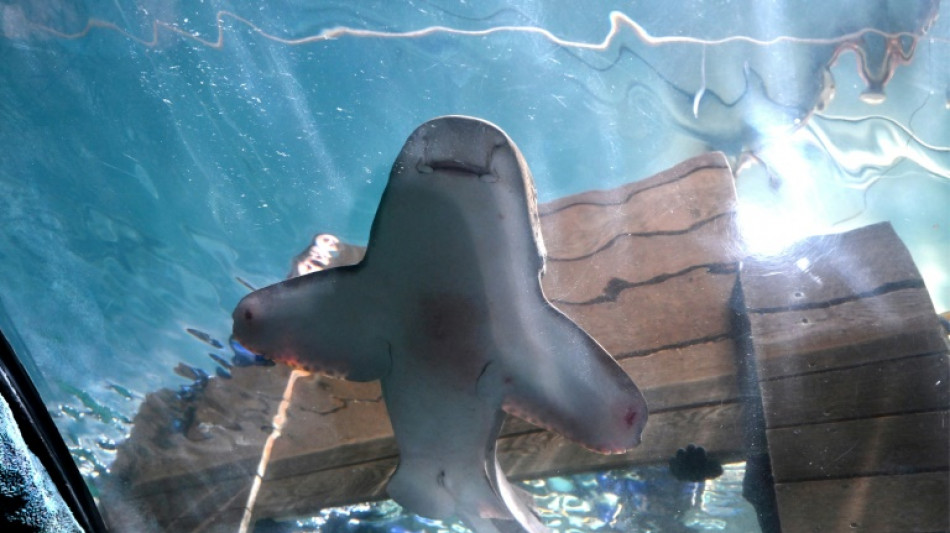
Scientists artificially inseminate leopard sharks to boost diversity / Photo: © AFP

Scientists artificially inseminate leopard sharks to boost diversity

A black-and-cream leopard shark enters a hypnotic-like state of relaxation as scientists at Sydney Aquarium carefully roll her onto her back in a small pool.

Text size:

The shark, named Zimba, is one of the first captive leopard sharks in the world to be artificially inseminated with the sperm of wild sharks in an attempt to build populations around the world.

If the process is successful, Zimba's shark pups will be sent to the Raja Ampat region in Indonesia, where the local population is on the brink of extinction due to unsustainable fishing practices and habitat destruction.

Artificial insemination allows sharks that would never normally interact to breed and increase genetic diversity, said SEA LIFE Australia and New Zealand regional coordinator Laura Simmons.

Simmons hopes that eventually the leopard shark population will be "genetically viable and capable of maintaining a self-sustaining population in the wild".

That could take years, she told AFP, but "this is one step closer to where we need to be".

The procedure is one part of a larger worldwide leopard shark breeding programme, known as StAR, that involves more than 60 conservation groups, aquariums and government agencies.

Globally, about 37 percent of oceanic shark and ray species, including the leopard shark, are now listed as either endangered or critically endangered by the International Union for Conservation of Nature, a global database for threatened species.

- 'Species belongs outside' -

Australia's leopard shark populations remain plentiful and of least concern, and scientists hope they can help bolster the numbers in other regions.

Back at the Sydney Aquarium pool, Ocean Park Hong Kong's chief veterinarian Paolo Martelli inserts a metal tube filled with the sperm of wild leopard sharks into Zimba's underside.

The shark is still in a natural state called tonic immobility -- a relaxed condition that allows scientists to work without getting injured.

The whole process takes a matter of minutes and everyone claps and cheers once it is over. Zimba is flipped back onto her stomach and swims around the pool as if nothing happened.

Martelli is using a technique he developed and has successfully used on other species, but this is the first time it has been used on leopard sharks.

"It's not straightforward," he said.

Martelli and his team collected the sperm of wild leopard sharks off the coast of Queensland -- which has a large shark population -- and brought the precious cargo to Sydney.

Only three of four samples taken survived the journey.

"This species belongs in outside habitats, not in a museum," Martelli said.

But as the shark's habitat declines, scientists must give a "helping hand" in protecting and conserving this valuable species, he added.

"It is safe to say that sharks have suffered a lot in the last century."

F.Garcia--TFWP