The Fort Worth Press - Zimbabwe rallies allies to push for legal ivory trade

USD -
AED 3.67295
AFN 65.999781
ALL 80.791633
AMD 366.140453
AOA 917.000203
ARS 1496.246101
AUD 1.41613
AWG 1.8025
AZN 1.676319
BAM 1.693949
BBD 2.013026
BDT 123.715983
BHD 0.377097
BIF 2992.5
BMD 1
BND 1.281592
BOB 12.13835
BRL 5.138019
BSD 0.999498
BTN 95.018556
BWP 13.553788
BYN 2.956053
BYR 19600
BZD 2.010125
CAD 1.40089
CDF 2260.999784
CHF 0.806825
CLF 0.023135
CLP 913.50203
CNY 6.74965
CNH 6.747495
COP 3181.99
CRC 453.238407
CUC 1
CUP 26.5
CVE 95.705219
CZK 20.93005
DJF 177.719855
DKK 6.469195
DOP 58.250422
DZD 132.815346
EGP 49.805598
ERN 15
ETB 161.315515
EUR 0.86536
FJD 2.209502
FKP 0.743223
GBP 0.742455
GEL 2.609793
GGP 0.743223
GHS 11.724985
GIP 0.743223
GMD 73.501313
GNF 8782.495737
GTQ 7.623551
GYD 209.07221
HKD 7.84395
HNL 26.788962
HRK 6.520398
HTG 130.679554
HUF 312.982979
IDR 17872
ILS 3.00375
IMP 0.743223
INR 95.043098
IQD 1309.307281
IRR 1374800.000129
ISK 122.710125
JEP 0.743223
JMD 158.828319
JOD 0.709011
JPY 157.664501
KES 129.370256
KGS 87.449718
KHR 4050.806134
KMF 427.999754
KRW 1421.070038
KWD 0.30922
KYD 0.83294
KZT 469.017006
LAK 22593.007998
LBP 89500.13208
LKR 335.394689
LRD 180.402482
LSL 16.396785
LTL 2.95274
LVL 0.60489
LYD 6.361621
MAD 9.315335
MDL 17.365547
MGA 4254.268776
MKD 53.292106
MMK 2099.302342
MNT 3598.197717
MOP 8.074676
MRU 40.078643
MUR 46.990041
MVR 15.459892
MWK 1733.030205
MXN 17.237605
MYR 4.094102
MZN 63.900902
NAD 16.396785
NGN 1361.850099
NIO 36.783939
NOK 9.513898
NPR 152.030834
NZD 1.697635
OMR 0.384502
PAB 0.999476
PEN 3.383395
PGK 4.481283
PHP 60.651499
PKR 277.52646
PLN 3.72135
PYG 5960.609053
QAR 3.654056
RON 4.539903
RSD 101.55502
RUB 80.977129
RWF 1468.233175
SAR 3.752529
SBD 8.071551
SCR 13.412956
SDG 600.501112
SEK 9.47949
SGD 1.280935
SLE 23.90005
SOS 571.205855
SRD 37.668027
STD 20697.981008
STN 21.219838
SVC 8.745171
SZL 16.383518
THB 33.0975
TJS 9.224886
TMT 3.51
TND 2.932668
TRY 47.568898
TTD 6.779955
TWD 32.2879
TZS 2649.99801
UAH 44.726481
UGX 3727.762476
UYU 40.187774
UZS 11881.376778
VES 754.21125
VND 26251
VUV 119.564009
WST 2.736752
XAF 568.132273
XAG 0.016087
XAU 0.000235
XCD 2.70255
XCG 1.801269
XDR 0.707453
XOF 567.499513
XPF 103.292972
YER 238.350256
ZAR 16.307035
ZMK 9001.201278
ZMW 19.079252
ZWL 321.999592
  • RBGPF

    -1.2500

    69.74

    -1.79%

  • RYCEF

    0.6500

    21

    +3.1%

  • CMSC

    -0.0600

    21.73

    -0.28%

  • NGG

    -0.1600

    80.26

    -0.2%

  • GSK

    -0.0700

    51.46

    -0.14%

  • RELX

    -0.1900

    36.61

    -0.52%

  • VOD

    -0.3800

    15.31

    -2.48%

  • BP

    -1.2300

    41.21

    -2.98%

  • BTI

    0.1500

    59.27

    +0.25%

  • RIO

    2.5000

    101.51

    +2.46%

  • BCC

    -1.6900

    84.8

    -1.99%

  • AZN

    5.8800

    161.5

    +3.64%

  • BCE

    0.0600

    22.06

    +0.27%

  • CMSD

    0.0200

    22.04

    +0.09%

  • JRI

    -0.0500

    12.67

    -0.39%

Zimbabwe rallies allies to push for legal ivory trade
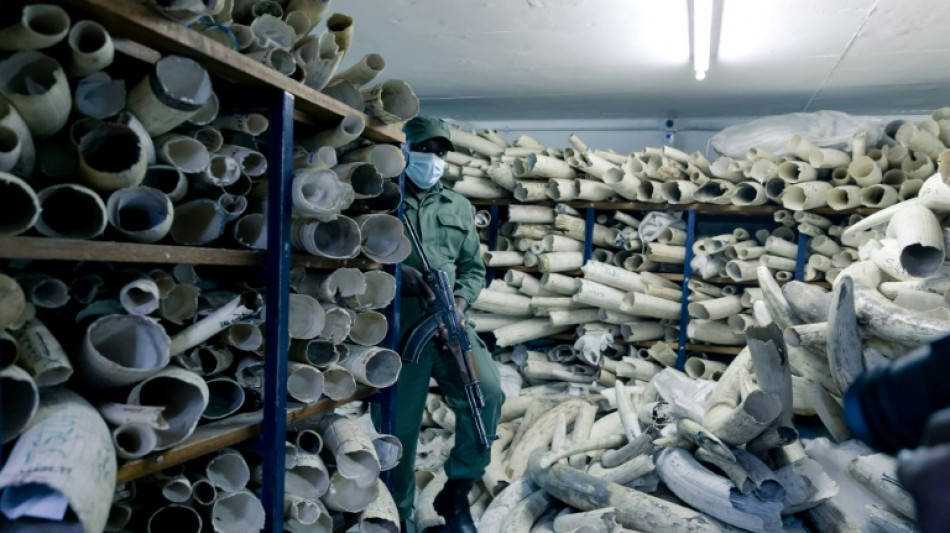
Zimbabwe rallies allies to push for legal ivory trade / Photo: © AFP/File

Zimbabwe rallies allies to push for legal ivory trade

Zimbabwe will this week press a drive to legalise the ivory trade, inviting officials from 15 nations to meet in a national park that's a beacon of success in protecting elephants.

Text size:

Hwange National Park is overflowing with elephants, which now routinely wander outside the boundaries to feed, sometimes running into deadly conflicts with people living in the surrounds.

Zimbabwe and its neighbours in southern Africa have seen their elephant herds thrive in recent years and are now home to about 70 percent of the continent's elephants.

That's a markedly different story than in the rest of Africa, where poaching and habitat loss have seen numbers declining.

Zimbabwe, by contrast, is home to 100,000 elephants -- nearly double the number that conservationists say the country's parks can support.

Elephants require vast areas for feeding. Even Hwange, a park nearly half the size of Belgium, isn't big enough to support its population.

Zimbabwe and other countries with large herds say they're left protecting vast stockpiles of ivory they can't sell to raise funds for either conservation work or to support communities affected by the growing elephant numbers.

"These are pertinent issues that are difficult to address in a balanced manner," Tourism and Environment Minister Mangaliso Ndhlovu said in a statement.

Zimbabwe last week urged European ambassadors to allow a one-off sale of $600 million worth of elephant ivory, kept in a warehouse outside central Harare.

International trade in ivory and elephants has been banned since 1989 under the Convention on International Trade in Endangered Species of Wild Fauna and Flora (CITES). One-off sales were allowed in 1999 and 2008, despite fierce opposition.

Countries in southern Africa say the ban prevents them even from supporting each other's conservation efforts, for example, by moving elephants from Zimbabwe to countries that want to repopulate.

The conference brings together countries likely to support a legalisation move, including China and Japan, where ivory is highly prized.

Kenya and Tanzania, which fear legalisation will encourage more poaching, were not invited. But the island nations of Seychelles and Madagascar, which have no elephants, are attending.

- Dangerous signal -

A collection of 50 anti-ivory trade organisations issued a statement warning that opening the ivory market would decimate the African herd, which in some regions is near extinction.

"The conference is sending a dangerous signal to poachers and criminal syndicates that elephants are mere commodities, and that ivory trade could be resumed heightening the threat to the species," they said.

But growing elephant herds pose real dangers to nearby communities.

Zimbabwe says 60 people have been killed by elephants so far this year, compared with 72 in all of last year.

"Governments of elephant range states are faced with social and political pressures on why elephants are prioritised over their own life and livelihoods," Ndhlovu said.

P.Navarro--TFWP