2024 'certain' to be hottest year on record: EU monitor / Photo: © AFP

This year is "effectively certain" to be the hottest on record and the first above a critical threshold to protect the planet from dangerously overheating, Europe's climate monitor said Monday.
The new benchmark affirmed by the Copernicus Climate Change Service caps a year in which countries rich and poor were hammered by disasters that scientists have linked to humanity's role in Earth's rapid warming.
Copernicus said an unprecedented spell of extraordinary heat had pushed average global temperatures so high between January and November that this year was sure to eclipse 2023 as the hottest yet.
"At this point, it is effectively certain that 2024 is going to be the warmest year on record," the EU agency said in its monthly bulletin.
In another grim milestone, 2024 will be the first calendar year more than 1.5 degrees Celsius hotter than pre-industrial times before humanity started burning large volumes of fossil fuels.
Scientists warn that exceeding 1.5C over a decades-long period would greatly imperil the planet, and the world agreed under the Paris climate accord to strive to limit warming to this safer threshold.
Copernicus Climate Change Service deputy director Samantha Burgess said a single year above 1.5C "does not mean that the Paris Agreement has been breached, but it does mean ambitious climate action is more urgent than ever".
- Cost of inaction -
The world is nowhere near on track to meeting the 1.5C target.
In October, the UN said the current direction of climate action would result in a catastrophic 3.1C of warming.
Emissions from fossil fuels keep rising despite a global pledge to move the world away from coal, oil and gas.
When burned, fossil fuels release greenhouse gases that warm Earth's oceans and atmosphere, disrupting climate patterns and the water cycle.
Scientists say that global warming is making extreme weather events more frequent and ferocious, and even at present levels climate change is taking its toll.
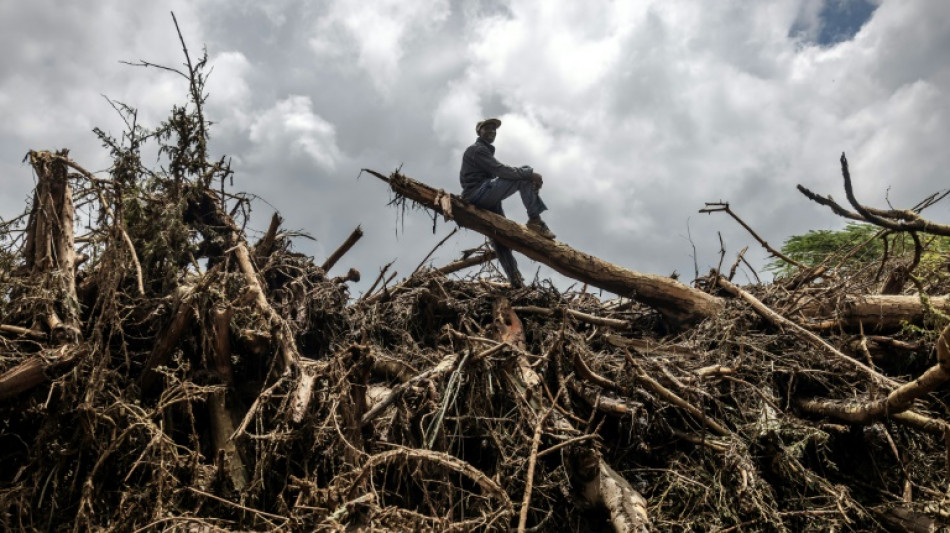
2024 saw deadly flooding in Spain and Kenya, violent tropical storms in the United States and the Philippines, and severe drought and wildfires across South America.
In total, disasters caused $310 billion in economic losses in 2024, Zurich-based insurance giant Swiss Re said this month.
Developing countries are particularly vulnerable and by 2035 will need $1.3 trillion a year in outside assistance to cope with climate change.
At UN climate talks in November, wealthy countries committed $300 billion annually by 2035, an amount decried as woefully inadequate.
- 'Exceptional' -
Copernicus uses billions of measurements from satellites, ships, aircraft and weather stations to aid its climate calculations.
Its records go back to 1940 but other sources of climate data -- such as ice cores, tree rings and coral skeletons -- allow scientists to expand their conclusions using evidence from much further in the past.
Scientists say the period being lived through right now is likely the warmest the Earth has been for the last 125,000 years.
Even by these standards, the extraordinary heat witnessed since mid-2023 has sparked scientific debate.
2024 began at the peak of El Nino, a natural phenomenon that moves around warm water, helping raise global temperatures.
But scientists said that such cyclical variability could not alone explain the record-breaking heat in the atmosphere and seas.
After the latest El Nino, temperatures were starting to fall but "very slowly, and the causes will have to be analysed", Robert Vautard, a scientist of the IPCC, the UN's expert climate advisory body, told AFP.
Last week, a study published in the peer-reviewed journal Science suggested a lack of low-lying clouds could be causing less heat to bounce back into space.
A separate paper in May explored the possibility that cleaner-burning shipping fuels were releasing less mirror-like particles into clouds, dimming their reflectivity.
Copernicus climate scientist Julien Nicolas said recent years were "clearly exceptional".
"As we get more data, we will hopefully better understand what happened," he told AFP.
M.Delgado--TFWP