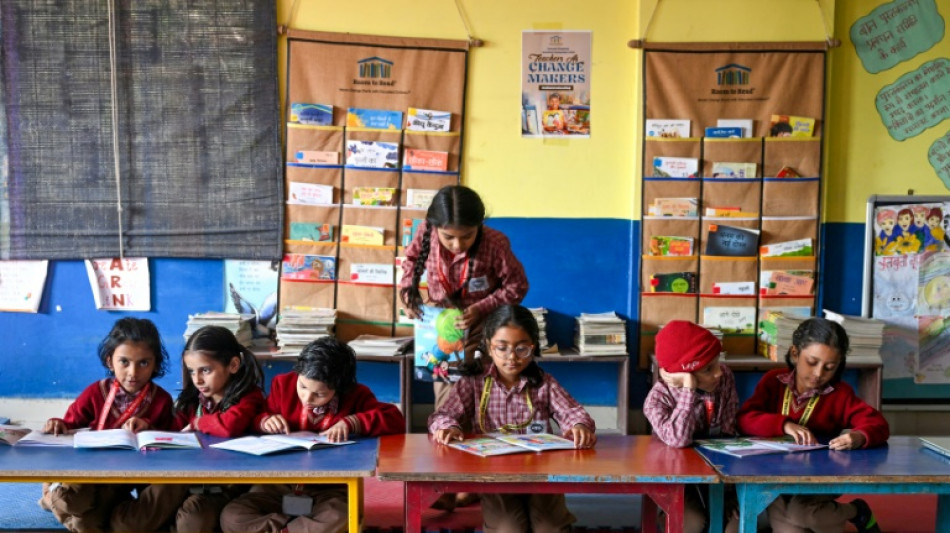
Relief as Delhi schools reopen but smog crisis persists / Photo: © AFP

Teenage student Aniksha is relieved to be back in class in India's capital -- even if the choking smog that prompted her school to close last month has yet to dissipate.
New Delhi and the surrounding metropolitan area is home to more than 30 million people and is blanketed by a thick and acrid haze each winter.
The public health crisis has grown steadily worse over the years and weeks-long school closures across the capital, aimed at shielding vulnerable children from the harmful skies, are now an annual occurrence.
But for the students like Aniksha it is a dreary ritual that disrupts their learning for weeks and keeps them stuck at home, isolated from friends.
"It's boring to stay at home," Aniksha, who uses only one name, told AFP on the grounds of her government school in the capital's west.
"I'm happy that class is back," the 13-year-old added. "You can do more in school. You can interact with the teachers and also get their help."
Nearly two million students across Delhi were out of schools for more than two weeks last month as the skies overhead turned a sickly yellow-grey.
At the peak of the smog, levels of PM2.5 -- dangerous cancer-causing microparticles that enter the bloodstream through the lungs -- surged more than 60 times the World Health Organization's recommended daily maximum.
Delhi's government gave schools the option to reopen last week, and many have resumed in-person classes in the days since.
But the crisis has not abated, with PM2.5 levels still 16 times the WHO limit on Tuesday, and the city regularly ranking as the world's most polluted by monitoring company IQAir over the past few days.
Schools are directed to offer online alternatives during smog closures to minimise disruption to lessons.
In practice, remote learning highlights the gulf between the city's prosperous classes and its mass of urban poor.
"Online teaching doesn't help much, many children don't have smartphones or struggle for network," language teacher Vandana Pandey, 29, told AFP.
Pandey said the school closures also did nothing to protect the health of students at her government school, who did not have the means to shield themselves from the poisonous air.
"They come from humble backgrounds," she said. When they don't have school, they are either playing outside or helping out their parents. They are not staying at home," she told AFP.
"It's not helping them in any way."
- 'Fit and healthy' -
Delhi is enveloped each winter by a mix of factory emissions and vehicle exhaust alongside smoke from seasonal crop burn-offs by farmers.
The toxic melange builds and lingers for weeks thanks to cooler temperatures and slow-moving winds.
A study in the Lancet medical journal attributed 1.67 million premature deaths in India to air pollution in 2019.
The foul air severely impacts children, with devastating effects on their health and development.
Scientific evidence shows children who breathe polluted air are at higher risk of developing acute respiratory infections, a report from the UN children's agency said in 2022.
A 2021 study published in the medical journal Lung India found nearly one in three school-aged children in the capital were afflicted by asthma and airflow obstruction.
Piecemeal government initiatives, such as partial restrictions on fossil fuel-powered transport and water trucks spraying mist to clear particulate matter from the air, have failed to make a noticeable improvement.
School closures are also ostensibly meant to improve air quality by cutting down on the number of Delhi residents commuting each day.
But Kashish, a sanitation worker and mother of two young students, who uses only one name, told AFP that it was obvious this year's closures had made no impact.
"You can't get rid of the pollution just by keeping children away from school," she said.
S.Jordan--TFWP