The farm fires helping to fuel India's deadly air / Photo: © AFP

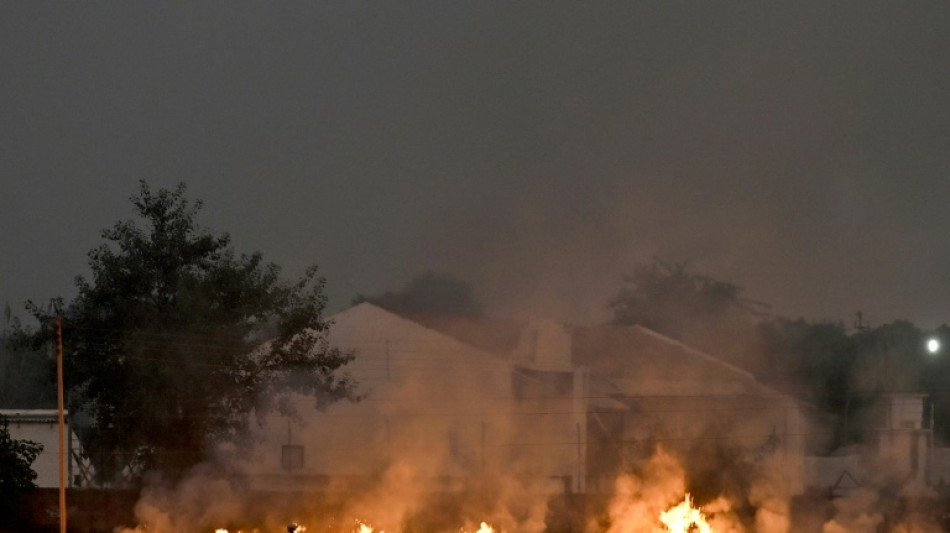
Blazing flames light the sky as Indian farmer Ali Sher burns his fields to clear them for new crops, a common but illegal practice that is fuelling deadly pollution killing millions.
Burning strips the fertility of fields, has a ruinous impact on India's economy and sends plumes of acrid smoke packed with dangerous cancer-causing particles drifting over a densely-populated belt of northern India, including capital New Delhi's 30 million people.
But it is cheap -- for farmers at least -- to carry out.
Small-scale growers like Sher with less than two hectares (five acres) of land -- who make up 86 percent of Indian farms, according to the World Economic Forum -- say alternatives to burning simply do not allow them to make the profit they need to survive.
The 55-year-old farmer is just one of the many thousands who torch the stubble left after their rice harvest to prepare the fields to plant a winter crop of wheat.
"I am scared of the authorities finding out, but I can't help it," said Sher, from Haryana's Jind district, as black plumes rose from his fields some 115 kilometres (70 miles) from the capital.
He faces a hefty fine and loss of critical government farming subsidies if caught.
But he said that burning provided the only way to clear the land in time to ensure wheat seeds are planted in the narrow weather window.
"If I don't plant the wheat now, it will be too late," he said.
Several studies indicate that farm fires turn the air in Delhi -- a city already choked by too many polluting vehicles and regularly ranked as the worst capital city in the world for air quality –- even more lethal.
- Toxic smog -
Those fires form a key part of the toxic smog impacting the health of millions, which, along with vehicle and factory emissions, create choking air that surges to more than 50 times the World Health Organization recommended limit of hazardous PM2.5 pollutants.
A study in the Lancet medical journal attributed 1.67 million premature deaths in India to air pollution in 2019.
India's federal government has pumped in millions of dollars of subsidies to encourage modern machinery to stop the burning.
That includes baling machines that gather the straw into blocks, as well as combined ploughing and planting tools, which return the stubble back into the soil while sowing the next crop.
It makes economic sense on paper for the longterm, but the wider cost of burning is vast.
One study by global consultancy firm Dalberg estimates air pollution overall drives losses to the tune of $95 billion annually, or roughly three percent of the country's GDP.
Burning fields also "reduces water retention and soil fertility by 25 to 30 percent", according to the UN Environment Programme, thus requiring farmers to pay more in expensive fertilisers and irrigation systems.
But small-scale farmers say the numbers do not add up for them.
They cannot afford to buy the tractors needed, so they must rely on costly contractors to clear their fields.
Rice and wheat farmer Ajay Saini said that slices into his already limited profits.
"We spend money from our pockets in paying the contractor," he said, adding that the straw bales collected had tumbled in value too.
In a farming economy shifting from animal husbandry to tractors, straw bales once used for animal bedding and winter fodder are needed far less.
"A small farmer burns his field out of necessity," he said.
Saini said he waited for two weeks for a contractor to clear his land, but they focused on big farms, and he could not afford to delay planting.
"I called several times, but he just would not come to a small farm like mine," he said. "If the moisture in the field is all gone, how will the wheat grow?"
- 'Land will become barren' -
Some farmers are slowly shifting to better practices.
Farm fires have reduced by as much as half since 2017, according to some government estimates.
Naresh, a farmer in his 60s who uses only one name, said he had stopped burning his fields.
"It will only hurt us," he said. "The microorganisms in the soil die, and our land will become barren."
The switch was aided by the Spanish rice exporting company Ebro, which buys his rice.
In a bid to reduce its carbon footprint, Ebro supported several farmers in Naresh's village to form a cooperative, providing them with a free seeder machine.
Farmers had to promise not to set fire to their fields, and instead spray stubble with a natural fungal spray speeding up decomposition, developed by the Indian Agricultural Research Institute.
That also reduces the need for fertilisers as it "recycles nutrients back into the soil", said Ebro official Surendra Pal, working to ensure the company's rice meets tougher European standards.
But for now, many farmers say burning is the only real option.
"We know that it is bad for our fields," said farmer Balkar Singh, from Haryana's Panipat district. "We only do it because we have no other choice."
M.T.Smith--TFWP