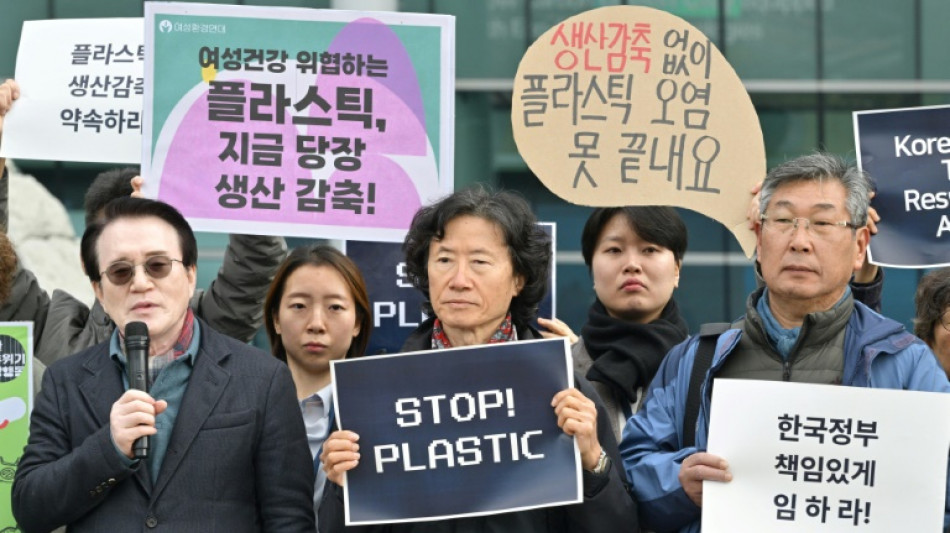
'Existential challenge': plastic pollution treaty talks begin / Photo: © AFP

A final round of talks on a treaty to end plastic pollution opened on Monday, with the diplomat chairing the difficult negotiations urging nations to "meet an existential challenge."
The meeting opens just hours after a chaotic end to the COP29 climate talks in Baku, which agreed to a boost in climate funding that developing countries slammed as insufficient.
"This conference is about far more than drafting an international treaty," Ecuadorian diplomat Luis Vayas Valdivieso told an opening plenary in South Korea's Busan.
"It is about humanity rising to meet an existential challenge."
Plastic pollution is so ubiquitous it has been found in clouds, the deepest ocean trenches and even human breastmilk.
And while almost everyone agrees it is a problem, there is less consensus on how to solve it.
Among the most contentious issues are whether the treaty should cap plastic production, a possible ban on chemicals feared toxic to human health, and how to pay for implementation.
"There are some real differences on some key elements," UN Environment Programme chief Inger Andersen acknowledged Sunday.
"I believe that we absolutely can land this, but that it will take everybody shuffling a little bit into the bus," she said.
In 2019, the world produced around 460 million tonnes of plastic, a figure that has doubled since 2000, according to the Organisation for Economic Co-operation and Development.
Plastic production is expected to triple by 2060.
More than 90 percent of plastic is not recycled, with over 20 million tonnes leaking into the environment, often after just a few minutes of use.
Plastic also accounts for around three percent of global emissions, mostly linked to its production from fossil fuels.
- 'Once-in-a-generation' -
Some countries, including the so-called High Ambition Coalition (HAC) that groups many African, Asian and European nations, want to discuss the entire "lifecycle" of plastics.
That means limiting production, redesigning products for reuse and recycling, and addressing waste.
On the other side are countries, largely oil producers like Saudi Arabia and Russia, who want a downstream focus on waste alone.
The HAC wants binding global targets on reducing production and warned ahead of the Busan talks that "vested interests" should not be allowed to hamper a deal.
The divisions have stymied four previous rounds of talks, producing an unwieldy document of over 70 pages.
Valdivieso has produced an alternative document intended to synthesise the views of delegations and move negotiations forward.
It is a more manageable 17 pages and highlights areas of agreement, including the need to promote reusability.
However, it leaves the thorniest issues largely unaddressed, angering some more ambitious nations and environmental groups.
And at the start of talks on Monday, Saudi Arabia, representing Arab nations, said the paper "cannot be the basis of our negotiations."
"The reality is that many countries do not see themselves represented in this paper," warned delegation head Eyad Aljubran.
- 'Failed summits' -
Some observers believe the talks are likely to falter and be extended -- especially after the difficult negotiations at UN climate and biodiversity conferences in recent weeks.
But both Andersen and Valdivieso insist a deal must be reached in Busan. That has some environmental groups worried an agreement will be watered down to ensure something is signed.
"After two back-to-back failed summits on nature and climate, Busan needs to be a refuge from further nature and climate inaction," the WWF warned Monday.
Key to any accord will be the United States and China, neither of which have openly sided with either bloc.
Earlier this year, Washington raised hopes among environmentalists by signalling support for some limits on production, a position that is reportedly now being rowed back.
The election of Donald Trump has also raised questions about how ambitious the US delegation will be, and whether negotiators should even bother seeking their support if a treaty is unlikely to be ratified by Washington.
Some plastic producers are pushing governments to focus on waste management and reusability.
"We see tremendous opportunity for this treaty to give value to waste," Chris Jahn, council secretary of the International Council of Chemical Associations, told AFP.
But others back a deal with global standards, including on "sustainable" production levels.
W.Lane--TFWP