The Fort Worth Press - Not enough time in universe for monkeys to pen Shakespeare: study

USD -
AED 3.672999
AFN 65.999829
ALL 81.750787
AMD 378.260601
ANG 1.79008
AOA 916.999753
ARS 1447.756099
AUD 1.429184
AWG 1.8025
AZN 1.705356
BAM 1.65515
BBD 2.013067
BDT 122.134821
BGN 1.67937
BHD 0.376967
BIF 2949.955359
BMD 1
BND 1.271532
BOB 6.906503
BRL 5.240099
BSD 0.999467
BTN 90.452257
BWP 13.162215
BYN 2.854157
BYR 19600
BZD 2.010138
CAD 1.36684
CDF 2200.000048
CHF 0.777199
CLF 0.021754
CLP 858.959666
CNY 6.938195
CNH 6.942025
COP 3630.33
CRC 495.478914
CUC 1
CUP 26.5
CVE 93.31088
CZK 20.656302
DJF 177.719754
DKK 6.326403
DOP 62.700992
DZD 129.730387
EGP 46.897988
ERN 15
ETB 154.846992
EUR 0.847269
FJD 2.20415
FKP 0.729917
GBP 0.732535
GEL 2.695027
GGP 0.729917
GHS 10.974578
GIP 0.729917
GMD 73.000395
GNF 8771.298855
GTQ 7.666172
GYD 209.107681
HKD 7.81245
HNL 26.40652
HRK 6.385502
HTG 131.004367
HUF 321.635985
IDR 16799.3
ILS 3.094805
IMP 0.729917
INR 90.43035
IQD 1309.366643
IRR 42125.000158
ISK 122.696076
JEP 0.729917
JMD 156.730659
JOD 0.709024
JPY 156.930997
KES 128.949967
KGS 87.449995
KHR 4034.223621
KMF 417.999628
KPW 899.945137
KRW 1460.080274
KWD 0.30734
KYD 0.83291
KZT 496.518171
LAK 21498.933685
LBP 89504.332961
LKR 309.337937
LRD 185.901857
LSL 15.973208
LTL 2.95274
LVL 0.60489
LYD 6.316351
MAD 9.162679
MDL 16.911242
MGA 4427.744491
MKD 52.226256
MMK 2099.936125
MNT 3569.846682
MOP 8.043143
MRU 39.687396
MUR 45.879977
MVR 15.450081
MWK 1732.791809
MXN 17.32713
MYR 3.932029
MZN 63.749875
NAD 15.973816
NGN 1368.559882
NIO 36.779547
NOK 9.669775
NPR 144.74967
NZD 1.665765
OMR 0.384498
PAB 0.999458
PEN 3.359892
PGK 4.282021
PHP 58.946982
PKR 279.546749
PLN 3.57345
PYG 6615.13009
QAR 3.645472
RON 4.316195
RSD 99.439016
RUB 76.247469
RWF 1458.735317
SAR 3.750111
SBD 8.058101
SCR 13.714455
SDG 601.502622
SEK 8.98486
SGD 1.272905
SHP 0.750259
SLE 24.474995
SLL 20969.499267
SOS 570.224434
SRD 37.894027
STD 20697.981008
STN 20.734071
SVC 8.745065
SYP 11059.574895
SZL 15.972716
THB 31.719708
TJS 9.340239
TMT 3.51
TND 2.890703
TOP 2.40776
TRY 43.519303
TTD 6.770395
TWD 31.6525
TZS 2580.290195
UAH 43.116413
UGX 3558.598395
UYU 38.520938
UZS 12251.99609
VES 371.640565
VND 25982
VUV 119.556789
WST 2.72617
XAF 555.124234
XAG 0.011427
XAU 0.000202
XCD 2.70255
XCG 1.80131
XDR 0.68948
XOF 555.135979
XPF 100.927097
YER 238.375001
ZAR 16.06744
ZMK 9001.199239
ZMW 19.565181
ZWL 321.999592
  • SCS

    0.0200

    16.14

    +0.12%

  • CMSD

    -0.0700

    23.87

    -0.29%

  • RBGPF

    0.1000

    82.5

    +0.12%

  • BCE

    0.2400

    26.34

    +0.91%

  • RIO

    0.1100

    96.48

    +0.11%

  • JRI

    0.0300

    13.15

    +0.23%

  • CMSC

    -0.1400

    23.52

    -0.6%

  • BCC

    5.3000

    90.23

    +5.87%

  • RYCEF

    -0.3200

    16.68

    -1.92%

  • NGG

    1.5600

    87.79

    +1.78%

  • RELX

    -0.7300

    29.78

    -2.45%

  • AZN

    3.1300

    187.45

    +1.67%

  • GSK

    3.8900

    57.23

    +6.8%

  • VOD

    0.4600

    15.71

    +2.93%

  • BTI

    -0.2400

    61.63

    -0.39%

  • BP

    0.3800

    39.2

    +0.97%

Not enough time in universe for monkeys to pen Shakespeare: study
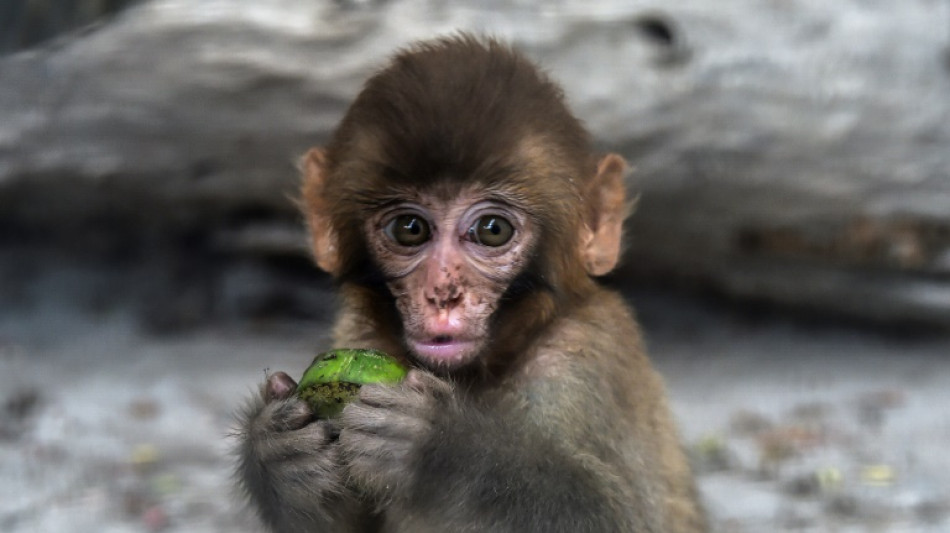
Not enough time in universe for monkeys to pen Shakespeare: study / Photo: © AFP

Not enough time in universe for monkeys to pen Shakespeare: study

If a monkey types randomly at a keyboard for long enough, it will eventually write the complete works of Shakespeare.

Text size:

This thought experiment has long been used to express how an infinite amount of time makes something that is incredibly unlikely -- but still technically possible -- become probable.

But two Australian mathematicians have deemed the old adage misleading, working out that even if all the chimpanzees in the world were given the entire lifespan of the universe, they would "almost certainly" never pen the works of the bard.

The "infinite monkey theorem" has been around for more than a century, though its origin remains unclear. It is commonly attributed to either French mathematician Emile Borel or British anthropologist Thomas Huxley, and some even think the general idea dates back to Aristotle.

For a light-hearted but peer-reviewed study published earlier this week, the two mathematicians set out to determine what happens if generous yet finite limits were placed on the monkey typists.

Their calculations were based on a monkey spending around 30 years typing one key a second at a keyboard with 30 keys -- the letters of the English language plus some common punctuation.

The "heat death" of the universe was assumed to take place in around a googol of years -- that is a one followed by 100 zeroes.

Other more practical considerations -- such as what the monkeys would eat, or how they would survive the Sun engulfing Earth in a few billion years -- were set aside.

- Monkey labour falls short -

There was only around a five percent chance that a single monkey would randomly write the word "banana" in their lifetime, according to the study in the journal Franklin Open.

Shakespeare's canon includes 884,647 words -- none of them banana.

To broaden out the experiment, the mathematicians turned to chimpanzees, the closest relative of humans.

There are currently around 200,000 chimps on Earth, and the study presumed this population would remain stable until the end of time.

Even this massive monkey workforce fell very, very short.

"It's not even like one in a million," study co-author Stephen Woodcock of the University of Technology Sydney told New Scientist.

"If every atom in the universe was a universe in itself, it still wouldn't happen."

And even if many more chimps who typed much quicker were added to the equation, it was still not plausible "that monkey labour will ever be a viable tool for developing written works of anything beyond the trivial," the authors wrote in the study.

The study concluded by saying that Shakespeare himself may have inadvertently given an answer as to whether "monkey labour could meaningfully be a replacement for human endeavour as a source of scholarship or creativity".

"To quote Hamlet, Act 3, Scene 3, Line 87: 'No'."

G.George--TFWP