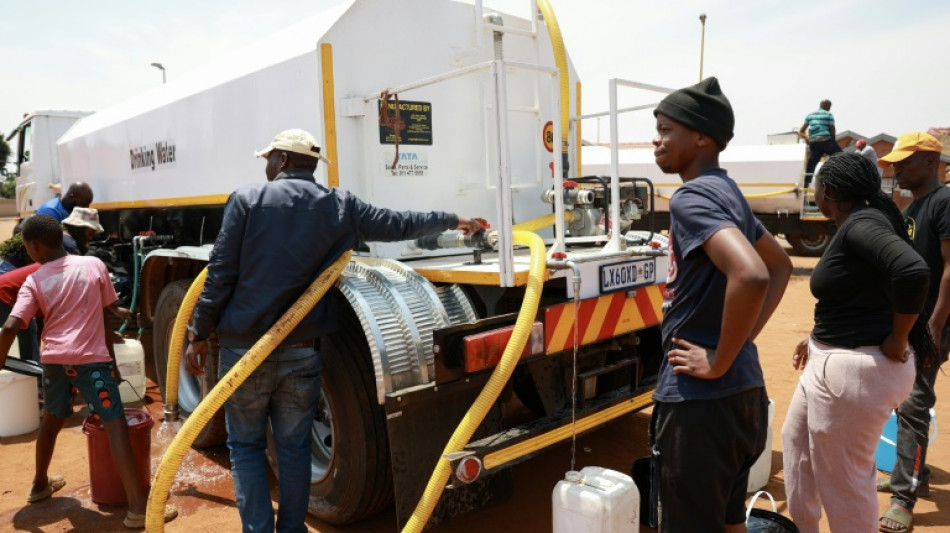
In South Africa, water shortages are the new reality / Photo: © AFP/File

Joyce Lakela runs a nursery in Tembisa, a Johannesburg township, but these days she spends most of her time trying to find water.
"It's been going on for five days," she said, lamenting shortages affecting South Africa's largest city where temperatures are rising with the beginning of summer.
"This is a big challenge," the elderly woman said, after filling up a large bin with water from a tanker. "The kids have to wash their hands, we have to flush the toilets, and we also have to wash the kids."
The crisis is the result of daily restrictions imposed by the city to stop what they say is over-consumption and to allow maintenance work.
While there is enough water in the country's reserves, for individuals like Lakela, who already faced months of electricity shortages last year, the reality is that taps are going dry for hours and sometimes days.
Last week, residents of Westbury and Westdene, suburbs to the west of the central business district, blocked the streets in protest against water outages. They burned tyres and blocked a road with rocks and debris.
Businesses and services have also been affected, including at least one hospital in northern Gauteng, the province of 16 million people which includes Johannesburg and the capital, Pretoria.
- Delays, leaks -
This comes after Rand Water, the water supplier for Gauteng, this month warned over high water consumption and instructed municipalities to impose daily limits.
"Water storage could soon be depleted if municipalities do not implement our recommendations. It is essential to act now to prevent the impending disaster," Rand Water said in a statement on October 12.
The water company is not just worried about consumers leaving taps on. There are also leaks and "illegal connections", or theft by individuals who divert pipelines and do not pay bills.
"We are losing an average of over 40 percent (of our water) if you look at it in Gauteng," Makenosi Marooa a spokeswoman for the utility told AFP.
Leaks are often cited by the municipalities as a reason for maintenance-related outages.
"We're not replacing anywhere near as much infrastructure as we should be," said Craig Sheridan, director of the Centre in Water Research and Development at the University of the Witwatersrand in Johannesburg.
For Chris Herold, another water expert, "one of the main problems is that they (the municipalities) are incompetently run, and there's also a lot of corruption which is hindering the efficient running of water systems."
Municipalities insist that they are doing what they can with the resources they have. According to at least one city in the province, Ekurhuleni, it is the utility that is not providing enough water and leaving the reservoirs empty.
But Rand Water is only licensed to withdraw a fixed amount approved by the Department of Water and Sanitation.
Already back in 2009, it was clear that more was needed as Gauteng's population was rapidly expanding. The government made a deal with neighbouring Lesotho to expand the bulk water supply to Rand Water.
The project initially meant for 2018 has been delayed until 2028 and as a result, sporadic restrictions to reduce demand are likely to continue.
- Climate change -
The rules could become more severe if South Africans do not change their habits, authorities have warned, adding that there could also be "financial implications".
The country is already considered water scarce, with an average annual precipitation of 450mm per year compared to the global annual average of 786mm per year, and a warming planet will exacerbate the issue.
Under a moderate climate change scenario, in which global emissions peak around 2040 and then decline, the amount of precipitation could fall by as much as 25 percent in South Africa by the end of the century.
The estimates were released in a report published this month by the Global Commission on the Economics of Water.
"There's definitely a sense of urgency," said Sheridan, who is particularly concerned by the health risks linked to turning water systems on and off, which has been South Africa's short term solution.
"When a pipe is full of water, the water leaks out of it. If the pipe is empty, then a leaking sewer next to it can potentially contaminate the supply."
J.P.Estrada--TFWP