The Fort Worth Press - Ethiopia's 'korale' recyclers turn waste into money

USD -
AED 3.672497
AFN 63.000127
ALL 83.045552
AMD 377.608336
ANG 1.790083
AOA 916.999582
ARS 1400.115202
AUD 1.437391
AWG 1.8025
AZN 1.698782
BAM 1.692703
BBD 2.017085
BDT 122.889314
BGN 1.709309
BHD 0.375272
BIF 2964.437482
BMD 1
BND 1.280822
BOB 6.920277
BRL 5.326897
BSD 1.001532
BTN 93.628346
BWP 13.656801
BYN 3.038457
BYR 19600
BZD 2.014228
CAD 1.373511
CDF 2274.999939
CHF 0.790045
CLF 0.023138
CLP 913.629897
CNY 6.886396
CNH 6.916875
COP 3696.54
CRC 467.791212
CUC 1
CUP 26.5
CVE 95.432004
CZK 21.264698
DJF 178.340531
DKK 6.480025
DOP 59.449729
DZD 131.454091
EGP 52.035801
ERN 15
ETB 157.836062
EUR 0.867199
FJD 2.21445
FKP 0.749521
GBP 0.752165
GEL 2.715018
GGP 0.749521
GHS 10.917148
GIP 0.749521
GMD 73.499323
GNF 8778.549977
GTQ 7.671603
GYD 209.529662
HKD 7.830705
HNL 26.509205
HRK 6.534203
HTG 131.388314
HUF 342.022986
IDR 16990.85
ILS 3.139701
IMP 0.749521
INR 93.948497
IQD 1311.97909
IRR 1315624.999818
ISK 124.719822
JEP 0.749521
JMD 157.346743
JOD 0.709014
JPY 159.524981
KES 129.250288
KGS 87.447897
KHR 4001.973291
KMF 426.999949
KPW 900.003974
KRW 1513.979862
KWD 0.30657
KYD 0.834581
KZT 481.491739
LAK 21506.092917
LBP 89692.06536
LKR 312.41778
LRD 183.27376
LSL 16.894603
LTL 2.95274
LVL 0.60489
LYD 6.411466
MAD 9.358386
MDL 17.440975
MGA 4176.061001
MKD 53.348104
MMK 2099.452431
MNT 3566.950214
MOP 8.084003
MRU 40.089837
MUR 46.570088
MVR 15.459624
MWK 1736.722073
MXN 17.992025
MYR 3.939499
MZN 63.897237
NAD 16.894749
NGN 1356.739806
NIO 36.852081
NOK 9.616303
NPR 149.804404
NZD 1.725615
OMR 0.382195
PAB 1.001519
PEN 3.46252
PGK 4.323066
PHP 60.376987
PKR 279.628351
PLN 3.713335
PYG 6541.287659
QAR 3.662273
RON 4.417101
RSD 101.650468
RUB 84.556145
RWF 1457.231632
SAR 3.754899
SBD 8.05166
SCR 13.74181
SDG 600.999794
SEK 9.395399
SGD 1.283745
SHP 0.750259
SLE 24.57502
SLL 20969.510825
SOS 572.35094
SRD 37.487497
STD 20697.981008
STN 21.204227
SVC 8.762971
SYP 110.564047
SZL 16.900787
THB 33.056504
TJS 9.619362
TMT 3.51
TND 2.95786
TOP 2.40776
TRY 44.32892
TTD 6.794814
TWD 32.133504
TZS 2600.260986
UAH 43.875212
UGX 3785.603628
UYU 40.356396
UZS 12210.172836
VES 454.69063
VND 26339
VUV 119.226095
WST 2.727792
XAF 567.726608
XAG 0.015794
XAU 0.000234
XCD 2.70255
XCG 1.80494
XDR 0.706079
XOF 567.716781
XPF 103.216984
YER 238.584438
ZAR 17.19515
ZMK 9001.198872
ZMW 19.554625
ZWL 321.999592
  • RBGPF

    -13.5000

    69

    -19.57%

  • BCC

    -1.5600

    68.3

    -2.28%

  • NGG

    -3.5400

    81.99

    -4.32%

  • BCE

    0.0600

    25.79

    +0.23%

  • RIO

    -2.5000

    83.15

    -3.01%

  • AZN

    -5.3300

    183.6

    -2.9%

  • RELX

    -0.4600

    33.36

    -1.38%

  • GSK

    -0.5300

    51.84

    -1.02%

  • CMSC

    -0.2000

    22.65

    -0.88%

  • BP

    -1.0800

    44.78

    -2.41%

  • BTI

    -1.3500

    57.37

    -2.35%

  • CMSD

    -0.2420

    22.658

    -1.07%

  • JRI

    -0.3900

    11.77

    -3.31%

  • VOD

    -0.0900

    14.33

    -0.63%

  • RYCEF

    -1.2600

    15.34

    -8.21%

Ethiopia's 'korale' recyclers turn waste into money
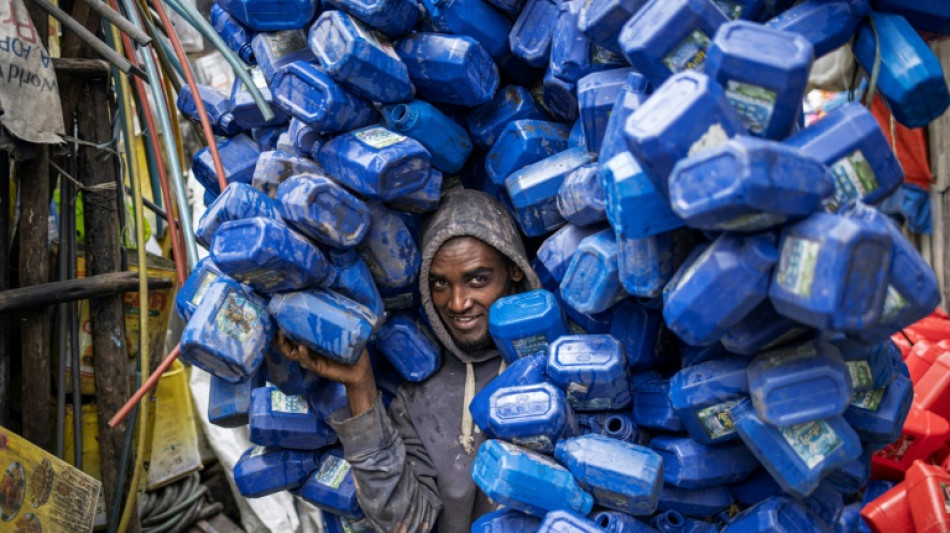
Ethiopia's 'korale' recyclers turn waste into money / Photo: © AFP

Ethiopia's 'korale' recyclers turn waste into money

With a tattered bag on his back, Dereje Enigdamekonen trawled the endless alleyways of the Merkato market in Addis Ababa, calling for the Ethiopian capital's abundant scrap.

Text size:

"Korale, korale," he shouted at regular intervals.

It's a made-up word in Amharic that is now used for the thousands of collectors, almost all men, who hunt out everything from used jerry cans and electrical equipment to shoes, shovels and any other unwanted bric-a-brac.

These objects are then either restored, stripped for spare parts, or transformed into something new -- giving new life to what would otherwise be polluting litter.

Dereje, 45, has been doing this work for a year, rain or shine, saying he buys "everything that can be reused".

For a kilogramme of collected metal, he can get about 40 birr ($0.30) and for jerry cans, depending on the size, between three and 25 birr.

"Waste can be transformed into money," he said with a smile.

After wandering for hours, the korales converged on an area of Merkato called Minalesh Tera, which translates from Amharic as "What do you have?".

Here, the narrow alleys of Merkato, one of Africa's largest open-air markets, are lined with tiny tin-shack shops as far as the eye can see.

The recyclers sell their daily finds to middlemen like Tesfaye Getahun, who was in the middle of dismantling a huge printer.

With heavy blows of a mallet, he isolated the motherboard and some aluminium parts.

Whether it is computers or old televisions, Tesfaye said he recycles everything.

"They aren't used anymore, and if left like that, they can cause environmental pollution. But if they are disassembled and sold for parts, it helps prevent pollution," he said.

Addis Ababa produces about 400,000 tonnes of waste annually, according to 2020 figures from the United Nations Development Programme (UNDP), of which only 70 percent is picked up by the official waste management system.

- 'Help the environment' -

Tamirat Dejene was almost lost among piles of jerry cans in his shop.

The 21-year-old, who has been collecting plastic for four years, said he earns between 500 and 1,000 birr ($4 to $8.50) a day.

That can be a godsend in a country where more than a third of its 120 million people live below the poverty line, according to the World Bank.

"We earn our living and we also help the environment because these items are not biodegradable," said Tamirat.

"It is also beneficial for Addis Ababa: if this waste were not collected, the city's landfills would overflow. So we earn our living while providing a solution," he added.

The objects made in Minalesh Tera are then sold in shops in the capital and all over the country.

Some go even further.

Biruk Shimeles, 31, buys scrap metal to make aluminium charcoal stoves which he sells in Sudan, Djibouti and Somalia.

"This work protects the community from waste by transforming it into a business opportunity," said Biruk.

W.Knight--TFWP