The Fort Worth Press - Panama's water wheel trash collector keeps plastic at bay

USD -
AED 3.672497
AFN 65.443166
ALL 80.861178
AMD 366.145626
AOA 918.000351
ARS 1499.737799
AUD 1.420374
AWG 1.8
AZN 1.702706
BAM 1.696506
BBD 2.013896
BDT 123.776354
BHD 0.377061
BIF 2993.650463
BMD 1
BND 1.281271
BOB 11.884005
BRL 5.099202
BSD 0.999879
BTN 95.145572
BWP 13.496235
BYN 2.977343
BYR 19600
BZD 2.010921
CAD 1.400935
CDF 2259.999914
CHF 0.810275
CLF 0.023176
CLP 915.120204
CNY 6.74905
CNH 6.74693
COP 3162.97
CRC 454.53954
CUC 1
CUP 26.5
CVE 95.649308
CZK 21.032496
DJF 178.055931
DKK 6.480765
DOP 58.368898
DZD 133.036949
EGP 49.778797
ERN 15
ETB 161.383609
EUR 0.86693
FJD 2.21395
FKP 0.743241
GBP 0.743525
GEL 2.614999
GGP 0.743241
GHS 11.733937
GIP 0.743241
GMD 73.99976
GNF 8782.057677
GTQ 7.628986
GYD 209.187745
HKD 7.84493
HNL 26.799903
HRK 6.5335
HTG 130.738004
HUF 315.983502
IDR 17848
ILS 3.00202
IMP 0.743241
INR 95.21305
IQD 1309.80882
IRR 1374849.999605
ISK 123.620252
JEP 0.743241
JMD 158.790465
JOD 0.709004
JPY 158.328497
KES 129.402481
KGS 87.450304
KHR 4061.274765
KMF 426.999937
KRW 1415.960098
KWD 0.30888
KYD 0.833247
KZT 468.616634
LAK 22575.258814
LBP 89537.973119
LKR 335.380452
LRD 180.479173
LSL 16.244058
LTL 2.95274
LVL 0.60489
LYD 6.360139
MAD 9.319182
MDL 17.387495
MGA 4266.798513
MKD 53.374161
MMK 2099.552715
MNT 3596.040078
MOP 8.079926
MRU 40.196738
MUR 47.069843
MVR 15.459842
MWK 1733.805211
MXN 17.15491
MYR 4.090201
MZN 63.912314
NAD 16.244058
NGN 1364.669975
NIO 36.795607
NOK 9.51425
NPR 152.232915
NZD 1.703215
OMR 0.384497
PAB 0.999866
PEN 3.386262
PGK 4.418787
PHP 60.862988
PKR 277.591253
PLN 3.726103
PYG 5945.498155
QAR 3.655172
RON 4.553006
RSD 101.728999
RUB 82.351799
RWF 1470.282086
SAR 3.754727
SBD 8.068348
SCR 14.491095
SDG 600.495633
SEK 9.48936
SGD 1.280885
SLE 24.600507
SOS 571.458312
SRD 37.866504
STD 20697.981008
STN 21.251865
SVC 8.749095
SZL 16.240762
THB 33.049875
TJS 9.223917
TMT 3.505
TND 2.937441
TRY 47.7066
TTD 6.777323
TWD 32.265704
TZS 2647.503015
UAH 44.783463
UGX 3724.827703
UYU 40.249652
UZS 11958.657362
VES 754.21125
VND 26204.5
VUV 119.010387
WST 2.728415
XAF 568.992228
XAG 0.015589
XAU 0.000232
XCD 2.70255
XCG 1.802071
XDR 0.708194
XOF 569.009503
XPF 103.452015
YER 236.849634
ZAR 16.22229
ZMK 9001.197435
ZMW 18.872278
ZWL 321.999592
  • GSK

    0.7100

    52.17

    +1.36%

  • RBGPF

    0.0000

    69.74

    0%

  • NGG

    0.1500

    80.41

    +0.19%

  • BTI

    -0.5400

    58.73

    -0.92%

  • RELX

    -0.8600

    35.75

    -2.41%

  • CMSD

    -0.0600

    21.98

    -0.27%

  • BCE

    0.7100

    22.77

    +3.12%

  • BP

    1.0200

    42.23

    +2.42%

  • RIO

    -1.8600

    99.65

    -1.87%

  • RYCEF

    -0.3800

    20.62

    -1.84%

  • AZN

    -0.4300

    161.07

    -0.27%

  • BCC

    -0.5400

    84.26

    -0.64%

  • JRI

    -0.0100

    12.66

    -0.08%

  • VOD

    0.6900

    16

    +4.31%

  • CMSC

    -0.0100

    21.72

    -0.05%

Panama's water wheel trash collector keeps plastic at bay
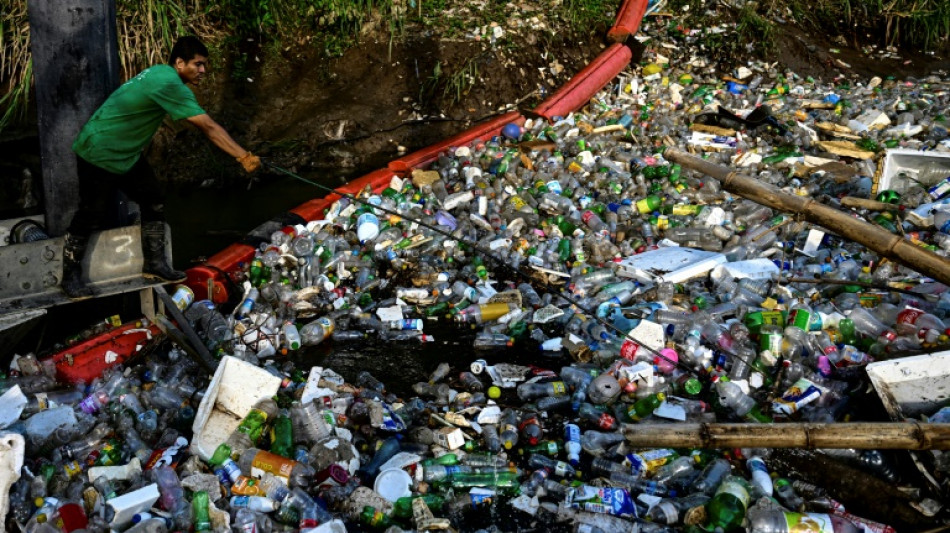
Panama's water wheel trash collector keeps plastic at bay / Photo: © AFP

Panama's water wheel trash collector keeps plastic at bay

A trash-collecting machine powered by a water wheel and solar panels has prevented hundreds of tons of plastic and other garbage from Panama from littering mangroves and the ocean.

Text size:

All kinds of trash flow down rivers running through Panama City and end up on the coastline of the Central American nation.

To combat the pollution, the nonprofit Marea Verde Foundation installed a machine called Wanda two years ago to collect and separate trash for recycling.

"We've captured 256,000 kilos of waste that would be in the mangroves and sea if it had not been for Wanda," said Laura Gonzalez, the foundation's executive director.

The garbage is stopped by a barrier across the Juan Diaz River that runs through Panama City before several workers separate the waste, which is sent by a long conveyor belt to a huge container to be recycled.

Wanda also has solar panels in case the hydropower system that harnesses the energy of the river current fails.

No other river in Panama has a similar system, so tons of garbage continue to reach the sea.

The country's coastal mangroves are a vital resting place for hundreds of thousands of migratory birds, but pollution and urban growth pose a serious threat.

Experts estimate that 30 percent of Panama City's garbage goes uncollected, and that around 100,000 tons of the country's waste end up in the sea every year.

When it rains, rising waters carry away garbage that is often dumped on riverbanks in slums of the city of 1.4 million people.

"We're working hard every day to ensure that this waste does not reach the shore," Ezequiel Vargas, leader of the crew that operates Wanda, told AFP.

"Sadly, the garbage arrives constantly every day," he said.

- 'Environmental disaster' -

Uncollected garbage litters the streets and residential areas of Panama City and its surrounding areas, while on the coast, there are piles of all kinds of waste.

Environment Minister Juan Carlos Navarro called the state of the rivers an "environmental disaster" in July when he took office.

"We cannot continue polluting our rivers and seas," he said.

According to a report by the United Nations Environment Programme, Panama City generates around 2,300 tons of garbage every day, of which 30 percent -- mostly plastics -- ends up in rivers, on the coast and in the sea.

Some 61,500 tons of solid waste from Panamanian cities reach the sea every year through sewers and drains, it said.

The trash captured by Wanda includes plastic bottles, shampoo containers and footballs.

"It's crazy. We received a plastic unicorn a few days ago," Gonzalez said.

According to Marea Verde, there are eight other similar facilities around the world, including one in the US city of Baltimore, but Wanda is the only one of its kind in Latin America.

It began operating in September 2022 and captured 130 tons of waste in its first year.

But the amount of rubbish dumped in the river continues to increase.

"This year we will probably exceed what we collected in the first year," Gonzalez said.

D.Johnson--TFWP