The Fort Worth Press - Climate change made deadly S. Africa rains twice as likely

USD -
AED 3.6725
AFN 66.000063
ALL 82.019444
AMD 379.030024
ANG 1.79008
AOA 917.000222
ARS 1452.1415
AUD 1.436864
AWG 1.8
AZN 1.699581
BAM 1.650151
BBD 2.016242
BDT 122.43245
BGN 1.67937
BHD 0.377035
BIF 2964.5
BMD 1
BND 1.271584
BOB 6.942435
BRL 5.261799
BSD 1.001076
BTN 91.544186
BWP 13.176113
BYN 2.86646
BYR 19600
BZD 2.013297
CAD 1.36714
CDF 2154.999935
CHF 0.778795
CLF 0.021919
CLP 865.500352
CNY 6.946501
CNH 6.938895
COP 3622.05
CRC 496.70313
CUC 1
CUP 26.5
CVE 93.874975
CZK 20.59725
DJF 177.719709
DKK 6.327105
DOP 62.950149
DZD 129.934449
EGP 47.089896
ERN 15
ETB 155.250273
EUR 0.84721
FJD 2.206598
FKP 0.729754
GBP 0.731315
GEL 2.694994
GGP 0.729754
GHS 10.954985
GIP 0.729754
GMD 73.55548
GNF 8751.000245
GTQ 7.681242
GYD 209.445862
HKD 7.810703
HNL 26.449908
HRK 6.386897
HTG 131.200378
HUF 322.735497
IDR 16766.2
ILS 3.10084
IMP 0.729754
INR 90.46795
IQD 1310.5
IRR 42125.000158
ISK 123.039932
JEP 0.729754
JMD 157.178897
JOD 0.709014
JPY 155.4575
KES 129.13006
KGS 87.449831
KHR 4025.492445
KMF 418.000086
KPW 900
KRW 1450.029709
KWD 0.30714
KYD 0.834223
KZT 505.528533
LAK 21494.999879
LBP 85549.999924
LKR 310.004134
LRD 185.999884
LSL 16.110186
LTL 2.95274
LVL 0.60489
LYD 6.320108
MAD 9.15875
MDL 16.948552
MGA 4450.000276
MKD 52.248327
MMK 2099.986463
MNT 3564.625242
MOP 8.053239
MRU 39.929374
MUR 45.650252
MVR 15.450036
MWK 1737.000377
MXN 17.388398
MYR 3.958498
MZN 63.749877
NAD 16.109867
NGN 1391.000271
NIO 36.697378
NOK 9.69397
NPR 146.471315
NZD 1.662775
OMR 0.38451
PAB 1.00108
PEN 3.365975
PGK 4.237972
PHP 58.919935
PKR 279.749793
PLN 3.57693
PYG 6656.120146
QAR 3.64125
RON 4.317897
RSD 99.493038
RUB 76.448038
RWF 1453
SAR 3.750185
SBD 8.058101
SCR 14.250149
SDG 601.501494
SEK 8.95644
SGD 1.271315
SHP 0.750259
SLE 24.474994
SLL 20969.499267
SOS 571.503458
SRD 38.025022
STD 20697.981008
STN 21.25
SVC 8.759629
SYP 11059.574895
SZL 16.109942
THB 31.490262
TJS 9.349825
TMT 3.51
TND 2.847497
TOP 2.40776
TRY 43.480099
TTD 6.777673
TWD 31.591702
TZS 2588.490529
UAH 43.112529
UGX 3575.692379
UYU 38.836508
UZS 12249.999719
VES 369.791581
VND 26020
VUV 119.156711
WST 2.710781
XAF 553.468475
XAG 0.012114
XAU 0.000209
XCD 2.70255
XCG 1.80413
XDR 0.687215
XOF 551.505966
XPF 101.749394
YER 238.374969
ZAR 16.066915
ZMK 9001.197925
ZMW 19.646044
ZWL 321.999592
  • SCS

    0.0200

    16.14

    +0.12%

  • BCC

    0.9400

    81.75

    +1.15%

  • NGG

    -0.6600

    84.61

    -0.78%

  • CMSC

    -0.0100

    23.75

    -0.04%

  • BCE

    -0.0300

    25.83

    -0.12%

  • CMSD

    0.0300

    24.08

    +0.12%

  • RBGPF

    0.1000

    82.5

    +0.12%

  • GSK

    0.8700

    52.47

    +1.66%

  • BTI

    0.3100

    60.99

    +0.51%

  • AZN

    1.3100

    188.41

    +0.7%

  • RIO

    1.4900

    92.52

    +1.61%

  • JRI

    0.0700

    13.15

    +0.53%

  • RYCEF

    0.7000

    16.7

    +4.19%

  • BP

    -0.1800

    37.7

    -0.48%

  • VOD

    0.2600

    14.91

    +1.74%

  • RELX

    -0.2700

    35.53

    -0.76%

Climate change made deadly S. Africa rains twice as likely
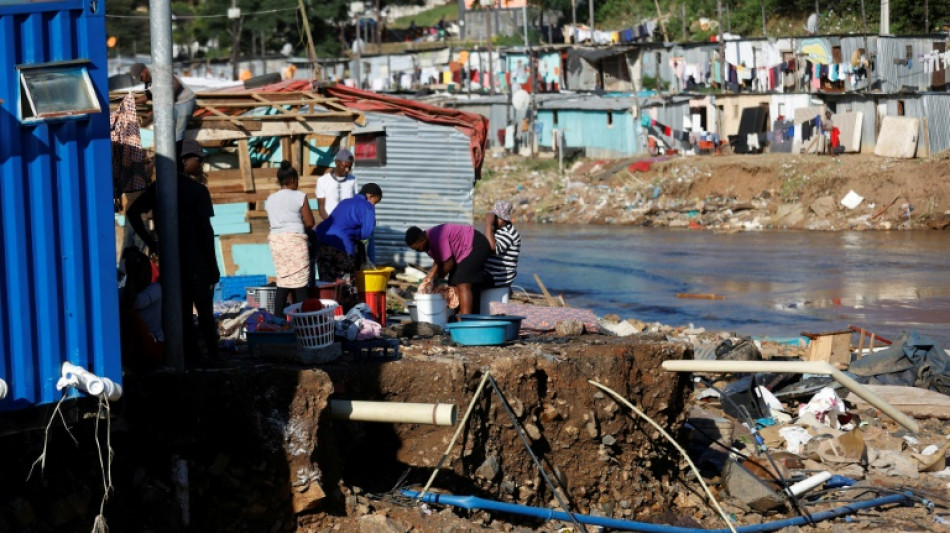
Climate change made deadly S. Africa rains twice as likely / Photo: © AFP/File

Climate change made deadly S. Africa rains twice as likely

Rainfall that caused catastrophic floods and landslides last month in and around Durban, South Africa, was made twice as likely by global warming, scientists said Friday.

Text size:

An exceptional downpour -- more than 35 centimetres (14 inches) over two days -- on April 11-12 claimed hundreds of lives and caused $1.5 billion in damage across the provinces KwaZulu-Natal and Eastern Cape.

Without climate change, rain of this intensity would happen roughly once every 40 years, according to a report from the World Weather Attribution consortium, a global network of scientists that quantify the impact of a warming world on individual extreme weather events.

But an increase in Earth's average surface temperature of nearly 1.2 degrees Celsius since the late-19th century has shortened that interval to about 20 years.

"The probability of an event such as the rainfall that resulted in this disaster has approximately doubled due to human-induced climate change," the scientists said in a statement.

As the planet continues to hot up in coming decades, so too will the frequency and intensity of devastating floods caused by these downpours, they warned.

The same is true for heatwaves, droughts, tropical cyclones -- also known as hurricanes or typhoons -- and wildfires.

Most of the world's nations have embraced a target of capping global warming at 1.5C, but current greenhouse gas reduction commitments would see temperatures rise far higher.

- Basic physics -

Scientists have long predicted such impacts. In the case of heavy rains, it's basic physics: every extra degree of global warming increases the amount of water in the atmosphere by about seven percent.

But only recently has an accumulation of climate data and more sophisticated tools made it possible to answer the most obvious of questions: To what extent is a particular weather disaster caused by global warming?

The heatwave, for example, that gripped western North America last June -- sending temperatures in Canada to a record 49.6C (121F) -- would have been "virtually impossible" without human-induced climate change, the WWA determined.

And record-setting rainfall and flooding last July in Germany and Belgium that left more than 200 dead up was made up to nine times more likely.

Friederike Otto, lead author of the South Africa assessment, said the destruction was a result not just rainfall intensity, but the exposure of human populations.

"Most people who died in the floods lived in informal settlements," said Otto, a scientist at Imperial College London's Grantham Institute and a pioneer in the burgeoning field of event attribution studies.

"So, again, we are seeing how climate change disproportionately impacts the most vulnerable people."

Early warning systems and urban infrastructure such sewage systems and flood controls are also critical factors.

The WWA is currently assessing the unprecedented heatwave that scorched large swathes of India and Pakistan during March and April.

A.Nunez--TFWP