'People will come back': Kazakhstan debates nuclear future / Photo: © AFP

In the semi-abandoned village of Ulken on a giant steppe, Anna Kapustina, a mother of five, hopes controversial plans to build Kazakhstan's first nuclear power plant will breathe life into her ailing hometown.
On the shore of the huge Lake Balkhash and lined with empty buildings, Ulken is at the centre of a raging debate in Kazakhstan -- scarred by massive Soviet-era nuclear testing -- on whether construction should go ahead.
Between 1949 and 1989, the USSR carried out around 450 nuclear tests in Kazakhstan, exposing 1.5 million people to radiation.
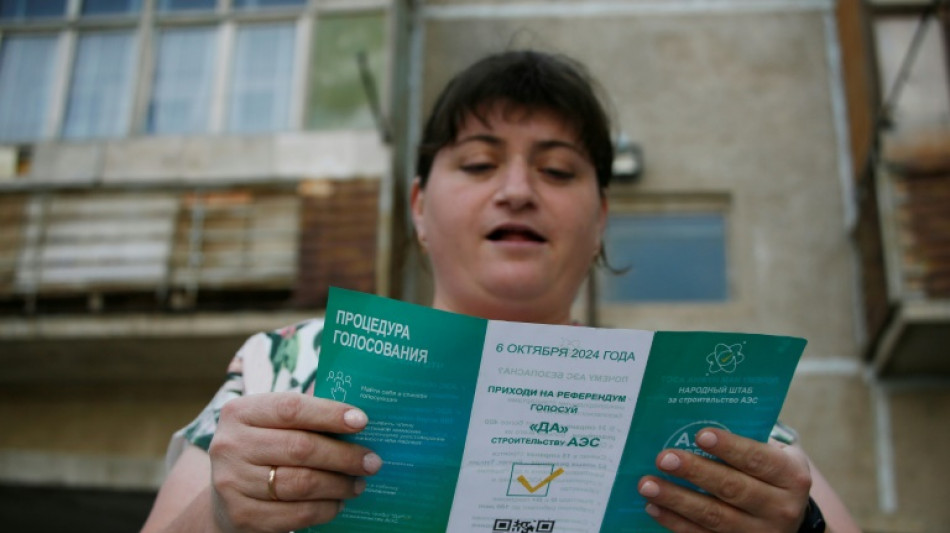
The Central Asian country is holding a referendum on the plant this weekend, with President Kassym-Jomart Tokayev, who is pushing for construction, promising to "take important decisions with the support of the people".
The campaign in the authoritarian state has been one-sided, with the vote largely designed to give an air of democracy.
In Ulken, which people left in droves after the fall of the Soviet Union when plans to build a thermal power plant were abandoned, many of the 1,500 remaining residents hope prosperity -- and work -- will return.
"We are waiting for our village to come back to life," said Kapustina, whose husband works as a miner in Aktobe, around 2,500 kilometres (1,550 miles) away.
While rich in oil and the world's biggest uranium producer, Kazakhstan faces chronic electricity shortages, which authorities are hoping to solve.
Kapustina said she was used to having to resort to candles. She hopes a nuclear plant will bring "cheap, uninterrupted electricity".
- Energy shortages -
Amid a huge state-backed campaign, most of Ulken's residents support the project.
But some are weary, fearing for the safety of the Balkhash, the second-biggest lake in a region that already struggles with access to drinking water.
Standing in the yellow fields of a steppe outside the village, engineer Sergei Tretyakov has been "dreaming" about a nuclear plant in Ulken since being sent by the Soviets to help build the abandoned thermal plant.
The 64-year-old thinks Kazakhstan would "simply run out of electricity" without it, with the huge country's south suffering from a particularly acute energy shortage.
Ulken is the perfect spot, he said.
"The soil is resistant and its location allows electricity to be distributed to the north and south," Tretyakov said.
And some of the infrastructure built in the Soviet times is still there.
"We had already built dykes and a cooling pond," he added, pointing to the waters of the immense Balkhash.
That project ended with the collapse of the Soviet Union, and Ulken has been slowly dying ever since -- most residents had left by the early 1990s.
It is now lined with abandoned apartment blocks, its streets little more than dusty tracks.
A mural of the never-constructed thermal power plant adorns a partially empty building.
- Abandoned city -
In a flat that doubles as the town hall, municipal worker Indira Kerimbekova flips through a photo album of Ulken in the 1980s.
"Until the USSR collapse, 10,000 people lived here," she said, showing pictures of packed canteens.
"It's hard to believe now... There were shops, schools, hairdressers."
Today, the only shops are small street grocers, and the nearest hospital is 200 kilometres away.
"We are hoping that if the plant is built, people will come back and will live here," she said.
Pensioner Tatiana Vetrova said people left Ulken because "there was no more work", recalling how residents could make a living only by fishing in Lake Balkhash.
"You had to catch fish, smoke it and sell it on the side of the road," she said.
- Fears for lake -
Many still rely on fishing for their survival, and it is fears for the future of the lake that have driven pockets of opposition against the plant.
"I do not want it," said 62-year-old Zheksenkul Kulanbayeva.
"We are losing the lake. We'll lose the fish. People here mainly make money from fishing," she said.
Even President Tokayev has acknowledged ecological concerns, calling them "understandable given the tragic legacy" of Soviet nuclear testing.
But the government has insisted the plant will be safe and has gone to great lengths to make sure Kazakhs will vote "yes" on Sunday.
Authorities sent representatives of "the people's headquarters for the construction of the plant" -- who are in fact from the powerful presidential party -- to hold "information sessions" across Kazakhstan.
Kulanbayeva was unconvinced. He did not trust billboards around her that read: "Clean energy for the future."
She worried about her town's access to the lake and the ability to fish.
Even residents who have other jobs in Ulken still fish to make extra cash, she said.
"This is what we could lose, I do not want that."
S.Jordan--TFWP