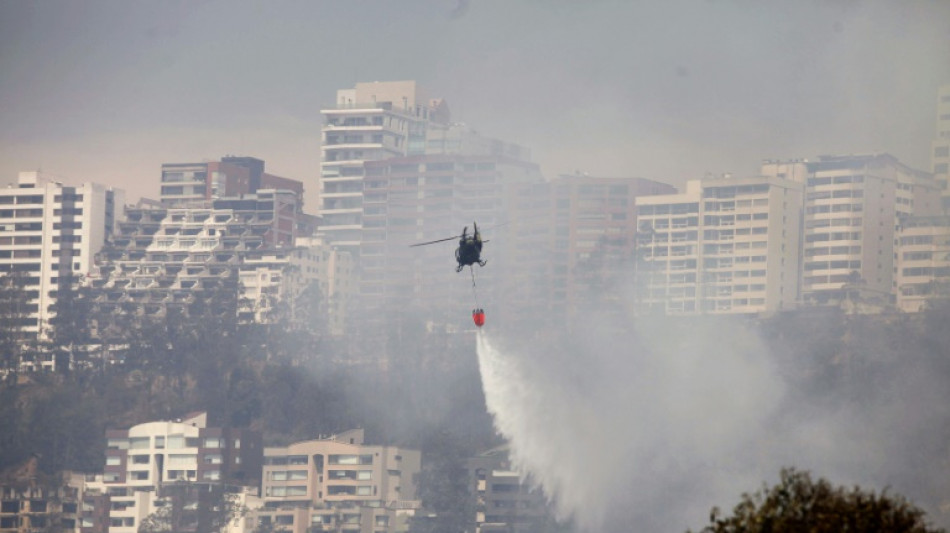
Why South America is burning / Photo: © AFP

A record wave of wildfires, fueled by severe drought linked to climate change and deforestation, is causing havoc across South America.
The blazes have killed at least 30 people, left cities shrouded in toxic smoke and caused millions of dollars in economic losses.
This fire season is "completely different" from the one that ravaged forests in Brazil, Peru and Bolivia in 2019, according to Brazilian environmentalist Erika Berenguer, a researcher at Oxford University.
At the time, rain helped douse the fires, which in Brazil were chiefly started by farmers taking advantage of lax legislation under then far-right president Jair Bolsonaro to clear land for crops and ranching.
This year, the continent is in the throes of a severe drought. The Amazon basin, usually one of the wettest places on Earth, is experiencing the worst fires in nearly two decades, according to the EU's Copernicus observatory.
Berenguer blamed climate change for making the Amazon "highly flammable."
- How bad are the fires? -
Between January 1 and September 26, more than 400,000 fires were recorded across South America, according to Brazil's National Institute for Space Research (INPE).
"In nine months we have already surpassed the number of outbreaks recorded in all of 2023," Berenguer noted.
In Brazil, the flames have consumed 40.2 million hectares (99 million acres) of vegetation this year, far above the average of 31 million hectares in each of the last 10 years, according to Copernicus.
A dozen firefighters have died on duty, according to local media.
In Ecuador, the mayor of the capital Quito declared this week the Andean city was "under attack" from 27 fires which forced the evacuation of over 100 families before being brought under control.
Ecuador had declared an emergency in several provinces, as has Peru, where 21 people have been killed by fires since July. Most were small-scale farmers.
Several fires are also blazing in Argentina and in Colombia, at opposite ends of the continent.
- What's causing the fires? -
Experts and national authorities point to a combination of combustible factors, chiefly droughts aggravated by climate change and slash-and-burn agriculture.
"It's a clear example of climate change. If anyone thought it didn't exist, well look, here it is," said Ecuadoran Environment Minister Ines Manzano.
In Peru and Bolivia, some of the fires are believed to have been started by farmers burning land to make it more fertile for planting, a traditional practice in the Andean countries that is tolerated by the authorities.
In the Brazilian Amazon, fires lit by both subsistence farmers and the agribusiness industry to clear forest for cattle or crops were fanned by the worst drought in the country's recent history.
President Luiz Inacio Lula da Silva, who has pledged to put a stop to illegal Amazon deforestation by 2030, considers most of the fires to be "criminal" in origin.
In some places, the fires are started by arsonists.
One person has been arrested in Quito and dozens in Argentina and Brazil on suspicion of maliciously starting fires.
- How are people affected? -
The fires have dramatically reduced air quality in several cities.
Sao Paulo, the largest city in Latin America, was ranked the most polluted city in the world in early September, according to Swiss company IQAir.
A large part of Brazil remains shrouded in acrid smoke that wafted as far south as Montevideo and Buenos Aires earlier this month, causing a phenomenon known as "black rain."
Inhabitants of many of Brazilian cities are experiencing respiratory problems and other symptoms such as stinging eyes.
In Bolivia, health authorities have recommended people wear face masks because of the poor air quality.
The region's economies are also feeling the burn. Losses in the Brazilian agricultural sector amounted to $2.7 billion between June and August, principally sugarcane harvests.
In Ecuador, nearly 45,000 farm animals have died after more than two months without rain.
- What are governments doing? -
Thousands of firefighters and soldiers have been deployed across the continent to tackle the blazes.
"Everyone wants to hire thousands of firefighters, buy aircraft, etc, etc. That's fine but it's too little, too late," Berenguer said.
"We need to prevent fires, because once they become big they are very difficult to fight," she said, advocating for tougher measures against deforestation and planet-warming greenhouse gas emissions.
burs-jss/cb/mlr/acb
T.Dixon--TFWP