Going green? British fashion struggles with sustainability / Photo: © AFP

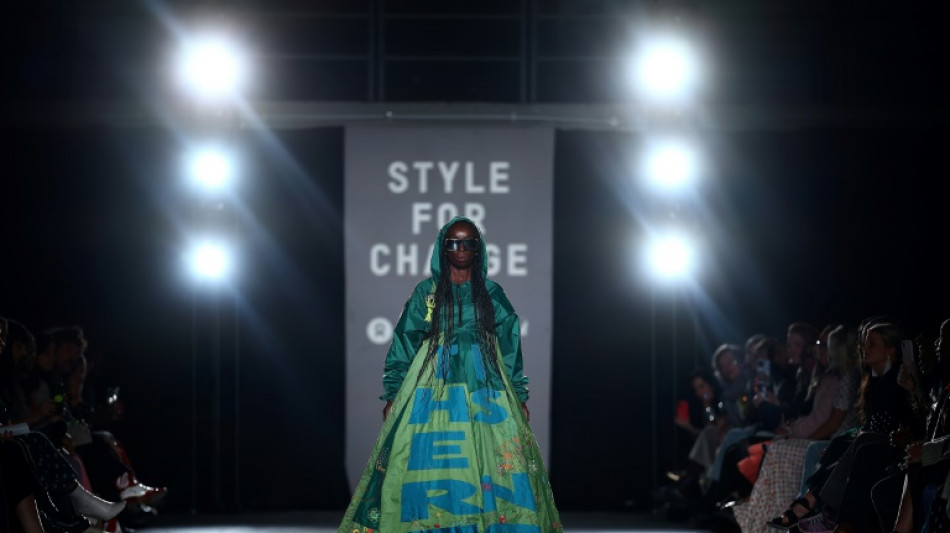
In an industrial underground space in central London, models in contrasting period dresses and playful streetwear strutted down a brightly lit London Fashion Week (LFW) runway.
But unlike most other shows, all the floral dresses, trending workwear and double-denim outfits were second hand at the event by charity Oxfam and online used clothes retailer Vinted's "Style for Change".
Bay Garnett, a sustainable fashion pioneer who picked out the pieces from Oxfam's warehouses, called the runway "really exciting".
"When we first did this show eight years ago, it was really not like this," Garnett told AFP backstage, noting the stream of enthusiastic attendees.
Despite the excitement surrounding the Oxfam show alongside another "pre-loved" runway by online auction site eBay, British fashion is struggling with sustainability.
Around 44 percent of all British companies overall have put in place a structured climate action plan, according to insurance company Aviva's "Climate-Ready Index".
By contrast, the fashion world is lagging sorely behind, a situation the Collective Fashion Justice (CFJ) charity said was "an embarrassment".
A recent CFJ report found that just seven of the 206 members of the British Fashion Council (BFC), which organises London Fashion Week, had set out targets to reduce their carbon emissions.
And only five of these -- or less than 2.5 percent -- had goals aligned with the 2016 Paris Agreement to cut global warming, CFJ said.
The UK is the third largest footwear and clothing market in the world, after China and the United States, according to analysis by the Fashion United platform.
A 2018 report from sustainability consultancy Quantis said the sectors account for around eight percent of planet-heating greenhouse gas emissions.
- Go big or go green? -
Luxury fashion giant Burberry -- a LFW veteran -- is one of the handful of brands publishing scientific targets.
Known for its tartan branding, the fashion house recently raised its emission reduction goals and hopes to be carbon neutral by 2040.
But BFC chief executive Caroline Rush said: "To set carbon reduction targets, you need a team to be able to measure your targets, understand how to reduce them and then report on them."
"For a small business that's quite a challenge."
To help, the BFC now has some 50 businesses that will go through its "low carbon transition" programme for designers.
Ideally, advocates say the programme should be extended to help brands monitor and report their carbon reduction plans.
Copenhagen Fashion Week has taken its own step to require all brands involved to meet a series of environmental goals.
In the United States, reform could come with a "Fashion Act" under consideration by the New York authorities, which would legally require businesses to cut emissions and take into account those of their entire supply chains.
"I think a lot of the issue is (that) the fashion industry can try to handball its problems to other industries," said CFJ director Emma Hakansson.
She explained that while there are many discussions on the climate impact of the meat industry for example, there wasn't the same pressure on producers of such materials as leather, wool and cashmere.
And yet the latter "are coming from the same supply chains", which use large quantities of water and emit methane.
- Textile waste -
There are a number of solutions to make fashion "greener", some of which will be on display at London Fashion Week.
Designer Ray Chu has created a vegan leather made using recycled tea leaves while Romanian designer ̦Ancuta Sarca uses recycled materials in her footwear collections.
But such innovations could struggle to keep up with the scale of emissions and textile waste.
Some 300 tonnes of clothes are binned every year in the UK, according to a 2020 British parliament report.
Since then, the popularity of fast fashion brands like H&M and Zara, and ultra-fast fashion brands like Shein and Temu, has only grown.
Such brands sell cheaply made, mass-manufactured clothes at breakneck speeds, only for them to fall apart or be discarded after being worn a few times.
While many brands are turning to recycled materials, or offering clothing repair or rental services, the long-term solution seems to be to "slow down our habits of consumption in general", said Hakansson.
To help with this, people could work towards "cultivating a sense of personal style", she suggested.
"If you don't know what you as an individual like, then you're much more likely to follow these micro trends that are being really pushed on us very hard," Hakansson added.
With greater awareness of the challenges posed by climate change, shopping second-hand has become more popularity, noted Garnett.
"The kids have basically got the idea that... second hand -- it's a cool way to shop. By finding your own style, a one-off piece, it (becomes) like a style choice."
D.Johnson--TFWP