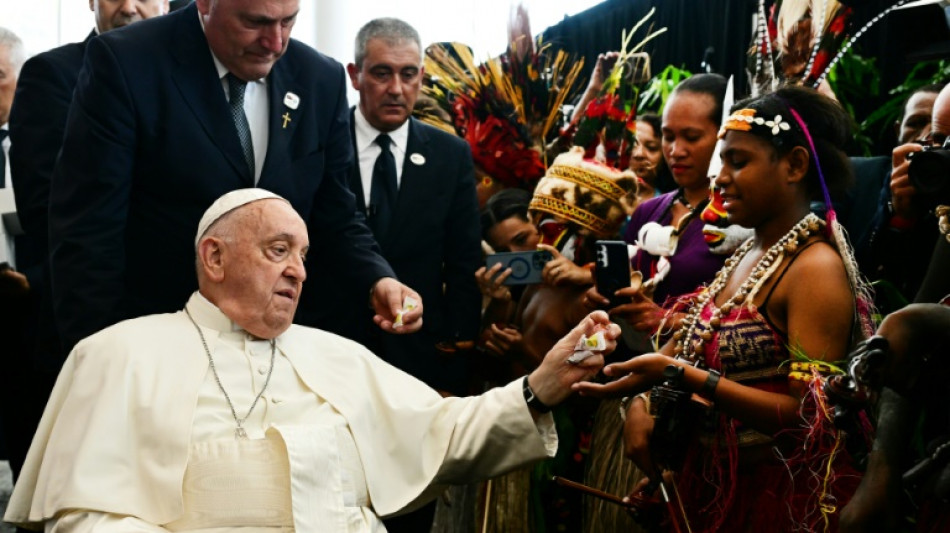
Visiting Papua New Guinea, pope says natural resources must benefit all / Photo: © AFP

Pope Francis visited Papua New Guinea Saturday, where he called for vast natural resources to benefit the "entire community" -- a politically charged demand in a nation where many believe their riches are being stolen or squandered.
Addressing political and business leaders, the 87-year-old pontiff hailed his hosts as being rich in culture and in natural resources -- a nod to vast reserves of gold, copper, nickel, gas and timber.
But, he suggested, the tens of billions of dollars made from digging, dredging and drilling the earth needed to benefit more than a fraction of the country's 12 million people.
"These goods are destined by God for the entire community," Pope Francis said.
Despite its resource wealth, Papua New Guinea is one of the poorest countries in the Pacific.
Between a quarter and half the population lives in extreme poverty. Scarcely more than 10 percent of homes have electricity.
Even if "outside experts and large international companies must be involved in the harnessing of these resources", they should not be the only ones to benefit, the pope said.
"It is only right that the needs of local people are given due consideration when distributing the proceeds and employing workers, to improve their living conditions," he added.
It is a message likely to resonate with millions of Catholics in Papua New Guinea -- and with millions more in resource-rich regions of Africa, Latin America and elsewhere.
Twenty-two-year-old pilgrim Jonathan Kais, from Manus Island, welcomed the pope's remarks and said he hoped they would spur the government to provide better services.
"The service we receive in our villages by our leaders at the parliament, it's not much (compared to) what they are getting from the resources of the country," he told AFP.
- 'Poverty hardly changed' -
For decades, Papua New Guinea has been dotted with vast American, Australian, Canadian, European and Chinese-run mines.
A $19 billion project led by ExxonMobil has produced tens of millions of tonnes of liquified natural gas since operations began in 2014.
But economists have found little evidence that any of the projects have helped poor Papua New Guineans.
A recent World Bank study showed that between 2009 and 2018, the country's gross domestic product per person grew by more than a third on the back of the resource boom.
"Poverty hardly changed over that time," the report's authors said.
- 'Spiral of violence' -
Pope Francis is on a marathon 12-day visit to the Asia-Pacific, visiting Indonesia, East Timor and Singapore as he promotes interfaith dialogue and embraces regions on the periphery of world affairs.
On Saturday he also made a plea for Papua New Guineans to "stop the spiral" of tribal violence that has killed untold numbers of people and displaced tens of thousands more.
"It is my particular hope that tribal violence will come to an end," he said.
"It causes many victims, prevents people from living in peace and hinders development."
There are few reliable estimates as to how many people have died during decades of tribal unrest between dozens of clans in the country's Highlands.
But UN agencies estimate that about 100,000 people have been displaced by the cycle of retaliatory attacks, which have intensified in recent years.
The murders are often extremely violent, with victims hacked by machetes, burned, mutilated or tortured. Civilians, including pregnant women and children, have been targeted in the past.
An influx of mercenaries and automatic weapons has made clashes much more deadly. Where bows, spears and clubs were once the weapons of choice, now tribesmen have a veritable armoury of SLR, AK-47, and M16 rifles.
Papua New Guinea's stretched government has tried suppression, mediation, gun amnesties and a range of other strategies to control the situation, with little success.
But experts say the violence has little to do with ancient customs, and is more about the modern problems of a surging population, a breakdown in traditional rules of war, joblessness and the rising cost of living.
And there is growing concern that violence is spreading to other parts of the country.
In July, at least 27 people -- among them 11 children -- were massacred in Angoram District, not far from the northern coast.
G.Dominguez--TFWP