Scorching heat magnifies housing crunch for Hong Kong's elderly / Photo: © AFP

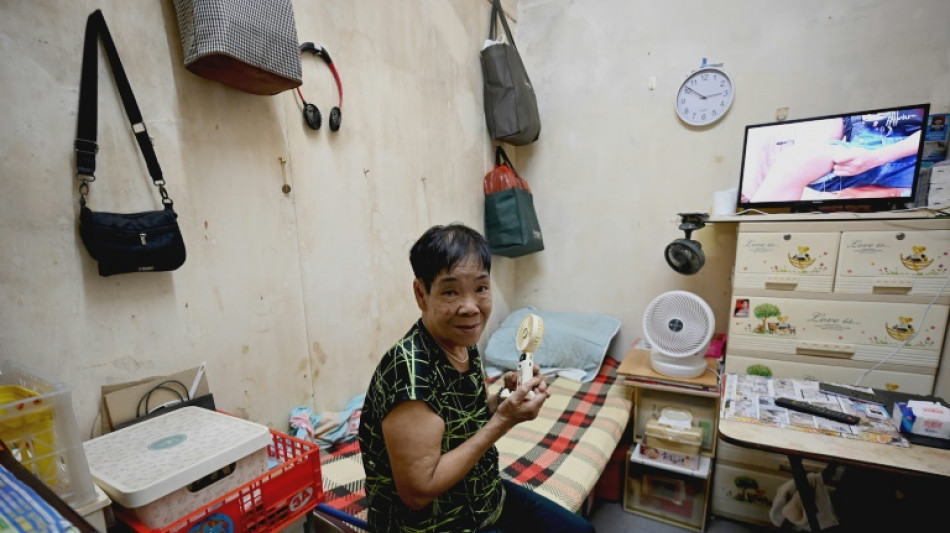
Even with two electric fans whirring, retired janitor Chun Loi was sweating profusely in her windowless, one-room flat that swelters during Hong Kong's humid summer.
Her 50-square-foot room is partitioned with well-worn planks from four other small rooms, commonly known as sub-divided units.
It is a sweaty but low-cost option that has proliferated across Hong Kong, one of the world's most expensive housing markets.
Experts warn that, with 2024 expected to be the hottest year in recorded history, elderly people like Chun living in Hong Kong's small, poorly ventilated units face greater risks.
AFP joined a Red Cross Hong Kong team that works with families that live in units like Chun's to improve their living conditions.
"The heat makes it very hard for me... I feel tired," the 84-year-old told AFP on Saturday, when the temperature crept past 32 degrees Celsius (90 degrees Fahrenheit).
"I try to stay in as much as possible with my fans... Otherwise, where can you go? It's embarrassing to stay in restaurants and malls if I am not eating anything," Chun said.
Her unit in Hong Kong's Kowloon region costs about HK$2,000 (US$256) a month.
She has waited more than six years for a public housing apartment to become available, but with only 430,000 targeted for construction in the next decade, her chances of getting one remain out of reach for now.
Eva Yeung of Red Cross Hong Kong, who has been working with about 650 households in subdivided units, warned that the elderly living in such units are especially vulnerable.
"Climate change affects everyone," Yeung said. "But the impact is not equal because some people, due to their living conditions and physical conditions, are affected more than others."
- Poor living conditions -
The number of subdivided units grew rapidly over the past two decades as the value of Hong Kong's private residential market tripled and public housing construction failed to keep up with demand.
The city is consistently ranked as one of the most expensive housing markets in the world, making low-cost solutions for people like Chun harder to find and blowing out waiting lists for public housing.
Hong Kong's 2021 census found that, out of a population of 7.5 million, 215,700 people live in such "shoe-box" spaces -- almost one in 50 people.
The elderly are the fastest-growing group among them, with an increase of more than 4,300 people from 2016. That reflects a United Nations forecast that Hong Kong will become the city with the world's oldest population by 2050.
Yeung tries to improve the living conditions of the families she works with by showing them how to increase air circulation or manage the temperature.
She said indexes that measure factors such as temperature, humidity and air quality were all below international standards.
"It means their health has been seriously affected... other than physical impacts, such living environments would also affect emotions," she said.
A 2020 study by the Chinese University of Hong Kong found that five consecutive "hot nights" -- defined as when temperatures rise above 28C (82F) -- would raise the risk of death by 6.66 percent.
A government task force that tackles this housing issue is expected to this month announce minimum living standards and measures to eradicate substandard units.
- 'Climate disaster' -
Lam Chiu-ying, the former chief of Hong Kong's weather observatory and a Red Cross council member, rooted around Chun's unit looking for any spare room.
He finally spotted an empty cupboard above the entrance that could hold another fan.
Lam, an ardent environmentalist who famously said he would never use an air conditioner, had been visiting families to offer advice.
"Climate change is gradually morphing into climate disaster," he told AFP.
"But we can't simply give up... what I am doing is trying my best before the death of the human race, hoping that people would wake up and maybe then, all of a sudden, we will have hope."
X.Silva--TFWP