The Fort Worth Press - Oh my (long) days: Melting ice caps slow Earth's spin

USD -
AED 3.672504
AFN 66.165927
ALL 82.323319
AMD 381.839809
ANG 1.790055
AOA 916.99992
ARS 1438.201103
AUD 1.500128
AWG 1.8
AZN 1.692152
BAM 1.669355
BBD 2.013657
BDT 122.174804
BGN 1.66867
BHD 0.376995
BIF 2954.848071
BMD 1
BND 1.293189
BOB 6.908501
BRL 5.420285
BSD 0.999744
BTN 90.24155
BWP 14.112325
BYN 2.933339
BYR 19600
BZD 2.010755
CAD 1.376695
CDF 2231.000222
CHF 0.793979
CLF 0.023349
CLP 915.99022
CNY 7.064601
CNH 7.05313
COP 3826.14
CRC 497.866166
CUC 1
CUP 26.5
CVE 94.117697
CZK 20.615011
DJF 178.030044
DKK 6.359335
DOP 64.023558
DZD 129.925958
EGP 47.507799
ERN 15
ETB 155.681547
EUR 0.851402
FJD 2.271803
FKP 0.749723
GBP 0.744765
GEL 2.690253
GGP 0.749723
GHS 11.477467
GIP 0.749723
GMD 73.504105
GNF 8695.800615
GTQ 7.65705
GYD 209.13281
HKD 7.781825
HNL 26.32127
HRK 6.417403
HTG 130.932059
HUF 326.387498
IDR 16665.1
ILS 3.21056
IMP 0.749723
INR 90.21755
IQD 1309.662001
IRR 42124.99965
ISK 126.190238
JEP 0.749723
JMD 160.176855
JOD 0.708968
JPY 155.035046
KES 128.950029
KGS 87.450266
KHR 4002.219187
KMF 421.999721
KPW 900.029165
KRW 1470.74499
KWD 0.30652
KYD 0.833134
KZT 520.578696
LAK 21684.02185
LBP 89529.020143
LKR 309.175487
LRD 176.459543
LSL 16.931376
LTL 2.95274
LVL 0.60489
LYD 5.430343
MAD 9.196634
MDL 17.026289
MGA 4434.107204
MKD 52.419132
MMK 2099.91721
MNT 3546.714389
MOP 8.01323
MRU 39.631273
MUR 46.069431
MVR 15.423681
MWK 1733.612154
MXN 18.067755
MYR 4.110426
MZN 63.909978
NAD 16.931376
NGN 1451.93044
NIO 36.787613
NOK 10.075025
NPR 144.386309
NZD 1.71778
OMR 0.384511
PAB 0.999744
PEN 3.36958
PGK 4.242171
PHP 58.934498
PKR 281.184022
PLN 3.597948
PYG 6832.536702
QAR 3.643797
RON 4.334402
RSD 100.01298
RUB 79.387502
RWF 1455.189484
SAR 3.752588
SBD 8.230592
SCR 13.733094
SDG 601.490257
SEK 9.25002
SGD 1.291535
SHP 0.750259
SLE 24.098595
SLL 20969.498139
SOS 570.331171
SRD 38.5875
STD 20697.981008
STN 20.911574
SVC 8.748128
SYP 11056.853244
SZL 16.926425
THB 31.701996
TJS 9.217822
TMT 3.51
TND 2.931401
TOP 2.40776
TRY 42.615502
TTD 6.784739
TWD 31.1965
TZS 2453.737986
UAH 42.201149
UGX 3554.967566
UYU 39.365979
UZS 12017.856076
VES 257.606285
VND 26327.5
VUV 122.493131
WST 2.780098
XAF 559.881359
XAG 0.015948
XAU 0.000236
XCD 2.70255
XCG 1.801809
XDR 0.696946
XOF 559.895696
XPF 101.792421
YER 238.525037
ZAR 16.872035
ZMK 9001.202853
ZMW 22.919939
ZWL 321.999592
  • RYCEF

    0.2300

    14.85

    +1.55%

  • VOD

    0.0350

    12.595

    +0.28%

  • SCS

    0.0200

    16.14

    +0.12%

  • RIO

    0.4100

    76.65

    +0.53%

  • NGG

    0.2600

    74.9

    +0.35%

  • GSK

    0.4700

    48.88

    +0.96%

  • AZN

    -0.4450

    91.065

    -0.49%

  • BTI

    0.1450

    58.905

    +0.25%

  • BCC

    0.7400

    77.75

    +0.95%

  • JRI

    -0.0350

    13.685

    -0.26%

  • RELX

    0.2900

    40.37

    +0.72%

  • RBGPF

    3.1200

    81.17

    +3.84%

  • BCE

    0.3400

    23.53

    +1.44%

  • CMSC

    0.0650

    23.365

    +0.28%

  • CMSD

    0.0350

    23.315

    +0.15%

  • BP

    -0.1600

    35.72

    -0.45%

Oh my (long) days: Melting ice caps slow Earth's spin
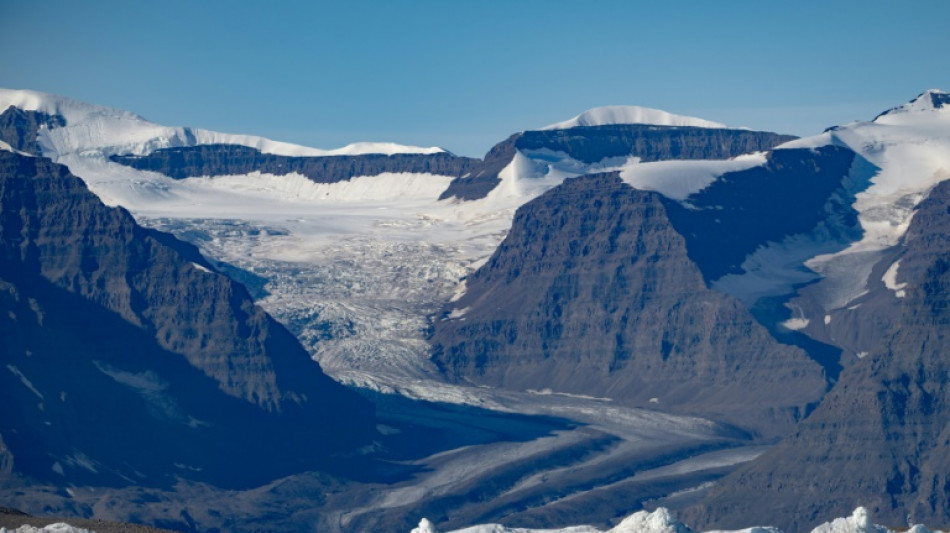
Oh my (long) days: Melting ice caps slow Earth's spin / Photo: © AFP/File

Oh my (long) days: Melting ice caps slow Earth's spin

It's well known that as far as the climate crisis goes, time is of the essence.

Text size:

Now a study out Monday shows that the melting of the polar ice caps is causing our planet to spin more slowly, increasing the length of days at an "unprecedented" rate.

The paper, published in Proceedings of the National Academy of Sciences, shows that water flowing from Greenland and Antarctica is resulting in more mass around the equator, co-author Surendra Adhikari of NASA's Jet Propulsion Laboratory told AFP.

"It's like when a figure skater does a pirouette, first holding her arms close to her body and then stretching them out," added co-author Benedikt Soja of ETH Zurich.

"The initially fast rotation becomes slower because the masses move away from the axis of rotation, increasing physical inertia."

Earth is commonly thought of as a sphere, but it's more accurate to call it an "oblate spheroid" that bulges somewhat around the equator, a bit like a satsuma.

What's more, its shape is constantly changing, from the impacts of the daily tides that affect the oceans and crusts, to longer term effects from drift of tectonic plates, and abrupt, violent shifts caused by earthquakes and volcanoes.

The paper relied on observational techniques like Very Long Baseline Interferometry, where scientists can measure the difference in how long it takes for radio signals from space to reach different points on Earth, and use that to infer variations in the planet's orientation and length of day.

It also used the Global Positioning System, which measures Earth's rotation very precisely, to about one-hundredth of a millisecond, and even looked at ancient eclipse records going back millenia.

- Implications for space travel -

If the Earth turns more slowly, then the length of day increases by a few milliseconds from the standard measure of 86,400 seconds.

A currently more significant cause of slowdown is the gravitational pull of the Moon, which pulls on the oceans in a process called "tidal friction" that has caused a gradual deceleration of 2.40 milliseconds per century over millions of years.

But the new study comes to a surprising conclusion that, if humans continue to emit greenhouse gases at a high rate, the effect of a warming climate will be greater than that of the Moon's pull by the end of the 21st century, said Adhikari.

Between the year 1900 and today, climate has caused days to become around 0.8 milliseconds longer -- and under the worst-case scenario of high emissions, climate alone would be responsible for making days 2.2 milliseconds longer by the year 2100, compared to the same baseline.

That might not sound like a great deal, and certainly not something that humans are able to perceive.

But "there are definitely a lot of implications for space and Earth navigation," said Adhikari.

Knowing the exact orientation of Earth at any given moment is crucial when attempting to communicate with a spaceship, such as the Voyager probes that are now well beyond our solar system, where even a slight deviation of a centimeter can end up being kilometers off by the time it reaches its destination.

C.M.Harper--TFWP