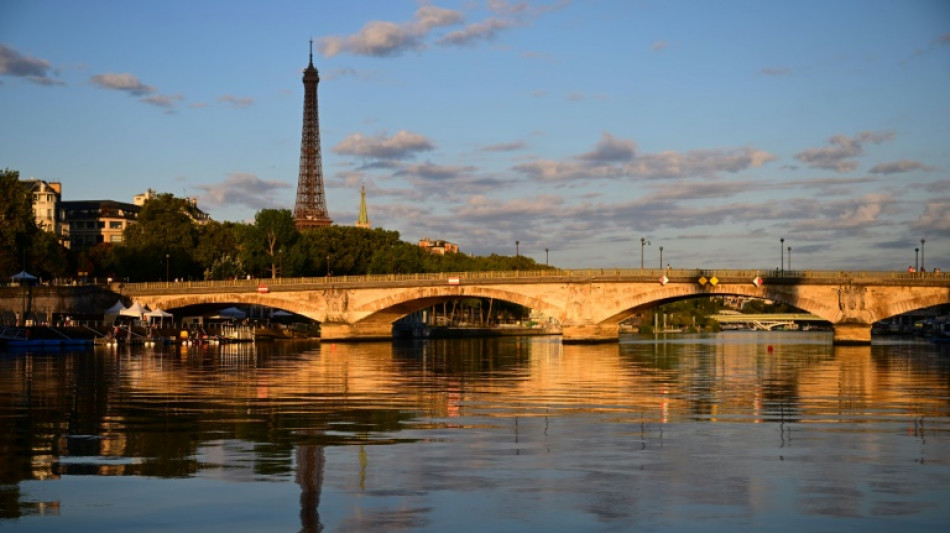
Paris dream of swimming in the Seine part of its Olympics vision / Photo: © AFP/File

Going for a dip in the Seine on a hot summer's day has been the pipedream of many a Parisian since swimming in the river was formally banned a century ago.
But floating on your back under the Eiffel Tower could very soon become reality thanks to investments linked to this month's Paris Olympics.
Weather permitting, the river will be the star of the opening ceremony of the Games on July 26 and will then host the triathlon and the swimming marathon.
Then, if all goes well, next summer Parisians and tourists will be able to dive in too.
Like Zurich and Munich before it, Paris has been reclaiming its river with one of three new urban "beaches" to open under the windows of its historic town hall next year, with another almost at the foot of the Eiffel Tower.
Nearly 30 more -- complete with pontoons, showers and parasols -- are planned for the suburbs and along the Marne, which flows into the Seine just east of the French capital.
Once regarded as an open-air dump, former French president Jacques Chirac first floated the idea of swimming in the Seine in 1990.
But it was the current mayor Anne Hidalgo who really ran with the idea, making it a pillar of her Olympic bid in 2016.
Some 1.4 billion euros ($1.51 billion) has been spent on colossal public works to counter pollution, with Hidalgo vowing to swim in the Seine next week to prove its cleanliness.
But with the capital suffering an exceptionally wet start to the year, causing regular discharges from the city's sewerage system into the river, the mayor has had to repeatedly delay taking to the water.
- Failed water quality tests -
The Seine's water quality fluctuates sharply after major rainstorms, which lead to untreated sewage being released, meaning there is still suspense about whether the Olympic swimming can take place.
Disastrous Olympic test events last August first raised doubts over whether the triathletes and marathon swimmers will be allowed to race for gold in the Seine.
Most of the events had to be cancelled because the water failed to meet European standards on two bacterias found in faeces.
Unusually violent downpours and a faulty valve in the sewage system were blamed.
But it prompted the reigning Olympic marathon swimming champion Ana Marcela Cunha to call for a "plan B".
"The health of athletes should come before everything," the Brazilian great told AFP.
In recent weeks, the river has continued to fail pollution tests, although dry weather forecast for the next few weeks should help raise standards.
Only a handful of people swim in the river regularly and their testimony is not always reassuring.
Lifeguard Gaelle Deletang, 56, a member of the French capital's aquatic civil defence team, got "diarrhoea and a rash" after swimming in the Seine in central Paris last winter.
Several other volunteers "had a bug for three weeks... and everyone had stomach upsets", she added.
Young adventurer Arthur Germain -- who happens to be the mayor of Paris's son -- also came across "zones where I had trouble breathing" from both industrial and agricultural pollution when he swam the whole 777-kilometre (482-mile) length of the Seine in 2021.
In deepest rural Burgundy -- days before he got anywhere near Paris -- he measured levels of faecal matter well above EU limits for swimming. Further north he swam past farmers spraying pesticides by the riverbank.
His "worst day", however, was a few kilometres downstream from the capital as he passed a sewage works at Gennevilliers.
- Sofas, scooters and corpses -
Yet the quality of the water has been on a steady upward curve.
Five major anti-pollution plants have come on stream ahead of the Games, while wildlife is returning and the quantity of garbage floating in the waterway has fallen.
His 20-metre (65-foot) catamaran Belenos sucks up rubbish, from dead leaves and plastic bags to bicycles.
Delorme, 36, has seen it all. "Scooters, sofas, dead animals, and once or twice a year, human corpses. You get used to it," he told AFP.
But year after year, the rubbish the boat hoovers up has been falling, from a high of 325 tonnes to 190 tonnes in 2020.
The push to make the Seine swimmable for the Olympics has accelerated a French government plan to limit waste water and sewage getting into both it and the river Marne.
A 2018 law obliges the boats and barges that line the Seine to be hooked up to the city's sewers to stop them flushing directly into the river. Officials says almost all are now following the rules.
"Uncontrolled flushing has a major impact on faecal bacteria in the river," said Jean-Marie Mouchel, professor of hydrology at the Sorbonne University.
Another problem was leakage from sewage pipes from some 23,000 homes in the suburbs, with shower and toilet water being discharged directly into the environment.
Officials have been going door-to-door offering subsidies to get them fixed and threatening penalties if they are not.
"We have gone from 20 million cubic metres to two million cubic metres of discharges into the Seine per year in recent years," said Samuel Colin-Canivez, head of major works for the Paris sewer network.
- The return of fish -
Hydrologist Jean-Marie Mouchel has seen big signs of improvement in the river's health, with better "oxygenation, ammonium and phosphate levels".
While the Seine "has not become a wild river again", it now has "more than 30 species of fish, compared with three in 1970", said the professor.
Bill Francois, who fishes up to five times a week near Pont Marie in the historic heart of Paris, caught a surprisingly large catfish the day he talked to AFP -- the likes of which he never expected to find in the Seine.
The 31-year-old physicist also hooked a small perch, which are becoming more and more numerous. Half a century ago "there were none left", he said.
Other fish that need far higher water quality are also returning, he said, as well as "insects, crustaceans, little shrimps, sponges and even jellyfish".
For microbiologist Francoise Lucas, who has been following efforts to clean the Seine for years, the weather will ultimately decide the fate of the Olympic events on the river
"Everything that could be done (technically) has been done," Lucas told AFP.
- Massive treatment plants -
Upstream from the capital, one of the newly modernised sewage plants is using an innovative treatment method based on performic acid -- an "organic disinfectant" -- according to Siaap, the body that deals with the Paris region's waste water and sewage.
It insists the acid is safe and "rapidly disintegrates even before coming into contact with the natural environment."
Not far away, a new stormwater control station has come online. Dug deep underground at Champigny-sur-Marne to the southeast of Paris, it is designed to stop the river being polluted by heavy downpours.
As well as catching the stormwater, it filters and cleans it to remove floating debris and counters bacteria with ultraviolet lamps before the water is released into the Marne.
And as a final safety net to avoid a recurrence of the failed Olympic test events last summer, a huge new stormwater cistern has opened at near Austerlitz station on the eastern edge of central Paris.
Fifty metres (164 feet) wide and 30m deep, it can hold the equivalent of 20 Olympic swimming pools worth of water.
A veritable underground cathedral, it is there to stop stormwater flooding the sewers and overflowing into the Seine.
Even so, "statistically there are a few rainstorms a year for which it won't be totally sufficient", admitted prefect Marc Guillaume, Paris's top state official.
- Urban beaches -
"We had forgotten about the Seine," said Stephane Raffalli, mayor of the riverside Paris suburb of Ris-Orangis, where one of the nearly 30 new urban beaches will open next year. "There are people who have lived here for years who have never walked along the banks of the river."
Yet suburbanites were still swimming in the Seine until the 1960s and right up to the 1970s in the Marne, where riverside lidos called "Little Trouville" or "Deauville in Paris" did their best to summon up the holiday atmosphere of English Channel beach resorts.
In Champigny-sur-Marne, the old "beach" had "a kind of small pool where children were able to touch the bottom," recalled 74-year-old Michel Riousset. "Everyone had their own cabin."
Ris-Orangis hopes to have its old river pool complete with cabins, first built around 1930, back in service next year.
"We have conducted pollution studies over a long period, and it is safe" to swim in the river, the mayor insisted.
With climate change, and the prospect of summer temperatures hitting 50 degrees Centigrade (122 Fahrenheit) in Paris, the need for somewhere to cool off in summer has never been greater.
But some have already taken the plunge. On a warm evening last July about 20 swimmers were enjoying the Seine off the Ile Saint Denis, where the Olympic Village has been built.
Josue Remoue swims in the river three times a month from May to October.
"I've never been sick," said the 52-year-old civil servant. "The water is dodgier at the edge, generally I don't linger there." And he never "goes underwater".
Remoue takes to the water on Sundays or in the evening to avoid barge traffic.
On the night AFP joined his group, the water was a bit earthy but not murky. With the temperature at 25C, the scene along the riverbank was almost bucolic despite the nearby tower blocks.
"It's completely different from swimming in a pool," said Celine Debunne, 47, as she emerged from "a super two-kilometre swim.... I love swimming like this."
L.Coleman--TFWP