Nigerians strive to bring mangrove forests back to life / Photo: © AFP

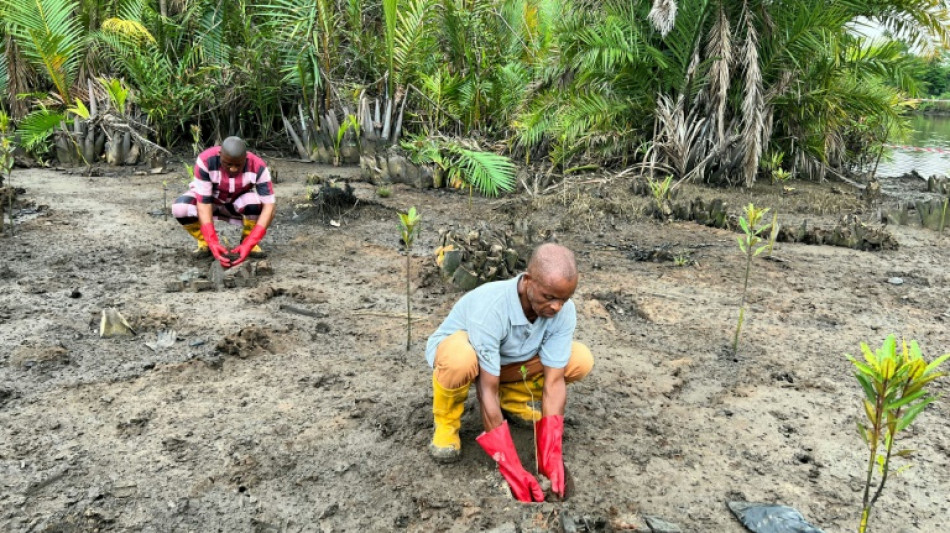
On a riverbank in the Niger Delta, a group of residents in rubber boots has been working to restore one of Nigeria's most precious and damaged ecosystems -- its mangrove forests.
The team members plunge their shovels into the mud and slot in saplings at the site in Bundu, a shanty town on the outskirts of the southern oil city Port Harcourt.
In recent years, human activity has destroyed swathes of the world's mangrove forests, which form a vital barrier against the tides and a sanctuary for wildlife.
But in this part of the Delta -- plagued by leaks from multinational oil company pipelines and a host of other threats -- a local community leader is pushing ahead with a project to restore the spoiled forests.
"We're going to bring our mangroves back to life," said fisherman David Oba, 53, who represents around 10,000 people in the town.
- 'Refuge' -
Mangrove forests are a biodiversity paradise. The specialist saltwater trees' huge root networks provide nurseries for juvenile fish, which are crucial to supporting stocks.
The forests teem with life above water too -- they are "refuges" for an array of birds that nest in their branches, explained Ijeoma Vincent-Akpu, a professor at the University of Port Harcourt.
Vincent-Akpu said the trees also protect against coastal erosion, storms and flooding, providing a key shield in the face of climate change.
Nigeria boasts some of the highest mangrove coverage in the world and more than anywhere else in Africa -- but its forests are shrinking.
The country had around 8,442 square kilometres (3,259 square miles) of mangrove forest in 2020, according to the monitoring platform Global Mangrove Watch.
Between 1996 and 2020 it lost 161.9 square kilometres of mangroves, the group said -- around two percent of the total and an area equal to more than 22,500 football pitches.
Experts say this is mainly due to human activity in the continent's most populous country.
- Oil pollution -
In Bundu, around 30 people have learned how to restore mangrove ecosystems with the help of a Nigerian NGO, the Centre for Environment, Human Rights and Development.
They have been through several weeks' training, said Nabie Nubari Francis, coordinator of the NGO, which has been running the project in three other communities in the Delta for nearly 15 years.
Priority is given to training community leaders so they can pass on their skills. David Oba said he had trained 70 people in Bundu since starting the project there several months ago.
One of the greatest threats to the mangroves is pollution from the multinational oil industry in the Delta. Residents say whole areas have been wiped out by spills.
Oil spills are frequent in the region due to a lack of pipeline maintenance as well as vandalism. Over the last five years, the National Oil Spill Detection and Response Agency has recorded almost 3,870 spills in Nigeria, mainly in the Niger Delta.
Kwani Dick Velvet, a retired journalist, recalled the first sapling he planted in his community, bought from a nearby nursery.
"If it was not for the fact that people came and planted some mangroves, this place would have been a very open field," he said, pointing to an area that he said was hit by an oil spill in 2020.
Residents said the spill was caused by vandals targeting an oil pipeline.
"When the spillage occurs, we cannot fish," 38-year-old fisherman Peter Opugulaya told AFP.
- Invasive palms -
Oil is not the only problem. Nigeria's mangroves are being damaged by illegal logging, waste dumping and urban expansion.
They face another threat, too -- the spread of Nipa palms, an invasive species that has muscled in among the mangroves.
Imported from South Asia and Oceania, the palms are used for baskets and roofing, but do not provide shelter for fish like the mangroves' arched roots.
Colin Love, from Kono village around 70 kilometres (over 40 miles) from Port Harcourt, complained the palms had taken root "everywhere".
The 40-year-old said he was planting mangroves "so that the fish will still come back for us."
On a visit to the Delta earlier this year, Nigeria's environment minister promised to work with local authorities to protect mangroves and mitigate the effects of climate change.
Four years earlier, the government announced its intention to launch a national mangrove restoration plan, but it was never implemented.
Residents said the government has been slow to act, prompting them to take measures into their own hands.
"We are helping each other," said 48-year-old driver and Kono resident Prince Nwilee, saying that communities were ready to share saplings with their neighbours.
"We are not sitting by and doing nothing," he said.
W.Knight--TFWP