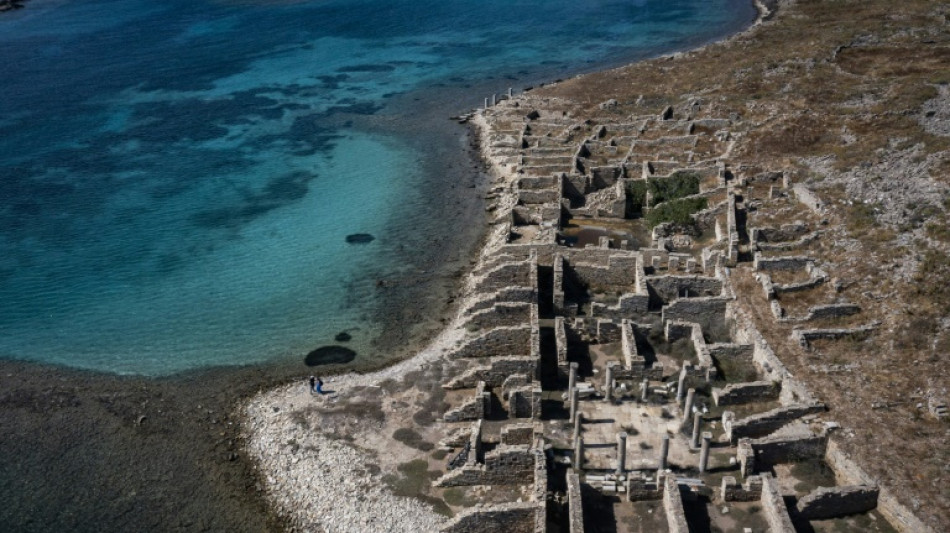
Ancient Greek sanctuary slowly sinks into the Aegean Sea / Photo: © AFP

A brief boat ride from the thrumming nightclubs of Mykonos lies the UNESCO heritage site of Delos, one of the most important sanctuaries of the ancient Greek and Roman world.
Surrounded by piercing azure waters, Delos' 2,000-year-old buildings offer a microcosm of information on daily life during the Hellenistic and Roman periods.
But within decades, because of rising sea levels brought about by climate change, the site known for its temples guarded by stone lions could be gone forever, scientists warn.
"Delos is condemned to disappear in around 50 years," said Veronique Chankowski, head of the French archaeological school of Athens (EFA), which has been excavating the site for the past 150 years under licence from the Greek state.
The tiny Aegean Sea island's silent drama could not be more at odds with the bustle of neighbouring Mykonos, which attracts hundreds of thousands of visitors annually.
The worst structural damage is visible in an area that once housed trade and storage buildings in the first and second centuries BCE and is not accessible to visitors.
- Seawater eroding walls -
"Water enters the stores in winter. It eats away at the base of the walls," noted Jean-Charles Moretti, the French mission's director on Delos and a researcher at the French state institute for the research of ancient architecture (IRAA).
"Every year in the spring, I notice that new walls have collapsed," Moretti, who has taken part in digs on the island for the past 40 years, told AFP.
In the space of 10 years, the sea level has risen by up to 20 metres (66 feet) in some parts of the island, added Chankowski.
A study by Aristotelio University in Thessaloniki last year found that increasing temperatures combined with high levels of humidity can significantly affect the chemical composition of certain materials used in cultural heritage monuments.
"Just like the human body, monuments are built to withstand specific temperatures," study supervisor Efstathia Tringa, a meteorology and climatology researcher at Aristotle University in Thessaloniki, told Kathimerini daily earlier this year.
A steady stream of tourists from Mykonos, who often veer away from permitted areas, constitute an additional problem.
In the summer, only a handful of archaeologists are at hand to supervise.
To the ancient Greeks, Delos was the birthplace of Apollo, god of light, arts and healing, and of his sister Artemis, goddess of the hunt.
The siblings were among the chief deities honoured by both the Greeks and the Romans.
At the height of its acclaim during the Roman era, Delos attracted pilgrims and traders from across the ancient world and ultimately grew to a bustling city of some 30,000 people.
But the island's popularity proved its undoing. It was looted twice in the first century BCE and eventually abandoned altogether.
For now, wooden support beams have been used to shore up some walls, Chankowski said.
But more robust measures are complex and will require a multi-disciplinary response, she added.
"All coastal cities will lose significant areas currently located at sea level," said Athena-Christiana Loupou, a Greek archaeologist who guides groups through the site's main attractions.
"We replaced plastic straws with paper straws but we lost the war" to protect the environment, she said bitterly.
J.P.Cortez--TFWP