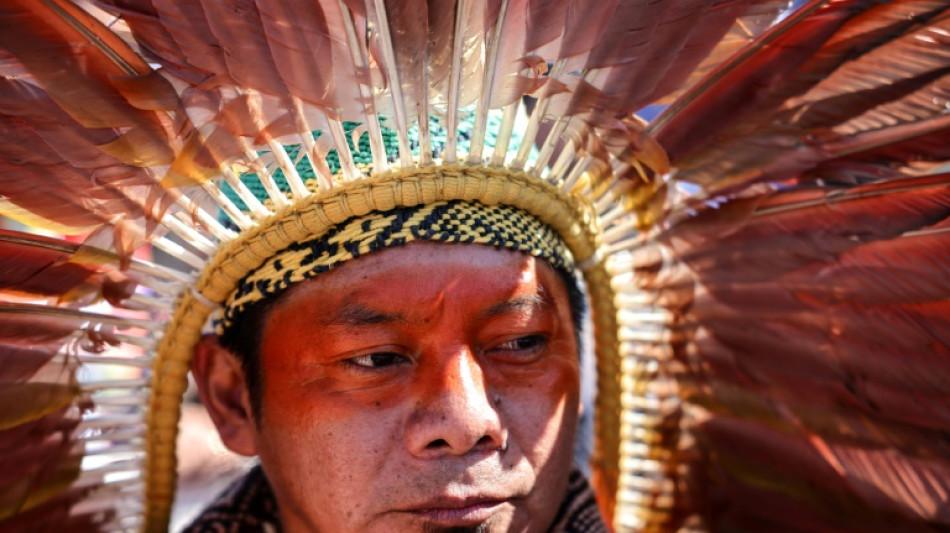
Amazonian chief at UN to combat traditional knowledge piracy / Photo: © AFP

The leader of the Brazilian Amazon's Huni Kui people remains hopeful that a planned United Nations treaty will advance the fight against biopiracy: the pillaging of traditional knowledge and genetic resources.
However, discussions towards concluding the agreement are progressing "very slowly", Chief Ninawa told AFP on the sidelines of the treaty talks at the headquarters of the UN's World Intellectual Property Organization in Geneva.
Wearing traditional costume, Ninawa officially blessed the WIPO diplomatic conference, with music and song, during a ceremony in front of negotiators.
"Indigenous peoples have always placed their trust in the UN", he said, though he deplored that though there were "declarations and recommendations to states, things do not change" -- and the plundering of traditional knowledge continues.
But "we want to keep faith in the UN", he said.
The draft treaty being finalised at WIPO -- the UN's agency for patenting, IP and innovation -- has been in the works for more than 20 years following a first request launched by Colombia in 1999.
It would require patent applicants to disclose the country of origin of an invention's genetic resources, and whether it is based on traditional knowledge.
- Traditional medicine pirated -
"Many plants are used in traditional medicine. Companies are appropriating this knowledge to make perfumes and medicines," Ninawa said.
While natural genetic resources -- such as those found in medicinal plants, agricultural crops and animal breeds -- cannot be directly protected as intellectual property, inventions developed using them can be patented.
These resources are increasingly used by companies in everything from cosmetics to seeds, medicines, biotechnology and food supplements, and have enabled considerable progress in health, climate and food security, according to the UN.
But developing countries deplore that patents are granted without Indigenous peoples being informed, for so-called inventions that are not really new because they are based on traditional knowledge.
"As connoisseurs and protectors of this knowledge, we have much to contribute to humanity," said Ninawa.
However, "in South America and Brazil, many companies have appropriated the traditional and genetic knowledge of Indigenous peoples" without their authorisation.
The Amazonian leader said that, much to his regret, the Brazilian authorities did not consult with them -- even if President Luiz Inacio Lula da Silva "has a lot of will to change things".
"But it does not depend only on President Lula," he said.
- Ayahuasca brew -
Ninawa cited ayahuasca as a case in point.
A psychoactive brew prepared from vines by the people of the western Amazon basin, ayahuasca is seen, depending on the version, as a miracle cure, a tool for inner exploration and personal development, a recreational hallucinogen, or a dangerous psychotropic drug.
In certain countries, psychedelic tourism has developed around ayahuasca, which can also be bought online, in capsules or as an infusion.
"There are a lot of laboratories that want to do research (on ayahuasca) to treat people with psychological or mental problems," said Ninawa.
The community he leads, comprising 17,000 people in Brazil and 4,000 in Peru, feels in danger from biopiracy.
"The way they enter our community, in search of traditional and ancestral knowledge, represents a very real, very strong threat," he said.
The battle against biopiracy could reach a turning point if WIPO's more than 190 member states manage to conclude an agreement. The talks in Geneva are scheduled to last until May 24.
"We came here to bring a declaration from the Indigenous peoples of Brazil, to highlight the problems that the appropriation of our knowledge causes for our communities," explained the Huni Kui leader.
This knowledge "is part of our spirituality, it is not resources for the economy".
"It is very important that governments and leaders know: our relationship with Mother Nature is not economic but a way of being in a relationship with life."
H.Carroll--TFWP