The Fort Worth Press - Philippine settlement submerged by dam reappears due to drought

USD -
AED 3.672503
AFN 62.501001
ALL 82.894362
AMD 377.440302
ANG 1.790083
AOA 917.00052
ARS 1397.044025
AUD 1.429215
AWG 1.8
AZN 1.692445
BAM 1.689807
BBD 2.011068
BDT 122.513867
BGN 1.709309
BHD 0.377467
BIF 2965
BMD 1
BND 1.277469
BOB 6.900038
BRL 5.235901
BSD 0.998523
BTN 93.323368
BWP 13.643963
BYN 2.973062
BYR 19600
BZD 2.008078
CAD 1.373545
CDF 2273.000133
CHF 0.787095
CLF 0.023076
CLP 911.180127
CNY 6.880502
CNH 6.887745
COP 3711.32
CRC 465.684898
CUC 1
CUP 26.5
CVE 95.250172
CZK 21.071007
DJF 177.719702
DKK 6.440602
DOP 59.875015
DZD 132.584589
EGP 52.340596
ERN 15
ETB 157.374954
EUR 0.86198
FJD 2.216402
FKP 0.749521
GBP 0.745135
GEL 2.714989
GGP 0.749521
GHS 10.905021
GIP 0.749521
GMD 72.999773
GNF 8779.999527
GTQ 7.648111
GYD 208.902867
HKD 7.83455
HNL 26.5202
HRK 6.494703
HTG 130.780562
HUF 334.426994
IDR 16869
ILS 3.11565
IMP 0.749521
INR 93.32665
IQD 1310
IRR 1315050.00006
ISK 123.779935
JEP 0.749521
JMD 157.274927
JOD 0.709027
JPY 158.5555
KES 129.502932
KGS 87.450267
KHR 4015.000133
KMF 424.999439
KPW 900.003974
KRW 1494.150262
KWD 0.30643
KYD 0.832131
KZT 481.288689
LAK 21550.000465
LBP 89550.000127
LKR 313.539993
LRD 183.596182
LSL 16.930263
LTL 2.95274
LVL 0.60489
LYD 6.394992
MAD 9.362015
MDL 17.464295
MGA 4165.00029
MKD 53.093953
MMK 2099.452431
MNT 3566.950214
MOP 8.056472
MRU 40.109616
MUR 46.569728
MVR 15.449812
MWK 1737.000149
MXN 17.806885
MYR 3.925001
MZN 63.909802
NAD 16.819595
NGN 1380.149729
NIO 36.719869
NOK 9.743205
NPR 149.304962
NZD 1.71015
OMR 0.384521
PAB 0.998475
PEN 3.472991
PGK 4.305498
PHP 59.685015
PKR 279.249653
PLN 3.672435
PYG 6524.941572
QAR 3.64401
RON 4.391901
RSD 101.273016
RUB 81.931677
RWF 1460
SAR 3.754344
SBD 8.051718
SCR 14.520415
SDG 601.000173
SEK 9.33575
SGD 1.275895
SHP 0.750259
SLE 24.549781
SLL 20969.510825
SOS 571.496482
SRD 37.336502
STD 20697.981008
STN 21.167495
SVC 8.736371
SYP 110.564047
SZL 16.849933
THB 32.469797
TJS 9.540369
TMT 3.5
TND 2.904983
TOP 2.40776
TRY 44.343698
TTD 6.778753
TWD 31.876796
TZS 2595.000039
UAH 43.841339
UGX 3769.542134
UYU 40.685845
UZS 12204.999854
VES 456.504355
VND 26341
VUV 119.226095
WST 2.727792
XAF 566.728441
XAG 0.014437
XAU 0.000226
XCD 2.70255
XCG 1.799457
XDR 0.706079
XOF 568.501353
XPF 103.393234
YER 238.650041
ZAR 16.87083
ZMK 9001.197429
ZMW 19.346115
ZWL 321.999592
  • BCC

    3.5800

    71.88

    +4.98%

  • BCE

    -0.0300

    25.76

    -0.12%

  • JRI

    -0.0900

    11.68

    -0.77%

  • RBGPF

    -13.5000

    69

    -19.57%

  • CMSD

    0.0816

    22.74

    +0.36%

  • GSK

    0.1500

    51.99

    +0.29%

  • NGG

    0.0700

    82.06

    +0.09%

  • BTI

    0.5500

    57.92

    +0.95%

  • AZN

    0.4700

    184.07

    +0.26%

  • CMSC

    0.2300

    22.88

    +1.01%

  • RIO

    2.6900

    85.84

    +3.13%

  • RELX

    0.4500

    33.81

    +1.33%

  • RYCEF

    0.7500

    16.05

    +4.67%

  • VOD

    0.1500

    14.48

    +1.04%

  • BP

    -1.2100

    43.57

    -2.78%

Philippine settlement submerged by dam reappears due to drought
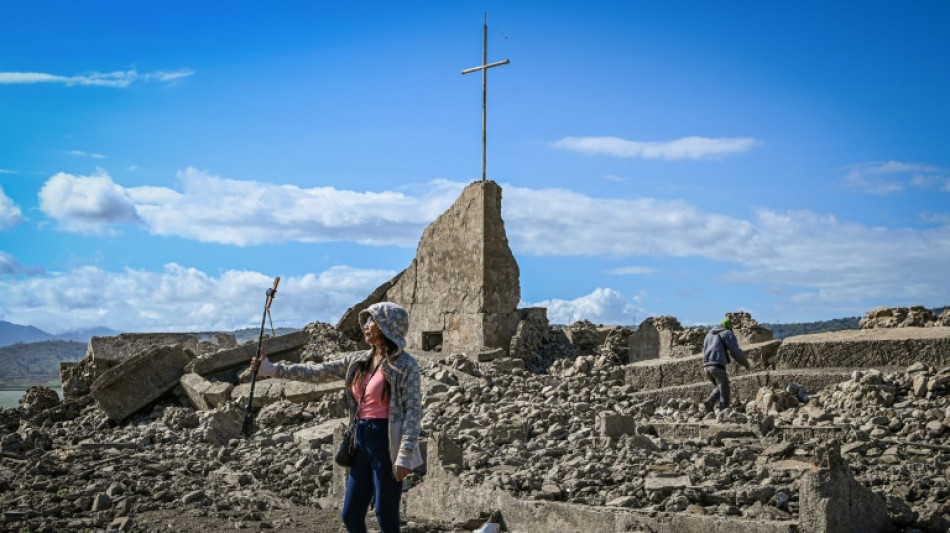
Philippine settlement submerged by dam reappears due to drought / Photo: © AFP

Philippine settlement submerged by dam reappears due to drought

A centuries-old settlement submerged by the construction of a dam in the northern Philippines in the 1970s has reappeared as water levels drop due to a drought affecting swathes of the country.

Text size:

The ruins in the middle of Pantabangan Dam in Nueva Ecija province are a tourist draw, even as the region swelters in extreme heat.

Parts of a church, municipal hall marker and tombstones began to resurface in March after several months of "almost no rain", said Marlon Paladin, a supervising engineer for the National Irrigation Administration.

It is the sixth time the nearly 300-year-old settlement has resurfaced since the reservoir was created to provide irrigation water for local farmers and generate hydro-power.

"This is the longest time (it was visible) based on my experience," Paladin told AFP.

The reservoir's water level has fallen nearly 50 metres (164 feet) from its normal high level of 221 metres, figures from the state weather forecaster show.

The months of March, April and May are typically the hottest and driest in the archipelago nation, but conditions this year have been exacerbated by the El Nino weather phenomenon.

About half of the country's provinces, including Nueva Ecija, are officially in drought.

Tourists wanting a close-up of the ruins pay around 300 pesos ($5.00) to fishermen for a short boat ride out to the temporary island in the middle of the reservoir.

Nely Villena, who lives in Pantabangan municipality, regularly visits a viewing platform overlooking the dam to see the ruins.

"The view is better when the water level is low. If the water is too high... all I can see is water," Villena, 48, told AFP, as a strong wind whipped across the water, providing relief from the scorching heat.

- 'Badly need water' -

The actual air temperature in Nueva Ecija has reached around 37 degrees Celsius (99 degrees Fahrenheit) most days this week, with the heat index hovering above the "danger" level of 42C.

The heat index measures what a temperature feels like, taking into account humidity.

Hundreds of residents of the submerged villages and farms where the dam is located were moved by the government to higher ground.

Melanie Dela Cruz, 68, was a teenager when her family was forced to leave their home. This year she returned for the first time.

"I got emotional because I got to recall my old life there," Dela Cruz told AFP.

"My heart was overwhelmed because I studied there, I was even born there."

The receding water level forced two hydropower plants near the dam to stop operating earlier this month, ahead of the normal shutdown on May 1.

It also deprived many rice farmers of much-needed irrigation water, forcing some to switch to growing vegetables, which require less water.

Dela Cruz said she prays for rain even though it means her old home will again disappear from view.

"Our farmers badly need water for their fields," she said.

W.Knight--TFWP