'Remarkable' giant coral reef found off Tahiti

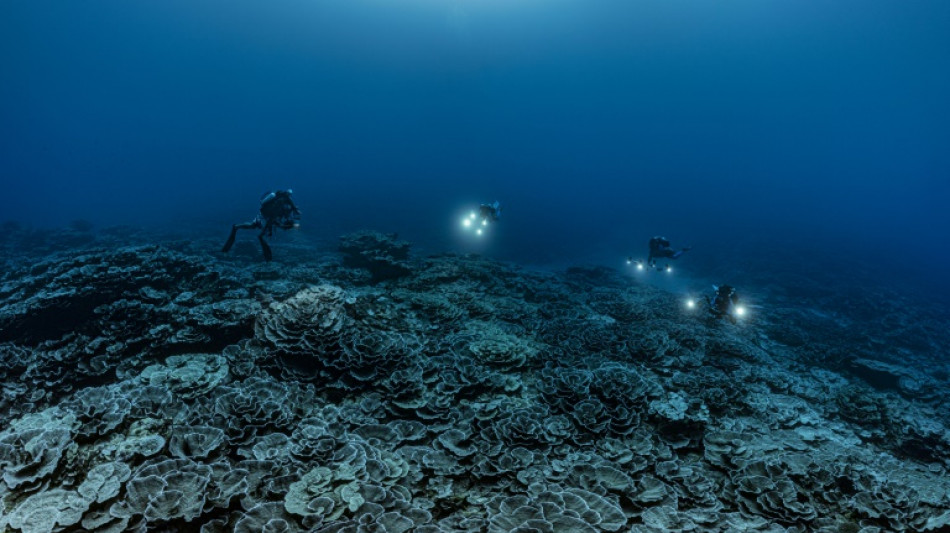
Scientists have discovered a vast reef of "pristine" rose-shaped corals apparently unharmed by climate change in deep water off the coast of Tahiti, UNESCO announced Thursday.
Mapping approximately three kilometres (two miles) long and up to 65 metres (213 feet) wide, UNESCO said it was "one of the most extensive healthy coral reefs on record".
The UN heritage agency said it was "highly unusual" to find healthy coral in cooler waters between 30 and 65 metres deep and that it could suggest that there are more reefs in the ocean depth that are safer from the impacts of warming waters.
The discovery was made in November by divers with special equipment that allowed them to go deeper and spend 200 hours at the reef.
"It was magical to witness giant, beautiful rose corals which stretch for as far as the eye can see. It was like a work of art," said Alexis Rosenfeld, a French photographer and founder of the UNESCO partner 1 Ocean campaign.
The giant rose-shaped corals are each up to two metres in diameter.
"To date, we know the surface of the moon better than the deep ocean," said UNESCO Director-General Audrey Azoulay, adding that only 20 percent of the world's seabed has been mapped.
- 'Inspire' -
"The discovery of this reef in such a pristine condition is good news and can inspire future conservation," said Laetitia Hedouin, a marine biologist at French research agency (CNRS).
"We think that deeper reefs may be better protected from global warming."
Most of the world's known reefs have been found at depths of up to 25 metres and the UN heritage body said the Tahiti reef could suggest there are more areas of healthy coral in the ocean's unmapped "twilight zone".
"This remarkable discovery in Tahiti demonstrates the incredible work of scientists who, with the support of UNESCO, further the extent of our knowledge about what lies beneath," said Azoulay.
French Polynesia suffered a significant bleaching event back in 2019, but this newly discovered reef does not appear to have been significantly affected.
"These corals do not show signs of stress or disease," Hedouin told AFP.
Bleaching occurs when healthy corals become stressed by spikes in ocean temperatures, causing them to expel algae living in their tissues, leaving graveyards of bleached skeletons where vibrant ecosystems once thrived.
- Warming threat -
Starfish can also ravage corals by eating them.
Temperature sensors have been placed in the area as part of a programme to analyse why the corals appear to be unaffected by climate change and to monitor its population dynamics.
Coral reefs cover only a tiny fraction of the ocean floor, but they are home to at least a quarter of all marine animals and plants.
In October, the Global Coral Reef Monitoring Network said dynamite fishing, pollution, but mostly global warming had wiped out 14 percent of the world's coral reefs between 2009 to 2018.
Hardest hit were corals in South Asia and the Pacific, around the Arabian Peninsula, and off the coast of Australia.
Oceans absorb more than 90 percent of the excess heat from greenhouse gas emissions, shielding land surfaces but generating huge, long-lasting marine heatwaves that are pushing many species of corals past their limits of tolerance.
A single bleaching event in 1998 caused by warming waters wiped out eight percent of all corals.
T.M.Dan--TFWP