Norway women bring seaweed to culinary heights in Europe / Photo: © AFP

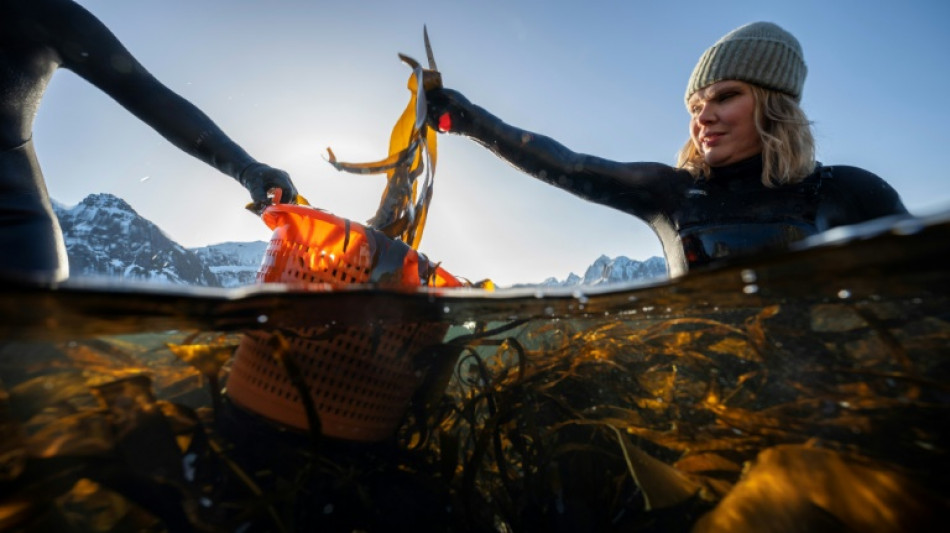
In the glacial waters of the Lofoten archipelago in Norway's far north, Angelita Eriksen uses a knife to cut a handful of seaweed that will soon end up in a fancy European eatery.
"We have the cleanest and clearest waters in the world. We're very lucky that we have this really important resource growing right outside our doorstep," Eriksen told AFP in a cabin on the shores of the northern Atlantic Ocean where the seaweed is laid out to dry.
"We want to show that to the world."
The daughter of a Norwegian fisherman, Eriksen joined forces with New Zealand-born Tamara Singer, whose Japanese mother served seaweed with almost every meal, to start the company Lofoten Seaweed -- specialising in harvesting and preparing seaweed for the food industry.
With the help of six others, they hand-pick 11 tonnes of seaweed a year, the snow-capped mountains plummeting into the sea behind them in a dramatic tableau.
It's a demanding and "physical job", said Eriksen.
The peak season runs from late April until June, but "we harvest the dulse, the nori and the sea truffle in the winter and fall".
"It can be quite cold, as we can stay out for about an hour along the shore", with lower legs and hands submerged in the chilly water.
By "late May, I'm actually sweating in my suit".
One time, she said, "I took my glove off and the steam was just rising up".
"It's physically hard but at the same time it's very meditative, or therapeutic in a way, to harvest," she says.
- 'Delicate' -
Truffle seaweed, winged kelp, nori, dulse, sugar kelp, oarweed kelp: the pair focus on about 10 types of seaweed, long eaten in Japan and increasingly popular in Europe for their nutritional qualities.
The seaweed is sold locally or shipped to gourmet restaurants in Norway and the rest of Europe.
The two women organise workshops to teach chefs about the different varieties and the qualities of each type.
"Seaweeds are like vegetables, they have their own texture, taste and colours," says Singer.
She said it was a "huge surprise" how many European chefs had little or no knowledge of the different flavours and ways of preparing seaweed.
The duo have worked with Japanese chefs "who know exactly what to do, you don't have to tell them anything".
"It's just so natural for them. It's like giving a piece of fish to a North Norwegian," says Singer.
Some 20 kilometres (12 miles) away, chef Josh Wing has been serving the pair's products in his high-end restaurant Hattvika Lodge for about five years.
He is well versed and does not need to take part in their workshops anymore.
Wing is particularly fond of the dulse, a "very delicate purple seaweed", which he serves with local fish dishes or bread.
It "can provide a physical texture in a dish that you can't get from other products", he tells AFP.
To ensure that their business is sustainable, Eriksen and Singer have mapped and dated their harvest sites, as well as the volumes of each species, for the past four years.
"Our results show that the regrowth in recently-harvested patches is actually faster than anticipated, almost as if a harvest actually stimulates growth," says Singer.
T.M.Dan--TFWP