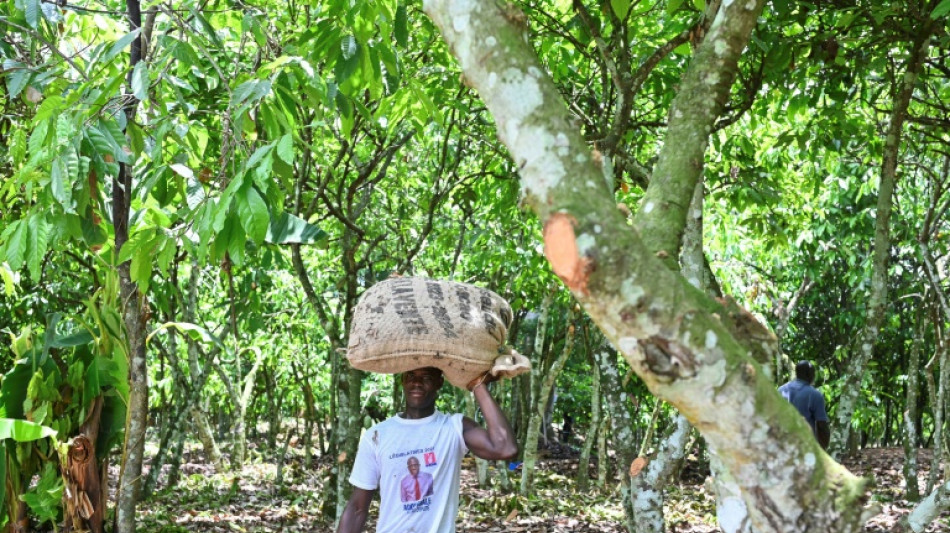
Record heat rots cocoa beans threatening Ivory Coast agriculture / Photo: © AFP

Surrounded by cocoa trees and intense heat, Christian Andre Yapi is forced to admit that the precious beans are no longer growing as they should, a major problem for the world's leading producer.
"The beans are turning black," and rotting, he tells AFP at his plantation near Agboville, 70 kilometres (nearly 45 miles) from the economic capital Abidjan.
"They are not growing properly because of the heat."
The leaves on the trees usually provide shade for the pods, but the sun "is drying them up and they are falling" off the trees.
It is so hot Yapi can work only in the morning, leaving plenty of spare time to dwell on his losses.
"Normally in the off season I get up to a tonne," but this year he expects just 300 kilograms (660 pounds).
Last year's heavy rains have given way to high temperatures, particularly from January to March, which have slashed the cocoa crop, which accounts for nearly 45 percent of global production.
The thermometer climbed to a record 41 degrees Celsius (106 Fahrenheit) at Dimbrokro in central Ivory Coast in February, said Daouda Konate, head of the national weather agency Sodexam.
Normal temperatures for that time of year would be 35C-36C (95-97F), he added.
Ivory Coast has not been alone in battling the hot weather over the region.
In Mali, the town of Kayes, in the southwest, suffocated under 48.5C (119F) in early April.
Long-lasting and intense periods of heat stress plants, said agronomist Siaka Kone, head of the higher school of agronomy in the Ivorian capital Yamoussoukro.
"The quantities of water available will not be sufficient for proper growth and there will be no blossom. Without flowers ... no fruit," he said.
Soil temperatures increase in line with air temperatures leading to greater water evaporation, noted Kone.
Agriculture represents a quarter of Ivory Coast's GDP and provides half of all employment.
- Africa warming faster -
"This year is different because of El Nino", a natural weather phenomenon which pushes up the temperature of a large part of the South Pacific, said Daouda Konate, recently appointed the first African vice-president of the UN's World Meteorology Organization.
"Human activity: what we consume and our industry," only make matters worse, said Nahounou Pierre Lautti Daleba, a geo-economist and environmental activist.
Africa has emitted only seven percent of global greenhouse gases since the mid-19th century, according to the UN climate change panel (IPCC), but temperatures have risen 1.4°C across Africa against 1.1 percent globally.
Ivory Coast is aiming to cut emissions by more than 30 percent and preserve forests after losing 90 percent since 1960.
According to government forecasts, climate change could lead to annual GDP losses of 3-4.5 percent up to 2030.
Farmers "are not prepared for heat waves", which are becoming repetitive, said Nahounou Pierre Lautti Daleba.
But there are ways to adapt, said Kone, who recommends water retention projects and not pulling up vegetation which protects against the sun.
Abidjan's rapid urbanisation with a surging population of six million, has made it even more difficult to cope with the weather.
"Over the last 10 years the city of Abidjan has seen an increase in the number and scale of heat waves," said Felix Houphouet-Boigny university researcher Maimouna Ymba in a Red Cross report.
Combined with human activity, this has created "islands of urban heat" where soil temperatures can rise 5-10 percent above the surrounding areas, she added.
W.Knight--TFWP