US announces tough tap water standards for 'forever chemicals' / Photo: © GETTY IMAGES NORTH AMERICA/AFP/File

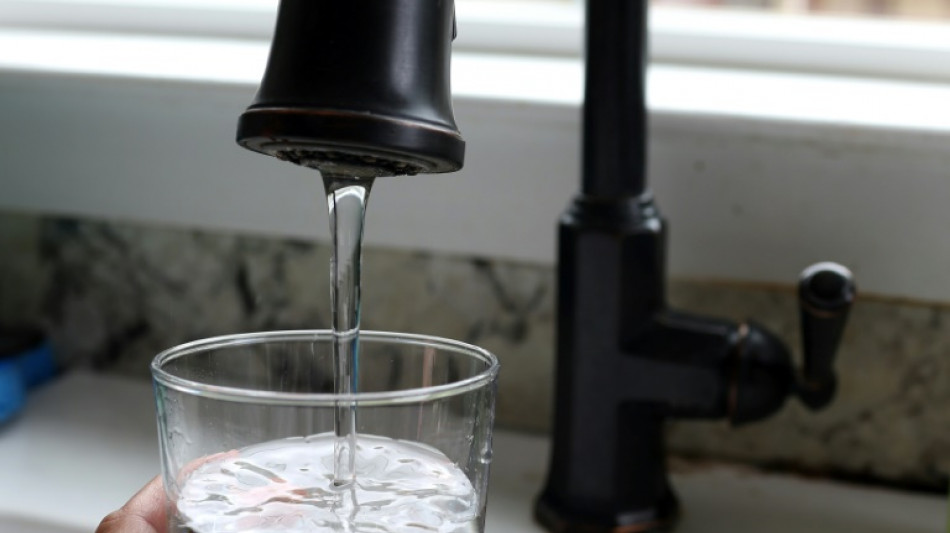
US President Joe Biden's administration on Wednesday announced the first nationwide tap water standards to protect the public from toxic "forever chemicals" linked to serious health harms ranging from cancers to developmental damage in children.
Invisible and present in the water, soil, air and food supply, per- and polyfluoroalkyl substances (PFAS) accumulate inside our bodies and never break down in the environment.
A new Environmental Protection Agency (EPA) rule would reduce PFAS exposure in the water supply of some 100 million people, preventing thousands of deaths and tens of thousands of serious illnesses, the agency said.
"This is a huge win for public health in the United States," Melanie Benesh, who works on policy issues for the nonprofit Environmental Working Group, told AFP.
"Getting these chemicals out of drinking water will reduce exposure, will reduce the disease burden, and ultimately will save lives."
The rule sets drinking water limits for five individual PFAS.
This includes two of the most commonly found PFAS: a contaminant known as PFOA previously used in nonstick Teflon pans, and PFOS, a compound once used in coatings to protect clothes and carpets in 3M's Scotchgard and in firefighting foams.
Specifically, it sets maximum levels for these two at 4 parts per trillion or ppt -- far lower than, for example Canada, where the limits are 200 ppt for PFOA and 600 ppt for PFOS.
"I am not aware of a lower or more health protective drinking water standard for PFAS globally," said David Andrews, a senior scientist with EWG.
Eleven US states already had their own PFAS water regulations, but the rest did not.
The administration also announced it was releasing $1 billion in additional funding from the Bipartisan Infrastructure Law to help jurisdictions fund detection and treatment systems for the new standards.
- Home filters -
"I'm extremely proud that this rule is a result of a collective bipartisan effort, with all sides united finding a solution to a challenge that transcends political and geographical boundaries," EPA chief Michael Regan told reporters on a call.
PFAS contamination of water supplies has devastated communities like Oakdale, Minnesota, where PFAS waste dumped by a chemical plant drove a rise in cancers among children.
These included youth environmental activist Amara Strande, who was diagnosed with an extremely rare form of liver cancer and died last year, two days before what would have been her 21st birthday.
Andrews said: "There's an incredible body of scientific evidence linking PFAS not just to cancer but to other health harms, impacts on development, effectiveness of vaccines."
It's thought 20 percent of people's PFAS exposure comes through drinking water, with the remainder coming from other sources including food, food packaging, consumer products and household dust, he added.
In all, there are nearly 15,000 types of PFAS, according to a chemicals database maintained by the EPA, but more research is needed to fully understand all their impacts.
Biden, who vowed to tackle the PFAS scourge as a campaign pledge, has previously passed actions phasing out the chemicals in food packaging, stopping the purchase of PFAS-containing chemicals in federal contracts, and more.
Given that water systems have up to five years to implement filtration techniques to reduce PFAS, Andrews said people could still buy devices for their homes, including carbon filters and reverse osmosis systems, to protect themselves and their families.
X.Silva--TFWP