The Fort Worth Press - 'The Meg' shark was actually quite thin, scientists say

USD -
AED 3.672497
AFN 63.496236
ALL 80.15939
AMD 362.919823
ANG 1.790365
AOA 916.999719
ARS 1514.244199
AUD 1.414917
AWG 1.80125
AZN 1.691204
BAM 1.712962
BBD 2.013821
BDT 122.932477
BGN 1.683441
BHD 0.376962
BIF 3004.585047
BMD 1
BND 1.277595
BOB 11.923749
BRL 5.131303
BSD 0.99986
BTN 95.678145
BWP 13.595481
BYN 3.027431
BYR 19600
BZD 2.01093
CAD 1.40891
CDF 2311.000026
CHF 0.82285
CLF 0.024072
CLP 950.520259
CNY 6.6998
CNH 6.70685
COP 3210.07
CRC 453.685538
CUC 1
CUP 26.5
CVE 96.574587
CZK 21.3671
DJF 178.050457
DKK 6.551265
DOP 59.478089
DZD 133.645601
EGP 51.398897
ERN 15
ETB 163.319699
EUR 0.87636
FJD 2.237199
FKP 0.750528
GBP 0.75325
GEL 2.595013
GGP 0.750528
GHS 11.583045
GIP 0.750528
GMD 73.505167
GNF 8793.441704
GTQ 7.63211
GYD 209.186734
HKD 7.843325
HNL 26.837396
HRK 6.603201
HTG 130.683635
HUF 319.267505
IDR 17825
ILS 3.01575
IMP 0.750528
INR 95.73935
IQD 1309.814191
IRR 1374650.000003
ISK 120.929585
JEP 0.750528
JMD 157.538176
JOD 0.708982
JPY 157.929498
KES 129.310285
KGS 87.449804
KHR 4054.823313
KMF 429.999861
KPW 900.000318
KRW 1365.049996
KWD 0.30907
KYD 0.833209
KZT 444.620586
LAK 22404.007848
LBP 89537.860574
LKR 328.955608
LRD 172.465735
LSL 16.310417
LTL 2.95274
LVL 0.60489
LYD 6.383128
MAD 9.57123
MDL 17.695844
MGA 4393.217489
MKD 53.88149
MMK 2099.577364
MNT 3597.923561
MOP 8.077068
MRU 40.034859
MUR 47.880241
MVR 15.460197
MWK 1733.73447
MXN 17.439766
MYR 4.079696
MZN 63.88613
NAD 16.310274
NGN 1324.480236
NIO 36.793911
NOK 9.464115
NPR 153.084711
NZD 1.75705
OMR 0.384501
PAB 0.99986
PEN 3.375476
PGK 4.454546
PHP 62.558506
PKR 277.084952
PLN 3.83586
PYG 5925.912951
QAR 3.645178
RON 4.625896
RSD 102.932975
RUB 84.352215
RWF 1475.675439
SAR 3.756768
SBD 8.026013
SCR 13.74007
SDG 601.513532
SEK 9.87837
SGD 1.278335
SHP 0.74758
SLE 24.649746
SLL 20969.491881
SOS 571.398543
SRD 37.740486
STD 20697.981008
STN 21.4581
SVC 8.748774
SYP 13002.000254
SZL 16.306476
THB 33.287502
TJS 9.253737
TMT 3.5
TND 2.95341
TOP 2.40776
TRY 48.826011
TTD 6.795649
TWD 31.670374
TZS 2645.002947
UAH 44.878367
UGX 3889.609025
UYU 40.078651
UZS 11798.503182
VES 851.341303
VND 26010.5
VUV 118.348377
WST 2.752527
XAF 574.854365
XAG 0.015348
XAU 0.000232
XCD 2.70255
XCG 1.801955
XDR 0.707052
XOF 574.854365
XPF 104.452317
YER 236.550089
ZAR 16.34619
ZMK 9001.202171
ZMW 19.472654
ZWL 321.999592
SSP 5712.590503
MXV 1.976583
  • RIO

    -0.3300

    97.04

    -0.34%

  • CMSC

    -0.0400

    20.67

    -0.19%

  • RELX

    0.0000

    33.41

    0%

  • RBGPF

    0.0000

    67.95

    0%

  • BCE

    -0.0700

    21.99

    -0.32%

  • BCC

    -0.0300

    75.66

    -0.04%

  • GSK

    0.8600

    51.08

    +1.68%

  • JRI

    -0.0300

    11.52

    -0.26%

  • NGG

    -0.1200

    76.68

    -0.16%

  • CMSD

    0.0900

    20.54

    +0.44%

  • BTI

    -0.0800

    55.75

    -0.14%

  • AZN

    2.0200

    168.1

    +1.2%

  • BP

    -1.4200

    43.16

    -3.29%

  • RYCEF

    0.4600

    19.7

    +2.34%

  • VOD

    0.0700

    17.02

    +0.41%

'The Meg' shark was actually quite thin, scientists say
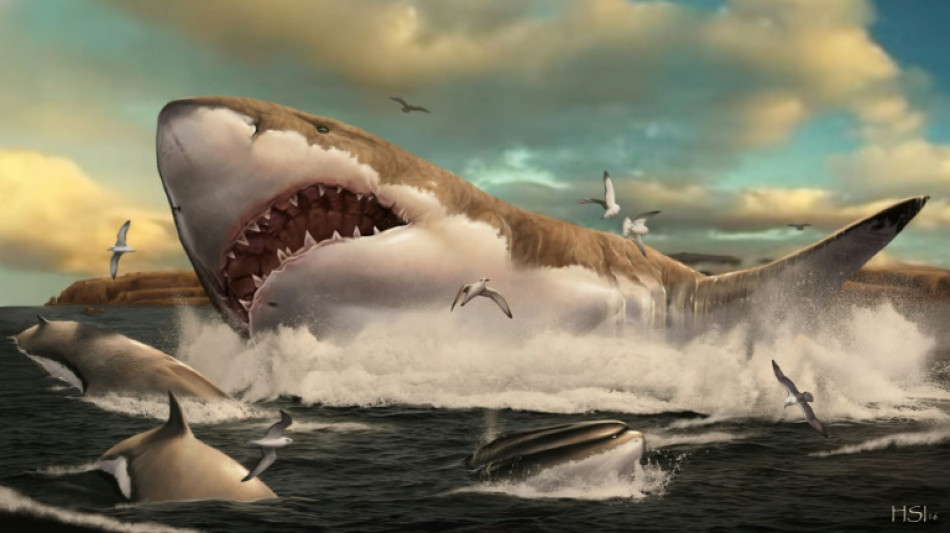
'The Meg' shark was actually quite thin, scientists say / Photo: © METAZOA STUDIO/AFP/File

'The Meg' shark was actually quite thin, scientists say

The prehistoric megalodon is known as one of the most fearsome creatures the world has ever known, a horrifyingly giant shark immortalised in the monster movie "The Meg".

Text size:

But after re-analysing the fossil evidence, scientists said on Monday they now think the shark was significantly thinner than previously thought.

While the 2018 B-movie starring Jason Statham depicted a megalodon preying on modern-day humans, the shark actually went extinct around 3.6 million years ago.

Previous research has suggested it could have been up to 20 metres (50 feet) long.

But size estimates have varied widely because they were based on the only remaining fossils of the shark, which are teeth and vertebrae.

And scientists had assumed that the megalodon had a similar stocky body shape to its modern descendant, the great white shark.

However a better model may be the thinner mako shark, according to an international team of researchers behind a study in the journal Palaeontologia Electronica.

"Our team re-examined the fossil record, and discovered the megalodon was more slender" than had been thought, University of California, Riverside biologist Phillip Sternes said in a statement.

But in bad news for Jason Statham in the next Meg movie, the shark actually may have been even longer than previously believed.

"It still would have been a formidable predator at the top of the ancient marine food chain, but it would have behaved differently based on this new understanding of its body," Sternes added.

In better news for the hapless human victims in a possible future Meg movie, the megalodon "may not have been a powerful swimmer" compared to the great white shark, said study co-author Kenshu Shimada, a paleobiologist at DePaul University in Chicago.

It also may have had to hunt less due to a longer digestive canal.

This could also affect the mystery of the megalodon's extinction.

It was previously theorised that the shark died off because there was less prey around. But its updated body image could point towards a different culprit.

"I believe there were a combination of factors that led to the extinction, but one of them may have been the emergence of the great white shark, which was possibly more agile, making it an even better predator than the megalodon," Sternes said.

Shimada said that knowing the Otodus megalodon's true shape would require finding a more complete skeleton.

"The fact that we still don't know exactly how O. megalodon looked keeps our imagination going," he added.

B.Martinez--TFWP