The mighty Mississippi, America's water highway, is dangerously low / Photo: © AFP

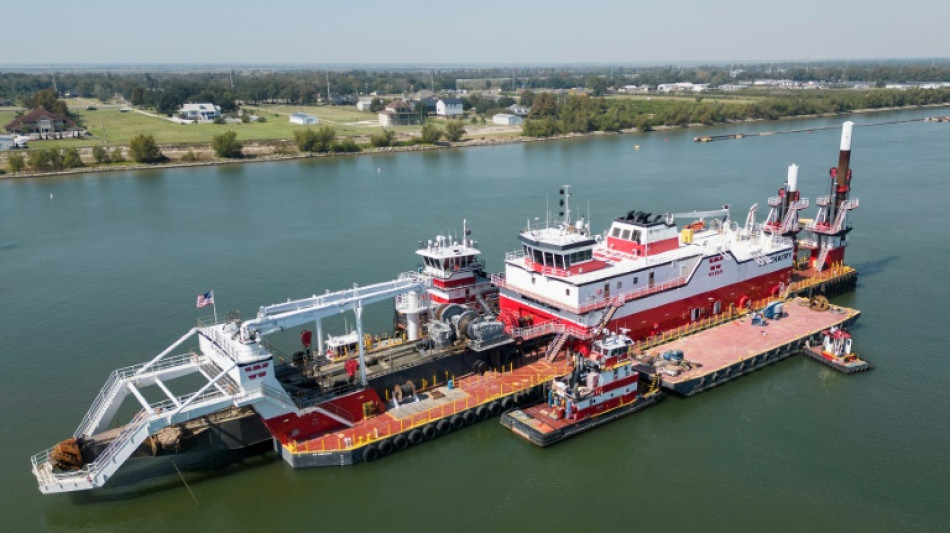
In the middle of the shrunken Mississippi, a barge drags a giant metal-edged suction head along the riverbed to remove sediment from shipping lanes.
The crew of the dustpan dredge Hurley has been working around-the-clock for months to deepen the channels so boats and barges can pass through.
"We've worked almost nonstop since last fall, everywhere from New Orleans up to St. Louis" in Missouri, said the vessel's captain Adrian Pirani, standing on the bridge.
For the second straight year, water levels in North America's biggest river have dropped to record lows amid a lengthy drought. Locals say they've never seen it this bad.
From the Great Lakes in the north to Louisiana in the south, the majestic Mississippi is a shadow of its former self.
Plants have taken over newly exposed banks. Salt water is pushing in from the Gulf of Mexico. And farmers dependent on the river to ship their products have watched with frustration as traffic has seized up.
Authorities are doing what they can to ensure the river remains navigable, and that's where the Hurley, operated by the US Army Corps of Engineers, comes in.
The dredge is currently digging at the same spot near Memphis, Tennessee for the third time. The dredge scrapes and sucks up mud from the river bottom and spews it onto the bank.
Pirani said he works long hours, first of all, "to make sure that commerce does not stop."
But the job hits closer to home.
"I come from a farming family right here across the river. So it is kind of personal for me... I will do all I can do to keep the river going," he told AFP.
- Unusable docks -
For farmers in the vast US Midwest, the Mississippi is an indispensable part of their transportation network.
But drought has left the river narrower and shallower, limiting shipping capabilities.
The bottleneck is ill-timed: early autumn is when farmers are working flat out to harvest soybeans and corn. With river shipping limited, they scramble to deal with massive buildups of stocks.
On the river in Osceola, Arkansas, Jeff Worsham manages an agricultural port. But two of its three docks are unusable due to the low water.
A barge is tied up at the only accessible dock as soybeans are shot from a huge metal spout into its hold.
The vessel's capacity equals that of roughly 80 trucks -- but for now, it can only be filled to 50 or 60 percent capacity so the craft does not run the risk of getting stuck in the mud.
To ensure operations at all three docks next year, Worsham says, "we have made plans to do some dredging next year."
- 'Extreme weather' -
The overriding fear is that the water crisis will become the new normal.
Last year, a record that had stood since 1988 was broken. It was broken again this September, and yet again in October.
A drought that began last year in the Mississippi's vast watershed (covering 40 percent of the continental United States) "lingered into this year, and it's gotten worse," Anna Wolverton, a National Weather Service specialist, told AFP.
"It's not normal for us to see this in back-to-back years."
The river's flow has grown so weak that in southern Louisiana, salt water from the Gulf of Mexico has been encroaching, contaminating drinking water in some towns and forcing inhabitants to rely on bottled water.
Around Memphis, gauges that monitor the Mississippi's depth have been left high and dry by the receding waters, explained Sarah Girdner, a hydrologist with the Army Corps of Engineers.
"Over the past 10 to 15 years, we've seen extreme weather on both spectrums," she told AFP aboard the Hurley. "We've seen more historic floods, and we've seen more historic droughts."
When asked what explained the conditions, she said: "We don't necessarily use the term 'climate change,' because causality is attached to that, but we do know that weather patterns are changing."
- 'Frightening' -
In 50 years working around the Mississippi, Pete Ciaramitaro has seen the changes.
But what Ciaramitaro, director of river operations for the Southern Devall shipping company, has not seen is two consecutive autumns with so little water.
While droughts used to occur roughly once every 25 years, he said, "It looks like it's going to be an annual thing to me. And that's frightening."
Of the dozen professionals interviewed by AFP, Ciaramitaro was the only one to link the drought explicitly to climate change -- a politically sensitive term in the United States.
"If somebody else has got a better explanation for it, I'd love to hear it," he said. "But it's the only one I can come up with -- climate change."
J.Barnes--TFWP