Glacial lake floods: a growing, unpredictable climate risk / Photo: © India's Ministry of Defence/AFP

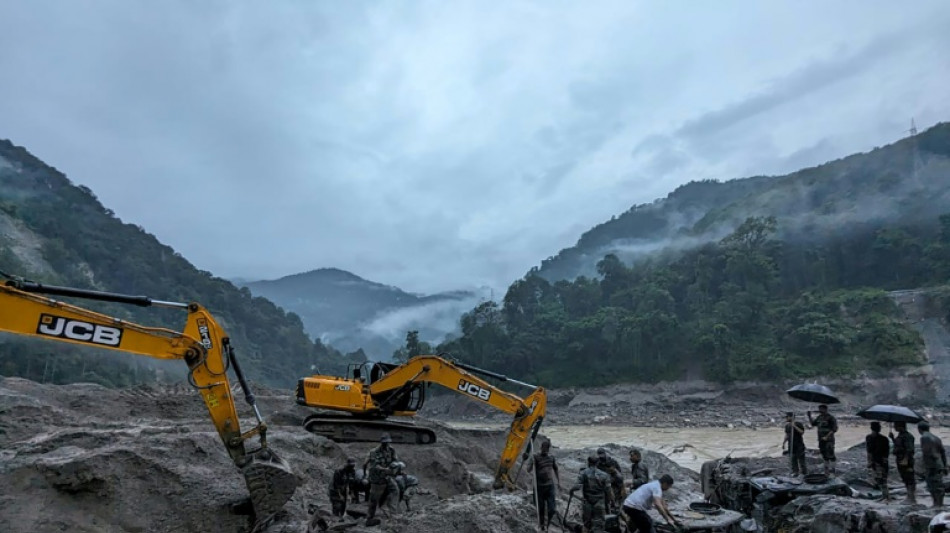
Indian rescuers are searching for over 100 people missing in a flash flood caused by a glacial lake bursting its banks, a risk scientists warn is increasing with climate change.
AFP explains what glacial lake outburst floods are and the risks they pose, particularly in parts of Asia:
What is a glacial lake outburst flood?
A glacial lake outburst flood (GLOF) is the sudden release of water that has collected in former glacier beds.
These lakes are formed by the retreat of glaciers, a naturally occurring phenomenon that has been turbocharged by the warmer temperatures of human-caused climate change.
Glacier melt is often channelled into rivers, but ice or the build-up of debris can form what is effectively a natural dam, behind which a glacial lake builds.
If these natural dams are breached, large quantities of water can be released suddenly from the lakes, causing devastating flooding.
What causes these breaches?
The natural dams holding back glacial lakes can be breached for a variety of reasons, explained Lauren Vargo, a glacier expert and scientist at the Antarctic Research Centre in New Zealand.
Causes include "an avalanche of snow, or a landslide causing a wave in the lake, or overfilling of the lake... from rain or the glacier melting", she told AFP.
Sometimes the dam has been gradually degraded over time, or is ruptured by an event like an earthquake.
The breaches are highly unpredictable, "because they can be caused by so many different factors", she added.
What is the impact of climate change?
Climate change is driving the disappearance of glaciers, with half the Earth's 215,000 glaciers projected to melt by the end of the century, even if warming can be capped at 1.5 degrees Celsius.
The volume of glacial lakes has jumped by 50 percent in 30 years, according to a 2020 study based on satellite data.
The more and larger lakes form, the greater the risk they pose to populations downstream.
Climate change is not only driving the creation of glacial lakes, but also can produce the conditions that result in dam breaches.
"The flooding can be caused by glaciers melting or these big rainfall events, we know that's happening more because of climate change," said Vargo.
How dangerous are these floods?
The particular danger of GLOFs lies in their unpredictability.
"The probability of a lake releasing a GLOF is difficult to accurately quantify without detailed and localised studies," a study of the problem globally warned this year.
The study, published in Nature Communications, found that 15 million people live within 50 kilometres (31 miles) of a glacial lake and within one kilometre of potential flooding from a breach.
The risk was greatest in "High Mountains Asia", an area that covers parts of 12 countries, including India, Pakistan, China and Nepal.
That is partly because more people live closer to glacial lakes in the region than in other parts of the world, making warning times even shorter.
But it also reflects the vulnerability of those populations, who may be poorer and less prepared to deal with the sudden arrival of catastrophic floodwaters.
"The most dangerous basins... do not always host the most, or the largest, glacial lakes," the authors wrote.
"Rather it is the high number of people and the reduced capacity of those people to cope with disaster that plays a key role in determining overall GLOF danger."
Thousands of people, for example, have been killed by glacier lake outburst floods in High Mountains Asia but only a handful in North America's Pacific Northwest, even though that region has twice as many glacial lakes.
Experts have called for more research on the risks posed by GLOFs, particularly in the Andean region, which remains comparatively understudied, but also for better preparedness.
"But then there's the larger part of what we can do in terms of reducing emissions, to try to slow down climate change and reduce the threats of this from growing even more," Vargo said.
T.Harrison--TFWP