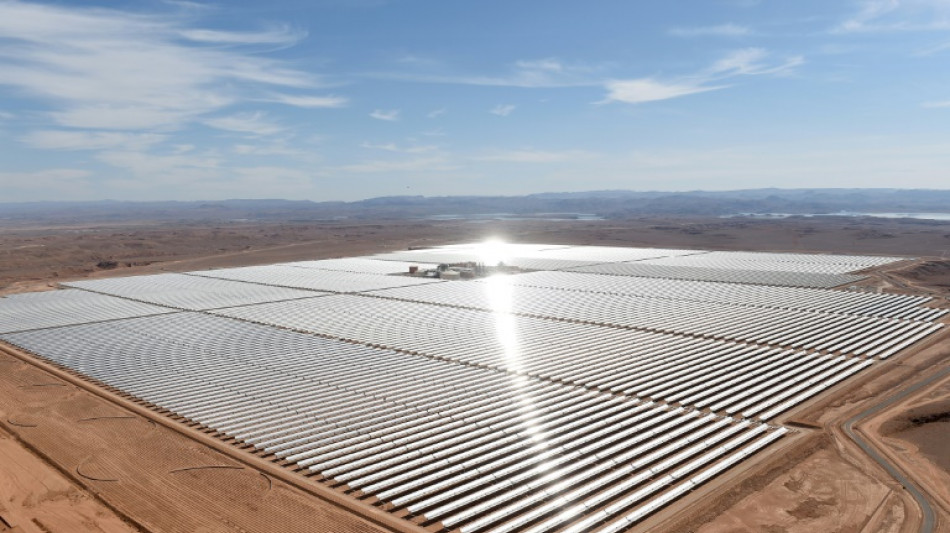
Morocco aims to become key player in green hydrogen / Photo: © AFP/File

Morocco has voiced ambitious plans to become North Africa's top player in the emerging "green hydrogen" sector, with plans to export the clean-burning fuel to Europe.
Hydrogen is seen as a clean energy source that can help the world phase out fossil fuels and reduce atmospheric carbon emissions in the battle to slow global warming.
Morocco, which already runs large solar power plants, also hopes to harness green hydrogen -- the kind made without burning fossil fuels -- for its sizeable fertiliser sector.
Around 1.5 million acres (6,000 square kilometres) of public land -- nearly the size of Kuwait -- have been set aside for green hydrogen and ammonia plants, the economy ministry says.
King Mohammed VI has hailed a national green hydrogen plan dubbed l'Offre Maroc (the Moroccan Offer) and called for its "rapid and qualitative implementation".
Speaking in July, before the country's earthquake disaster, he said Morocco must take advantage of "the projects supported by international investors in this promising sector".
Local media have reported about investment plans by Australian, British, French, German and Indian companies.
- Fertiliser sales -
Hydrogen can be extracted from water by passing a strong electrical current through it.
This separates the hydrogen from the oxygen, a process called electrolysis.
If the power used is clean -- such as solar or wind -- the fuel is called "green hydrogen", which is itself emission-free when burnt.
But there are problems: hydrogen is highly explosive and hard to store and transport. This has set back hydrogen fuel cell cars in the race against electric vehicles using lithium-ion batteries.
However, experts say green hydrogen also has a big role to play in decarbonising energy-intensive industries that cannot easily be electrified such as steel, cement and chemicals.
Powering blast furnaces with hydrogen, for example, offers the promise of making "green steel".
Hydrogen can also be converted into ammonia, to store the energy or as a major input in synthetic fertilisers.
Morocco is already a major player in the global fertiliser market, thanks mainly to its immense phosphate reserves.
It profited after fertiliser shortages sparked by Russia's invasion of Ukraine sent prices up to 1,000 euros ($1,060) per tonne.
Morocco's state Phosphate Office has announced plans to quickly produce a million tonnes of "green ammonia" from green hydrogen and triple the amount by 2032.
- Solar power -
Analysts caution that Morocco still has some way to go with its ambitious green fertiliser plans.
The sector is "embryonic and the large global projects will not see the light of day until three to five years from now", said Samir Rachidi, director of the Moroccan research institute IRESEN.
Morocco's advantage is that it has already bet heavily on clean energy over the past 15 years.
Solar, wind and other clean energy make up 38 percent of production, and the goal is to reach 52 percent by 2030.
For now green hydrogen is more expensive than the highly polluting "brown hydrogen" made using coal or "grey hydrogen" produced from natural gas.
The goal is to keep green hydrogen production below $1-$2 per kilogram, Ahmed Reda Chami, president of the Economic, Social and Environmental Counsel, told the weekly La Vie Eco.
Rachidi of IRESEN said water-scarce Morocco must also step up the desalination of seawater for the process.
It must build "an industrial value chain which begins with seawater desalinisation plants for electrolysis, electricity storage, to transportation and hydrogen marketing", he said.
Already hit by droughts that threaten its farm sector, Morocco has announced plans to add seven desalinisation plants to its 12 existing facilities.
- Regional contest -
Morocco is competing on green hydrogen with other regional countries from Egypt to Mauritania.
Business consultants Deloitte have predicted that North Africa will be the world's largest green hydrogen-exporting region by 2050, reshuffling the global energy cards.
Currently, Algeria produces only three percent of its electricity through renewables, but is investing heavily to boost capacity.
Algeria has numerous desalinisation plants whose capacity is set to more than double to two billion cubic metres (about 70 billion cubic feet) in 2030.
Its roadmap for green hydrogen targets "production of one million tonnes for export to the European market" and 250,000 tonnes for domestic consumption, said Sellami.
Tunisia also wants to enter the fray, provided it can build up its renewables production, said its energy ministry's general director Belhassen Chiboub.
It hopes to grow clean power output from three percent now to 35 percent by 2030.
If it meets that target, Chiboub predicted, "it will be able to export between 5.5 and six million tonnes of green hydrogen to Europe by 2050".
F.Carrillo--TFWP