The Fort Worth Press - Most species of 'world's largest flower' risk extinction: study

USD -
AED 3.672503
AFN 66.000272
ALL 81.750267
AMD 377.657389
ANG 1.79008
AOA 916.497564
ARS 1447.743897
AUD 1.432295
AWG 1.80125
AZN 1.69884
BAM 1.656847
BBD 2.015105
BDT 122.260014
BGN 1.67937
BHD 0.377008
BIF 2953.091775
BMD 1
BND 1.272884
BOB 6.913553
BRL 5.245602
BSD 1.000479
BTN 90.561067
BWP 13.175651
BYN 2.857082
BYR 19600
BZD 2.012224
CAD 1.368345
CDF 2224.999981
CHF 0.77707
CLF 0.021813
CLP 861.249915
CNY 6.94215
CNH 6.938765
COP 3642
CRC 496.003592
CUC 1
CUP 26.5
CVE 93.41048
CZK 20.61185
DJF 178.163135
DKK 6.32984
DOP 63.04994
DZD 130.013823
EGP 46.974985
ERN 15
ETB 154.976835
EUR 0.847765
FJD 2.206601
FKP 0.732184
GBP 0.73708
GEL 2.690395
GGP 0.732184
GHS 10.985781
GIP 0.732184
GMD 73.514885
GNF 8780.996111
GTQ 7.67429
GYD 209.32114
HKD 7.81233
HNL 26.428662
HRK 6.385504
HTG 131.143652
HUF 321.765975
IDR 16870
ILS 3.106995
IMP 0.732184
INR 90.323502
IQD 1310.5
IRR 42125.000158
ISK 122.77015
JEP 0.732184
JMD 156.862745
JOD 0.709032
JPY 157.190173
KES 128.999889
KGS 87.449732
KHR 4030.000237
KMF 416.999971
KPW 900.030004
KRW 1465.559807
KWD 0.30735
KYD 0.83376
KZT 497.113352
LAK 21520.880015
LBP 86150.000117
LKR 309.665505
LRD 185.999893
LSL 16.060215
LTL 2.95274
LVL 0.60489
LYD 6.323093
MAD 9.174502
MDL 16.928505
MGA 4431.457248
MKD 52.26893
MMK 2099.783213
MNT 3569.156954
MOP 8.051354
MRU 39.72959
MUR 46.060083
MVR 15.460281
MWK 1737.9996
MXN 17.35351
MYR 3.946989
MZN 63.759989
NAD 16.060109
NGN 1370.429432
NIO 36.81834
NOK 9.68341
NPR 144.897432
NZD 1.668235
OMR 0.384501
PAB 1.000479
PEN 3.362501
PGK 4.286719
PHP 58.717498
PKR 279.84277
PLN 3.574895
PYG 6622.13506
QAR 3.64125
RON 4.319497
RSD 99.522041
RUB 76.547406
RWF 1459.958497
SAR 3.750074
SBD 8.064647
SCR 13.682273
SDG 601.50319
SEK 9.005105
SGD 1.27355
SHP 0.750259
SLE 24.550125
SLL 20969.499267
SOS 571.495602
SRD 37.894002
STD 20697.981008
STN 20.755852
SVC 8.7544
SYP 11059.574895
SZL 16.060401
THB 31.744501
TJS 9.349774
TMT 3.505
TND 2.845497
TOP 2.40776
TRY 43.54031
TTD 6.777163
TWD 31.683899
TZS 2575.000201
UAH 43.151654
UGX 3562.246121
UYU 38.562056
UZS 12264.970117
VES 377.98435
VND 25970
VUV 119.687673
WST 2.726344
XAF 555.589718
XAG 0.012796
XAU 0.000206
XCD 2.70255
XCG 1.803149
XDR 0.691101
XOF 555.690911
XPF 101.550161
YER 238.325012
ZAR 16.154095
ZMK 9001.179364
ZMW 19.585153
ZWL 321.999592
  • SCS

    0.0200

    16.14

    +0.12%

  • JRI

    0.0300

    13.15

    +0.23%

  • CMSC

    -0.1400

    23.52

    -0.6%

  • BCC

    5.3000

    90.23

    +5.87%

  • NGG

    1.5600

    87.79

    +1.78%

  • CMSD

    -0.0700

    23.87

    -0.29%

  • RIO

    0.1100

    96.48

    +0.11%

  • AZN

    3.1300

    187.45

    +1.67%

  • GSK

    3.8900

    57.23

    +6.8%

  • BCE

    0.2400

    26.34

    +0.91%

  • RBGPF

    4.4200

    86.52

    +5.11%

  • RYCEF

    -0.3100

    16.62

    -1.87%

  • BTI

    -0.2400

    61.63

    -0.39%

  • BP

    0.3800

    39.2

    +0.97%

  • RELX

    -0.7300

    29.78

    -2.45%

  • VOD

    0.4600

    15.71

    +2.93%

Most species of 'world's largest flower' risk extinction: study
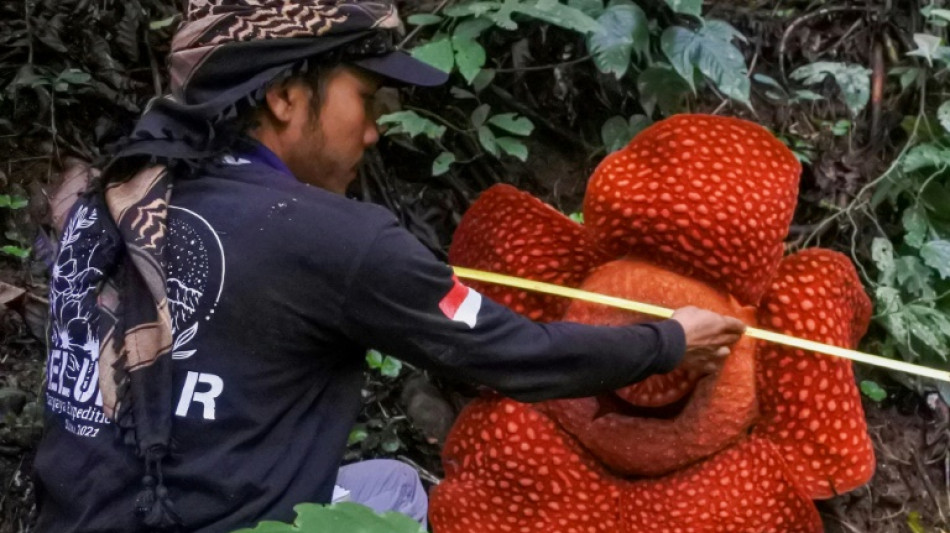
Most species of 'world's largest flower' risk extinction: study / Photo: © AFP/File

Most species of 'world's largest flower' risk extinction: study

Most species of the famously large Rafflesia flower, which has long captured the imagination with its enormous speckled red petals, are now at risk of extinction, new research warned Wednesday.

Text size:

Rafflesia is actually a parasite, and lives on tropical vines across parts of Southeast Asia, producing blooms that are among the largest in the world.

It is something of an enigma, with its flowers emerging unpredictably, and botanists have had limited success propagating it outside its natural environment.

One species of the flower is currently classed as "critically endangered", according to the International Union for Conservation of Nature.

To better understand the plant and its conservation status, an international group of botanists examined 42 known Rafflesia species and their habitats -- primarily Brunei, Indonesia, Malaysia, the Philippines and Thailand.

Based on the rapid disappearance of its forest habitats, as well as insufficient conservation strategies and protection plans, the plant is at far greater risk than previously known, they said.

"We estimate that 60 percent of Rafflesia species face a severe risk of extinction," the researchers wrote in the study, published Wednesday in the peer-reviewed Plants, People, Planet journal.

Some species risk going extinct before they are even known to science, the study said, urging more research into the unusual plant.

"We urgently need a joined-up, cross-regional approach to save some of the world's most remarkable flowers, most of which are now on the brink of being lost," said Chris Thorogood, deputy director of Oxford University's Botanical Garden and a study author.

The research points out that the plant is believed to grow in fairly limited areas, making it particularly vulnerable to habitat destruction.

It also highlights several bright spots in conservation efforts, including successful propagation at a botanical garden in Indonesia's West Java, and sustainable ecotourism around the plant in West Sumatra.

Last year, nations pledged to protect 30 percent of the world's land and seas by 2030 in a landmark deal to slow the disappearance of species and ecosystems.

Repeated studies have warned that the twin threats of climate change and environmental destruction caused by humans are dramatically reducing biodiversity worldwide.

P.Grant--TFWP