S.African rhino farm, world's largest, bought by NGO / Photo: © AFP/File

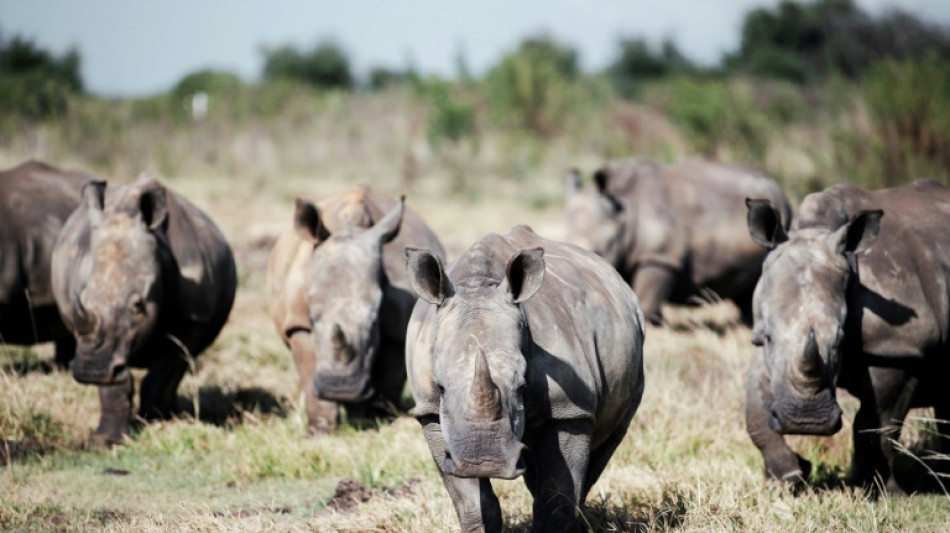
The largest rhino farm in the world, which is home to 2,000 animals and located in South Africa, has been bought by the NGO African Parks, the organisation said Monday.
Home to nearly 80 percent of the world's rhinoceroses, South Africa is a poaching hotspot, driven by demand from Asia, where horns are used in traditional medicine for their supposed therapeutic effect.
The government said 448 of the rare animals were killed across the country last year, only three fewer than in 2021 despite increased protection at national parks such as the renowned Kruger.
"African Parks has stepped in as the new owner of the world's largest private captive rhino breeding operation," the conservation NGO said in the statement.
The NGO will take over the 7,800 hectare "Platinum Rhino" site in the North West province, which it says currently is home to 15 percent of the world's remaining wild population of southern white rhino.
The rhino farm was previously owned by 81-year-old South African conservationist John Hume, who auctioned the property earlier this year.
Although he said he was looking for a "billionaire" to take it over, African Parks said that no offers were received, leaving the rhinos at "serious risk of poaching".
The NGO said it received support from the South Africa government.
Peter Fearnhead, CEO of African Parks, said the NGO had "no intention of being the owner of a captive rhino breeding operation with 2,000 rhino."
"However, we fully recognise the moral imperative of finding a solution for these animals so that they can once again play their integral role in fully functioning ecosystems,” he added, describing the scale of the operation as "simply enormous, and therefore daunting".
"However, it is equally one of the most exciting and globally strategic conservation opportunities," he said in the press statement.
African Parks, which manages 22 protected areas across the continent, says it plans to phase out the breeding programme and return the 2,000 southern white rhino to the wild over the next 10 years.
- Security and surveillance -
The species was hunted to near extinction in the late 19th century but gradually recovered thanks to decades of protection and breeding efforts.
Hume told AFP in an interview before the sale that through the years he had lavished around $150 million on his massive philanthropic project to save the world's second largest land mammal.
Security and surveillance was the farm's biggest cost, the former businessman said.
"I've used all my life savings spending on that population of rhinos for 30 years. And I finally ran out of money," he told AFP in April.
Miles of fences, cameras, heat detectors and an army of rangers patrol the site, which employs about 100 people.
The full extent of the security measures taken and the number of armed rangers on guard are kept secret.
The International Union for Conservation of Nature (IUCN) said the move was a "lifeline thrown to a near-threatened species".
Poachers have increasingly targeted privately-owned reserves in their hunt for horns, which consist mainly of hard keratin, the same substance found in human nails.
They are highly sought after on black markets, where the price per weight rivals that of gold and cocaine at an estimated $60,000 per kilogramme.
Much of the demand for the horns comes from Asia, where they are used in traditional medicine for their supposed therapeutic effect.
D.Johnson--TFWP