'Citizen scientists' battle to save historic UK river / Photo: © AFP

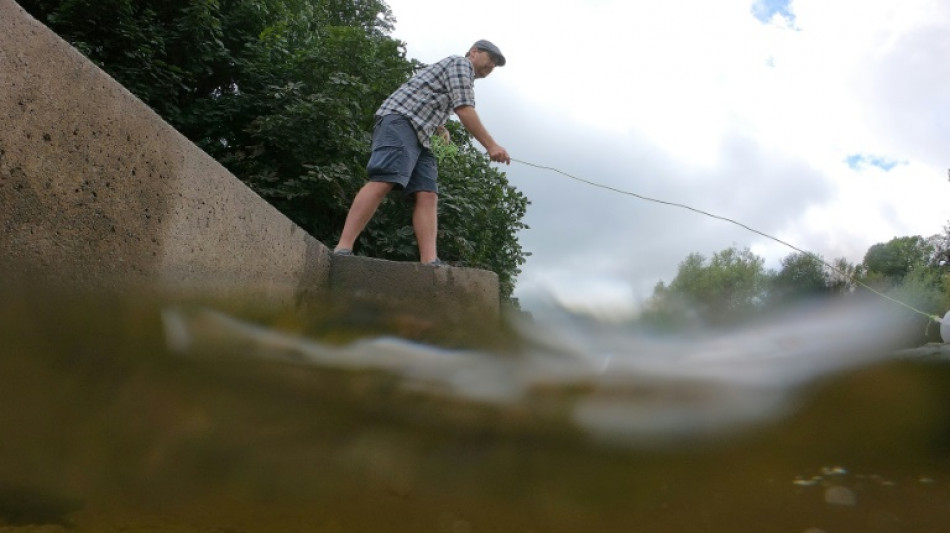
On the banks of the River Wye on the border between England and Wales, Pat Stirling flings a plastic measuring jug tied to a rope into the water.
Up and down the river, a team of 250 others have been doing the same, hoping to save it from an unfolding ecological crisis.
"The river is declining. The next thing is it's partially dead, then it's completely dead," Stirling told AFP between tests.
The researchers say that after years of being ignored, their data has finally forced admissions about a pollution problem caused mostly by chicken manure.
The Wye Valley and its meandering river have notably inspired the Romantic poet William Wordsworth who eulogised it in the 1798 poem "Tintern Abbey".
Stretching 250 kilometres (155 miles) from its source in mid-Wales to the Severn estuary, the Wye cuts through stunning countryside.
But in 2020 signs began to emerge that the river and its rare wildlife were under threat.
People noticed that the usually smooth stones on the floor of the river had become "slimed up", said Stirling, 43, a carbon footprint consultant originally from Australia.
- 'Disgusting stuff' -
Bird and insect life dwindled and anglers noticed that fish were struggling to grow to larger sizes.
Most noticeably, the Water Crowfoot -- an aquatic flowering plant that the river was once thick with -- was disappearing.
First thoughts turned to a nearby sewage treatment plant.
But as nothing had changed in the way the plant operated locals concluded that it was no more polluting than previously.
"You can take a shot of sewage overflow but what you can't take a photo of is the shocking amounts of animal manure coming out of the intensive poultry units," Stirling said.
A study of planning applications on both sides of the border pointed to the vast number of poultry units that had sprung up along the river in recent years.
Campaigners estimate that there are now 20 million farmed birds in the area of the River Wye in over 760 units.
The units supply a chicken processing plant run by Avara Foods in Hereford, which a decade ago won a huge contract to supply UK supermarket giant Tesco.
After one reported pollution incident, Stirling investigated and found "this horrendous smell and this truly disgusting stuff everywhere".
- 'Declining' -
"Something had gone awfully wrong. I took samples and identified that it was coming from a specific farm", he said.
The manure produced by the chicken sheds contains high levels of the essential nutrient phosphorus, excessive amounts of which damage water quality.
The manure is either spread onto farmland and then washed into the river by rain or into the river directly from the ground where it is dropped by free-range chickens.
Wye phosphorus levels were "nearly 60 percent greater than the national average", Lancaster University scientist Paul Wither told MPs last year.
Conservation watchdog Natural England, which advises the government, in May downgraded the water quality rating of the river, following declines in important species like Atlantic salmon and white-clawed crayfish.
Stirling said he believed the updating of the classification to "unfavourable-declining" only happened due to the noise generated by campaigners and "citizen scientists" like him.
He welcomed the body's interest but added: "We also know they would never have done anything if we hadn't (got involved in testing)."
- Positive signs -
If the river is to avoid the two lowest categories -- "part-destroyed" or "destroyed" -- the authorities need to urgently pull the right "levers", he said.
Some of the signs are positive.
In a letter to farmers this month, Avara foods explained that contracts would be changed so their manure could not be sold within the Wye catchment area.
Its aim was to make sure that "our supply chain is demonstrably not part of the problem by 2025", it said.
The firm told AFP that although they would play their part to "mitigate the impact of our supply chain" Avara Foods were not "direct polluters".
"Farms in our supply chain use or sell poultry litter... yet we recognise the potential impact this may have," it added.
Stirling said he believed Avara's new position was linked to a law suit in the United States involving its joint owner, food giant Cargill, and other poultry producers.
A judge in January ruled that the companies were responsible for degrading the Illinois River in a similar way to the pollution of the Wye.
For now Stirling and his team of citizen scientists will carry on testing and feel hopeful they can make a difference.
"What gets measured gets managed and we are seeing that happen. We are getting traction because of the public data noise," he said.
K.Ibarra--TFWP