The Fort Worth Press - Beijing fishmongers worry as Japan begins Fukushima water release

USD -
AED 3.672502
AFN 63.489738
ALL 82.601083
AMD 368.069674
ANG 1.790403
AOA 916.999982
ARS 1461.477901
AUD 1.439242
AWG 1.8
AZN 1.707442
BAM 1.707839
BBD 2.019173
BDT 122.896637
BGN 1.69088
BHD 0.378044
BIF 2989.634336
BMD 1
BND 1.296533
BOB 6.91239
BRL 5.1438
BSD 1.002494
BTN 94.655909
BWP 13.605776
BYN 2.805013
BYR 19600
BZD 2.016285
CAD 1.41819
CDF 2264.999925
CHF 0.81005
CLF 0.023027
CLP 906.270129
CNY 6.774805
CNH 6.78864
COP 3440.13
CRC 454.784115
CUC 1
CUP 26.5
CVE 96.874962
CZK 21.2166
DJF 178.525487
DKK 6.55262
DOP 58.604757
DZD 133.513606
EGP 49.720305
ERN 15
ETB 159.149898
EUR 0.87662
FJD 2.24285
FKP 0.754878
GBP 0.756565
GEL 2.645007
GGP 0.754878
GHS 11.23023
GIP 0.754878
GMD 73.000059
GNF 8784.035073
GTQ 7.628428
GYD 209.275317
HKD 7.84004
HNL 26.669772
HRK 6.604697
HTG 130.960611
HUF 310.455013
IDR 17859
ILS 2.994097
IMP 0.754878
INR 94.73975
IQD 1310
IRR 1375000.000381
ISK 126.239838
JEP 0.754878
JMD 158.408737
JOD 0.709023
JPY 161.384976
KES 129.44972
KGS 87.450289
KHR 4012.500592
KMF 430.99985
KPW 900.00035
KRW 1538.295006
KWD 0.308791
KYD 0.835444
KZT 488.630447
LAK 22049.999765
LBP 89549.999929
LKR 335.219143
LRD 182.197023
LSL 16.472163
LTL 2.95274
LVL 0.60489
LYD 6.427478
MAD 9.349445
MDL 17.629557
MGA 4230.000121
MKD 54.016038
MMK 2099.387374
MNT 3579.000015
MOP 8.095209
MRU 40.069418
MUR 47.960269
MVR 15.460004
MWK 1738.365682
MXN 17.4688
MYR 4.147105
MZN 63.895467
NAD 16.472091
NGN 1367.770085
NIO 36.630381
NOK 9.757702
NPR 151.770486
NZD 1.758045
OMR 0.384498
PAB 1.000358
PEN 3.38498
PGK 4.36375
PHP 61.220126
PKR 278.149683
PLN 3.755796
PYG 6111.57296
QAR 3.64601
RON 4.596799
RSD 102.906043
RUB 74.598078
RWF 1464.5
SAR 3.753691
SBD 8.065041
SCR 14.054599
SDG 600.515223
SEK 9.67836
SGD 1.29557
SHP 0.746601
SLE 24.74991
SLL 20969.503664
SOS 572.921224
SRD 37.430503
STD 20697.981008
STN 21.6
SVC 8.771861
SYP 110.532098
SZL 16.409714
THB 33.151497
TJS 9.278635
TMT 3.51
TND 2.911498
TOP 2.40776
TRY 46.479915
TTD 6.798512
TWD 31.647032
TZS 2625.231946
UAH 45.088297
UGX 3651.795772
UYU 40.002096
UZS 11994.999906
VES 616.865275
VND 26327.5
VUV 118.758526
WST 2.756325
XAF 574.021212
XAG 0.016093
XAU 0.000243
XCD 2.70255
XCG 1.80679
XDR 0.713895
XOF 574.016189
XPF 104.850375
YER 238.649519
ZAR 16.490032
ZMK 9001.197648
ZMW 17.769494
ZWL 321.999592
  • RBGPF

    -0.2700

    60.34

    -0.45%

  • CMSC

    -0.2100

    22.16

    -0.95%

  • BCC

    -2.1200

    72.54

    -2.92%

  • BTI

    -0.0100

    58.9

    -0.02%

  • BCE

    -0.6300

    22.65

    -2.78%

  • GSK

    0.0700

    50.74

    +0.14%

  • BP

    0.6800

    39.78

    +1.71%

  • RIO

    -0.7200

    99.36

    -0.72%

  • NGG

    1.5300

    80.97

    +1.89%

  • AZN

    1.5000

    176.43

    +0.85%

  • JRI

    -0.0200

    12.65

    -0.16%

  • RYCEF

    0.2300

    18.63

    +1.23%

  • RELX

    -0.3500

    30.83

    -1.14%

  • VOD

    -0.1800

    14.12

    -1.27%

  • CMSD

    -0.2100

    22.08

    -0.95%

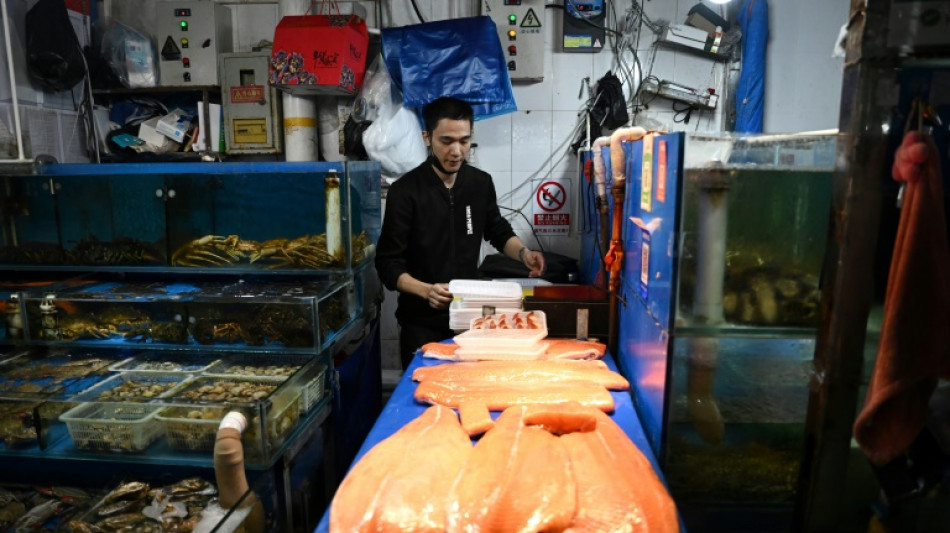
Beijing fishmongers worry as Japan begins Fukushima water release
Beijing fishmongers worry as Japan begins Fukushima water release / Photo: © AFP

Beijing fishmongers worry as Japan begins Fukushima water release

Seafood sellers in Beijing expressed consternation Thursday over Japan's gradual release of wastewater from the disaster-hit Fukushima nuclear plant into the ocean.

Text size:

Hours before the release began, a store manager named Wang Jinglong in one of the Chinese capital's biggest seafood markets told AFP that there had already been a "major impact" on his business, especially tuna sales.

"We used to get some fresh Japanese fish, but due to customs bans we stopped receiving them two months ago," Wang said, referencing the import controls imposed last month.

Wang showed AFP frozen Japanese seafood products that he will be unable to restock once sold -- if customers are still interested.

"There's a large gap in our sales volume compared with before. In the past, such as during the pandemic, we had to kill three to five tuna every week," Wang said.

"Now we kill very few fish, and they are not from Japan, but from Australia, New Zealand and Spain."

The 53-year-old said the quality of these products is "very poor, and not comparable to that of Japan".

But in the face of "great resistance" from the public to Japanese products, he said he has little choice.

"This pollution topic is being closely followed."

The release plan has been endorsed by the International Atomic Energy Agency -- the UN's nuclear watchdog -- which said it meets international standards and "will not cause any harm to the environment".

And the overriding consensus among international experts is that the operation is safe.

But shortly after the discharge of wastewater began on Thursday, China said it would suspend the import of all Japanese aquatic products.

And elsewhere in the Beijing market, workers said the impact of the water release plan had been significant.

Many recently stopped selling all seafood from Japan.

"The plan to release the water is causing trouble for Japan and all other countries," said Huang Xiaohao, the boss of a store advertising imported products.

"If you look around at what we're selling, you'll find that most of these things are actually domestic products," he said.

Pressure has come both from official customs restrictions, others said, as well as from consumers who worry about the impact of Japanese seafood products on their health.

One merchant who declined to be named told AFP that tuna from places other than Japan -- where he usually sourced products -- are simply not as good.

C.Dean--TFWP