Tropical forests nearing critical temperatures thresholds / Photo: © AFP

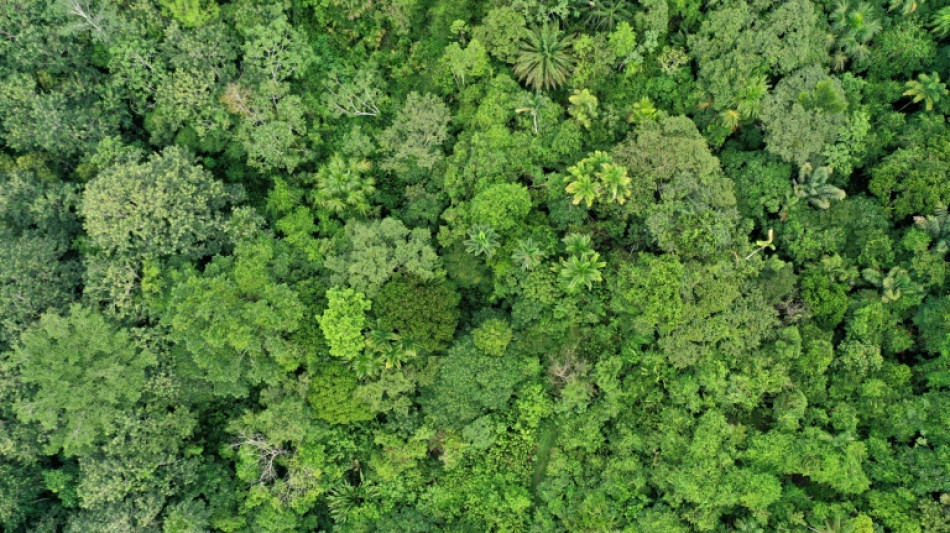
Global warming is driving leafy tropical canopies close to temperatures where they can no longer transform sunlight and CO2 into energy, threatening total collapse if the thermometer keeps climbing, according to a study Thursday.
A tiny percentage of upper canopy leaves have already crossed that threshold, reaching temperatures so high -- above 47 degrees Celsius -- as to prevent photosynthesis, the study published in Nature reported.
Currently, some leaves exceed such critical temperatures only 0.01 percent of the time, but impacts could quickly scale up because leaves warm faster than air, the researchers said.
"You heat the air by two to three degrees and the actual upper temperature of these leaves goes up by eight degrees," lead author Christopher Doughty of Northern Arizona University told journalists.
If tropical forest's average surface temperature warms 4C above current levels -- widely considered a worst-case scenario -- "we're predicting possible total leaf death," he said.
The new research suggests that leaf death could become a new factor in the predicted "tipping point" whereby tropical forests transition due to climate change and deforestation into savannah-like landscapes.
If air temperatures increase unabated by 0.03 C per year, the study projected, mass mortality among the canopies could happen in a little more than a century.
Doughty and his team used data from the NASA ECOSTRESS satellite -- designed to measure plant temperatures -- validated with ground observations, based in part on sensors attached to individual leaves.
- Increased tree death -
There remain uncertainties as to how high leaf temperatures might impact the forest as a whole, the scientists cautioned.
"Believe it or not, we don't know terribly much about why trees die," said co-author Gregory Goldsmith of Chapman University.
It doesn't take a scientist to know that when a tree loses its roots it dies, he said.
But the interactions and feedbacks between heat and drought -- and water and temperature -- on overall tree health aren't as clear.
Total leaf death might not necessarily mean total tree death.
The critical temperature at which leaves turn brown and die might also differ by species, depending on the size and thickness of their leaves and the breadth of their canopy.
But there are already concerning signs. In the Amazon, where temperatures are higher than in other tropical forests, the rate at which trees are dying has increased in recent decades.
"The Amazon is currently experiencing higher levels of mortality than Central Africa and that could possibly be due to the high temperatures we've seen there," said Doughty.
Increased fragmentation of the forests from deforestation has also been shown to make the remaining forest areas warmer.
Tropical biomes contain 45 percent of the Earth's forests, and play an outsized role in absorbing human-caused carbon pollution.
They also harbour half or more of the world's plant biodiversity, with at least 40,000 different tree species, according to the Intergovernmental Panel on Climate Change (IPCC).
The fact that a few leaves are overheating at current temperatures is a "canary in the coal mine," said senior author Joshua Fisher of Chapman University.
"You want to be able to detect something happening before it's widespread," he said.
"The fact that we can do that now gives us that ability to actually do something as a collective society."
Scientists not involved in the study said it should serve as a warning that nature's capacity to adapt to climate change has limits.
"It is true that trees and other kinds of vegetation can soak up emissions and provide cooling," commented Leslie Mabon, a lecturer in environmental systems at The Open University.
"However, this study illustrates that without concerted action by humans to reduce emissions and limit global heating at the same time as protecting and enhancing nature, some functions of nature may start to break down at higher temperatures."
F.Garcia--TFWP