The Fort Worth Press - Key Spanish lagoon dries out due to drought, overexploitation

USD -
AED 3.673104
AFN 64.000368
ALL 81.091764
AMD 369.010403
ANG 1.789884
AOA 918.000367
ARS 1398.000104
AUD 1.3799
AWG 1.8025
AZN 1.70397
BAM 1.662466
BBD 2.013854
BDT 122.689218
BGN 1.668102
BHD 0.377404
BIF 2975
BMD 1
BND 1.267973
BOB 6.9098
BRL 4.914804
BSD 0.999873
BTN 94.420977
BWP 13.425192
BYN 2.825886
BYR 19600
BZD 2.010964
CAD 1.368195
CDF 2315.000362
CHF 0.776504
CLF 0.022628
CLP 890.580396
CNY 6.80075
CNH 6.796155
COP 3749.7
CRC 459.648974
CUC 1
CUP 26.5
CVE 93.718924
CZK 20.630304
DJF 177.720393
DKK 6.34307
DOP 59.467293
DZD 132.257352
EGP 52.72204
ERN 15
ETB 156.137601
EUR 0.848704
FJD 2.183504
FKP 0.734821
GBP 0.733745
GEL 2.680391
GGP 0.734821
GHS 11.264445
GIP 0.734821
GMD 73.000355
GNF 8773.107815
GTQ 7.634866
GYD 209.223551
HKD 7.828495
HNL 26.583478
HRK 6.39504
HTG 130.919848
HUF 300.852504
IDR 17359.5
ILS 2.901304
IMP 0.734821
INR 94.40555
IQD 1309.963492
IRR 1312900.000352
ISK 122.060386
JEP 0.734821
JMD 157.601928
JOD 0.70904
JPY 156.60604
KES 129.150385
KGS 87.420504
KHR 4012.087263
KMF 419.00035
KPW 899.950939
KRW 1462.110383
KWD 0.30769
KYD 0.833358
KZT 462.122307
LAK 21929.626969
LBP 89172.975107
LKR 321.915771
LRD 183.493491
LSL 16.405102
LTL 2.95274
LVL 0.60489
LYD 6.322723
MAD 9.144703
MDL 17.099822
MGA 4176.618078
MKD 52.342393
MMK 2099.606786
MNT 3578.902576
MOP 8.06268
MRU 39.968719
MUR 46.820378
MVR 15.455039
MWK 1733.612706
MXN 17.19605
MYR 3.921039
MZN 63.903729
NAD 16.405102
NGN 1359.450377
NIO 36.794016
NOK 9.20185
NPR 151.087386
NZD 1.67685
OMR 0.384491
PAB 0.999962
PEN 3.457057
PGK 4.415452
PHP 60.502504
PKR 278.66746
PLN 3.593895
PYG 6107.687731
QAR 3.654753
RON 4.430373
RSD 99.623038
RUB 74.203474
RWF 1465.941884
SAR 3.782036
SBD 8.032258
SCR 14.001038
SDG 600.503676
SEK 9.21914
SGD 1.26673
SHP 0.746601
SLE 24.603667
SLL 20969.496166
SOS 571.467429
SRD 37.399038
STD 20697.981008
STN 20.823594
SVC 8.749309
SYP 110.543945
SZL 16.394307
THB 32.207038
TJS 9.329718
TMT 3.51
TND 2.904513
TOP 2.40776
TRY 45.361304
TTD 6.776593
TWD 31.351504
TZS 2598.394038
UAH 43.92104
UGX 3746.547108
UYU 39.879308
UZS 12128.681314
VES 496.20906
VND 26308
VUV 118.026144
WST 2.704092
XAF 557.575577
XAG 0.012388
XAU 0.000212
XCD 2.70255
XCG 1.802048
XDR 0.695511
XOF 557.525817
XPF 101.364158
YER 238.603589
ZAR 16.38082
ZMK 9001.203584
ZMW 19.037864
ZWL 321.999592
  • CMSD

    0.1140

    23.534

    +0.48%

  • CMSC

    0.1400

    23.11

    +0.61%

  • BCE

    -0.4300

    24.14

    -1.78%

  • BCC

    -2.0900

    70.67

    -2.96%

  • NGG

    0.9800

    86.89

    +1.13%

  • RBGPF

    0.0000

    63.18

    0%

  • JRI

    0.0000

    13.15

    0%

  • RIO

    2.2700

    105.38

    +2.15%

  • RYCEF

    -1.0800

    16.37

    -6.6%

  • RELX

    0.0759

    33.58

    +0.23%

  • VOD

    0.5100

    16.2

    +3.15%

  • BP

    -0.4700

    43.34

    -1.08%

  • GSK

    -0.0900

    50.41

    -0.18%

  • AZN

    0.3300

    182.85

    +0.18%

  • BTI

    0.2000

    58.28

    +0.34%

Key Spanish lagoon dries out due to drought, overexploitation
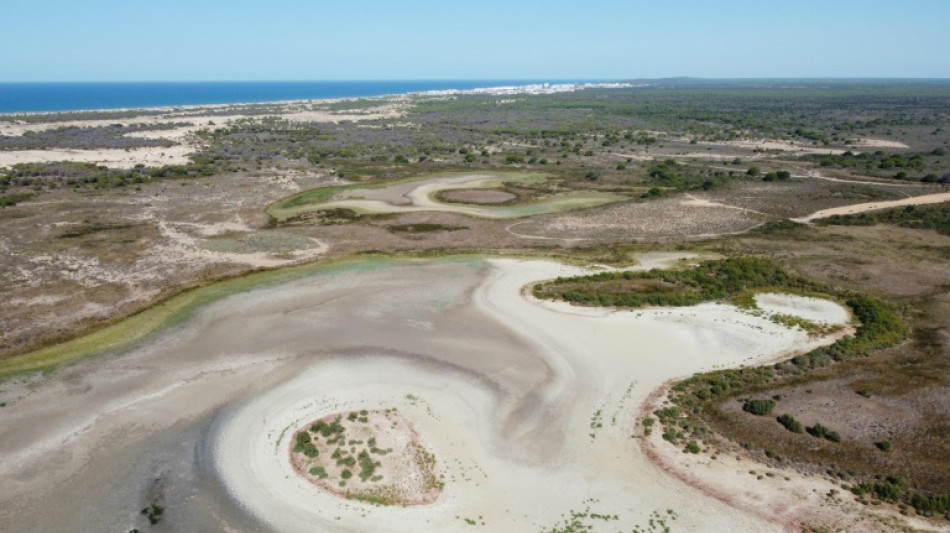
Key Spanish lagoon dries out due to drought, overexploitation / Photo: © Spanish National Research Council (CSIC)/AFP

Key Spanish lagoon dries out due to drought, overexploitation

The largest permanent lagoon in drought-hit southern Spain's Donana natural park, home of one of Europe's largest wetlands, has completely dried out for the second summer in a row.

Text size:

A huge patch of cracked white earth has replaced the waters of the Santa Olalla lagoon, which usually houses abundant aquatic life and huge colonies of migrating birds.

The lagoon -- which once covered around 45 hectares (110 acres) -- has been shrinking in recent years but this is the first time that it has dried out for two consecutive years, according to the Spanish National Research Council (CSIC).

Scientists blame the lagoon's disappearance on a prolonged drought combined with the overexploitation of aquifers for farming and tourism.

"Recent years have been very dry, which is not rare for a Mediterranean climate," Carmen Diaz Paniagua, a researcher at the Donana Biological Station, told AFP.

Most lagoons in the reserve are temporary, filling with rainwater in winter and then drying out in the summer but a few contain water year-round, providing an important refuge for animal life.

"The real problem is the mismanagement of the aquifers. We don't even know how much water is being extracted because there are many illegal wells," she added.

The Donana national park is surrounded by a sea of greenhouses and the Matalascanas resort town is located less than a kilometre from the northernmost lagoons of the reserve.

"This is not a natural thing happening only because of climate change. It can be reversed, if we can reduce the water extractions the lagoon could resist," said Diaz Paniaga.

Water use restrictions are in place on other parts of Spain but that is not the case in towns near Donana where beaches still operate showers, she added.

The Dona reserve boasts marshlands, scrub woodland and beaches and is home to deer, badgers and endangered species including the Spanish imperial eagle and the Iberian lynx.

But at the Santa Olalla lagoon where wild horses once drank water surrounded by storks and flamingos, they now graze alone on the few tufts of grass they find growing from the cracked earth.

Despite warnings from UNESCO and the European Commission, the conservative regional government of Andalusia where Donana is located is pushing to extend irrigation rights near the park.

A draft law currently making its way through the regional parliament would regularise hundreds of hectares of berry farmland currently irrigated by illegal wells.

Defenders of the proposal argue it will aid those who unfairly missed out during a previous regularisation of farms in the area put in place in 2014 under a Socialist government.

"The water management policy is really not conducive to the conservation of Donana's lagoons," said Diaz Paniagua.

F.Garcia--TFWP