Relief and despair: repeal of logging ban divides Kenya / Photo: © AFP

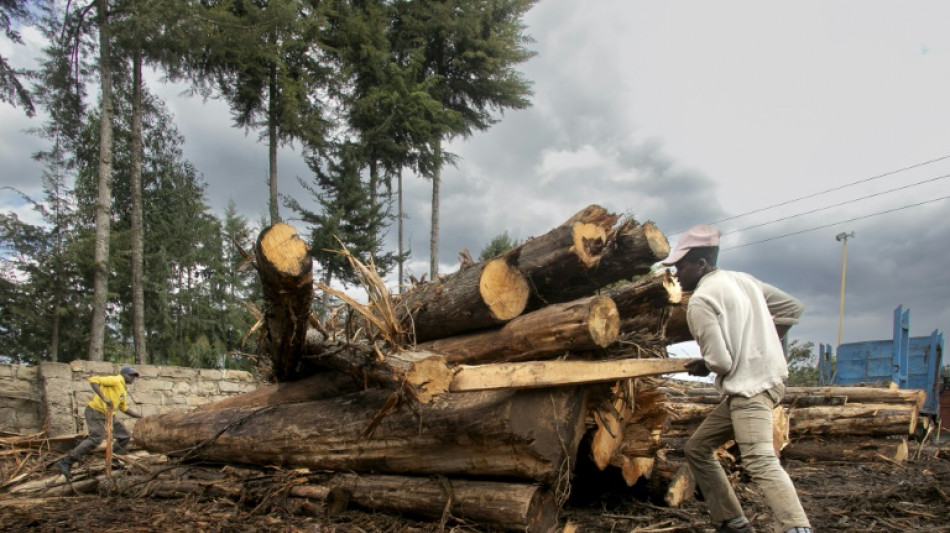
It was the news Kenya's timber industry had waited over five years to hear: a ban on logging was over, and the country's forests were once again open for business.
But conservationists were dismayed at the announcement in July by President William Ruto, who had cast himself as a champion of the environment, and made planting 15 billion trees a centrepiece of his climate change agenda.
The government defended lifting the ban, insisting that only mature trees in state-run plantations would be felled, and that Kenya's most biodiverse and carbon-rich wild forests would remain untouched.
The explanation did little to quash charges of hypocrisy, with Ruto just weeks away from hosting a international climate conference in Nairobi.
"Kenya has been a clear leader here, investing in clean green growth and raising forest cover. Now the country is busy clearing its forests while at the same time hosting climate change negotiations," said opposition leader Raila Odinga.
- 'Ruto to the rescue' -
Ruto, who was deputy president when the ban was introduced in 2018, said it was "foolishness" to let trees rot while businesses were importing timber.
The temptation to assist a sector that employs 50,000 people directly -- and 300,000 indirectly -- would have been strong at a time when anti-government demonstrators are protesting rising prices.
In Molo, a highland town northwest of Nairobi, sawmill owner Bernard Gitau said Ruto had "come to the rescue" after he was forced to lay off workers and curb output because of the ban.
His factory is still only half operational, with machinery laying idle and coated in sawdust.
But a skeleton crew of 50 has been sanding doors and planing lumber as he waits for business to rebound.
"Some of them came and were praying outside my gate there, saying we thank God now that this sawmill has come back to life," said Gitau, who is also chairman of the Timber Manufacturers Association of Kenya, an industry group.
"The economy of this town is going to improve."
The ban was introduced at a time when Kenya's forests were being cleared at a rate of 5,000 hectares a year, depleting water supply in the drought-prone country, and contributing to global warming.
Forests have slowly started recovering since the ban took effect but, without it in place, questions are being asked about how Ruto can more than double the nation's tree cover by 2032 as he's promised.
"This time you're talking about planting, tomorrow you're talking about cutting. It does not add up," said Godfrey Kamau, chair of the Thogoto Forest Family, a conservation group protecting 53 hectares of native forest outside Nairobi.
Environmentalists won a reprieve on August 1, when a court temporarily barred the government from issuing logging licences until a legal challenge is fully heard.
- 'Rampant corruption' -
The move has also revived scrutiny of the Kenya Forest Service (KFS), the state agency tasked with policing the scheme and allocating logging permits.
KFS said the process would be transparent, and replanting carried out in cleared areas.
But critics say the KFS has not undertaken adequate reforms since being accused of "rampant corruption" as well as the "wanton destruction" and "plunder and pillaging" of forests by a government taskforce in 2018.
Sawmill owner Gitau said concerns over native forests being logged were misplaced.
The timber industry was only interested in the fast-growing trees introduced during British colonial rule like pine and eucalyptus, he said, not indigenous species found in protected forests.
"We know the law," he said. "It is prohibited."
But in the nearby Mau Forest, a vast mountain ecosystem and crucial water source, Environment Minister Soipan Tuya said trees were being illegally cleared just days after the ban was lifted.
She ordered additional KFS rangers to Mau and other threatened hotspots as part of a "ruthless" campaign to stamp out illegal logging.
"People who imagine that our forests are available for encroachment should forget it," she said.
The mixed messages from the government undermine community efforts to discourage logging, said Kamau, whose organisation works with locals to protect Thogoto Forest.
"The president stood and said that logging has been allowed... The common wananchi (people) will decide now it's time to start cutting a tree," he told AFP in Thogoto, which is hemmed in by hundreds of acres of plantation forest.
He lamented the focus on replanting and extracting timber rather than indigenous trees that attract wildlife, store carbon and support nature for generations to come.
"It feels like you have been doing zero work at the end of a day."
A.Maldonado--TFWP