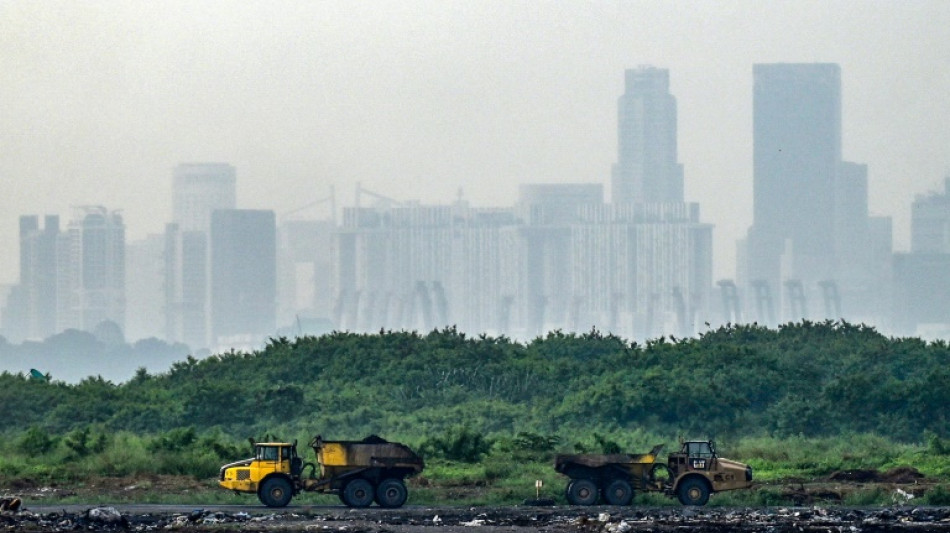
Singapore races to save 'Garbage of Eden' / Photo: © AFP

Visitors to the island hosting Singapore's only landfill might expect foul odours and swarms of flies, but instead they are greeted with stunning views of blue waters, lush greenery and wildlife.
Welcome to Pulau Semakau, the land-scarce city's eco-friendly trash island, where ash from the incinerated garbage of its nearly six million people is dumped.
With just over a decade to go until the site is projected to be filled, the government is in a race against time to extend the lifespan of the island landfill, so serene it has earned the moniker "Garbage of Eden".
"This is the only landfill in Singapore, and due to the small area and the competing land needs, it is difficult to find another location," Desmond Lee, the landfill manager at the National Environment Agency (NEA), which oversees the island, tells AFP.
"It is imperative that we continue to use the Semakau landfill for as long as possible, and if possible extend its life beyond 2035," he says.
- 'Massive waste -
Singapore generated 7.4 million tonnes of waste last year, of which about 4.2 million tonnes, or 57 percent, was recycled.
Plastics remain a sticking point for the island’s waste drive, with just 6 percent recycled last year. Food waste, of which 18 percent was recycled, also poses a problem.
Environmental group Greenpeace criticised the city-state for producing a "massive" amount of waste for its size.
In 2019, the government launched a "zero-waste" campaign seeking to boost the amount of recycled waste to 70 percent and slash the amount of trash dumped at Semakau by 30 percent before the end of the decade.
Roughly the size of New York City, Singapore has carefully managed its rapid growth in recent decades to avoid the problems faced by other fast-developing Asian metropolises, such as overcrowding and undisposed garbage.
The government built the offshore landfill after an inland waste depot began running out of space in the early 1990s.
Engineers merged Semakau -- whose residents had earlier been resettled to the mainland -- with the nearby island of Pulau Sakeng.
A seven-kilometre (four-mile) perimeter bund was constructed to enclose part of the open sea between the two islands and create space for the landfill, which began operating in 1999.
- Pollution risks -
With Singapore’s population growing steadily, authorities were forced to roll out bold, space-saving solutions.
Incinerators were deployed to burn non-recyclable waste, before authorities shipped the ash to Semakau on a covered barge.
But the practice of burning the rubbish has been criticised by environmental groups for its pollution.
"The process results in pollution in each of its phases -- from waste hauling to managing air emissions and residues," Abigail Aguilar, Greenpeace's anti-plastics campaigner for Southeast Asia, told AFP.
"While aesthetically it might be appealing, the landfill still contains waste that could potentially leak," said Aguilar.
The NEA has said its incineration plants are fitted with treatment systems that clean the gas before they are released into the atmosphere.
It added that the landfill had been lined with an impermeable membrane and marine clay to contain any potential pollution within the site, and the water is tested regularly for leakage.
- Eco island -
There could still be more use for Singapore's garbage island, with plans to build solar farms and also to turn ash from the landfill into road construction materials.
After the barge docks on Semakau, earthmovers scoop the ash and load them onto giant yellow tipper trucks for the trip to the landfill, which has been subdivided into sections.
As each pit is progressively filled up over the years, the area is covered with soil, allowing for the growth of natural vegetation.
Mangrove forests have also been planted, making the island verdant and attracting wildlife.
During a recent visit by an AFP team, a couple of brahminy kites were seen swooping down on the water to catch fish, while a white-bellied sea eagle circled above.
Red-wattled lapwings made bird calls on the edge of a mangrove patch and little terns manoeuvred above a filled-up pit.
A family of grebes swam on a pond, its dike lined with coconut trees.
D.Johnson--TFWP