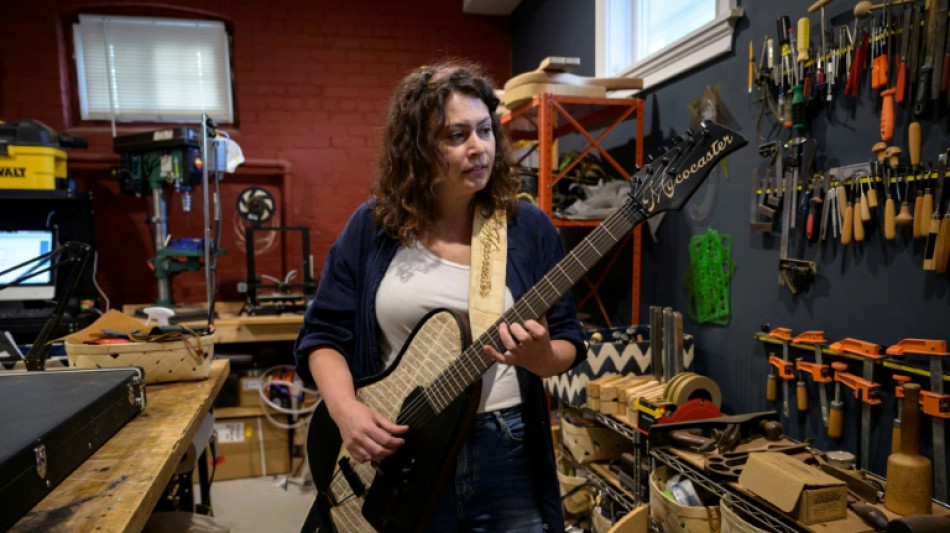
Meet the French luthier making music out of mushrooms / Photo: © AFP

Leave mushroom spores in a mold for a couple weeks and they'll bloom into a puffy material akin to brie, says Rachel Rosenkrantz, a sustainability-minded guitar-maker innovating with biomaterials.
Once her mycelium, the root-like structure of fungus that produces mushrooms, mimics the rind of a soft-ripened cheese Rosenkrantz dehydrates it into a lightweight, biodegradable building material -- in this case, the body of a guitar.
The musician trained as an industrial designer embarked on her career as a luthier -- maker of string instruments -- about a decade ago, and over the past several years has integrated mycelium and other biomaterials in her quest to create more environmentally friendly, plastic-free instruments.
Rosenkrantz chuckles as she delivers her brie analogy that's also a nod to her French roots; the designer was raised in Montfermeil, an eastern suburb of Paris, and now resides near Providence where she teaches at the prestigious Rhode Island School of Design.
The basement atelier below her sunny apartment full of plants and books is home to her craft and doubles as a science lab, where she's growing materials like kombucha leather to make banjo heads, and using fish leather to make pickguards.
"In the design world, everybody's working with biomaterial, it's exponential," the 42-year-old told AFP from her workshop.
"It's not, like, a hippie solution anymore," she continued, pointing to BMW which has used flax fiber in dashboard construction, or Hermes, which has used mushroom-derived leather in their purse linings.
"It's not a pie in the sky like just five years ago. It's actually very tangible."
- 'Potential' -
Traditionally luthiers construct guitars with woods including cedar, rosewood, mahogany and ebony, depending on the tonal qualities sought.
Wood of course is also biodegradable, but issues including overforesting have led makers like Rosenkrantz toward more sustainable options, reclaiming wood and sourcing from local woods.
"Do we really need to use the same species as 400 years ago, because who really plays music like 400 years ago? A few students at Juilliard," she said, referring to the elite Manhattan conservatory.
"This is an industry where I feel because it's craft-based, there's a lot of 'how things are supposed to be,'" she continued, adding that woods like poplar or bamboo were long ignored but could offer new opportunities.
"What if it's frankensteining parts of guitars that are still good, so we don't discard the whole instruments?" Rosenkrantz said.
"We have to keep our eyes peeled and see the potential in different things."
- 'Mushroom sound' -
Cue mycelium, the fungal network that lies beneath the fruit we know as mushrooms.
It's easy to grow, easy to mold and easy to replace even if it begins to disintegrate, and can be made into both acoustic and electric instruments.
And sound-wise? Rosenkrantz's mushroom guitar is layered and fine-tuned, and doesn't sound just like a traditional guitar.
It's a bit nasal -- but rife with possibility.
"The idea came about when I was looking at packaging, since mushroom has been used to replace polystyrene" which "is known to be a good sound conductor, because it's full of air," she said.
The designer found that her mycelium also conducted sound -- "but it has a different timbre. So it doesn't sound like something else before."
"It's just a new sound," she continued. "It won't replace cedar because it's not cedar."
She's found the mushroom materials generally work best with electric formats: "There's a regular pickup, so it sounds like a normal electric guitar, and there's also another microphone that's in the mushroom."
"So then you can switch how much mushroom sound you want."
- 'Help the cause' -
Some of Rosenkrantz's custom-made guitars are made completely out of wood, and others integrate the more experimental biomaterials.
Given the time it takes to make a unique guitar from scratch, her instruments start at about $6,000.
But when it comes to the mushroom-based prototype, "my dream is for a big company to say, 'Let's produce it, 50 bucks, every kid can have one," Rosenkrantz said.
"Some students cannot afford an instrument... what if that could be a solution? Hello Fender, if you hear that," she said with a smile.
Much of Rosenkrantz's work is driven by curiosity: she keeps bees, and trained them to build an art piece of a guitar by providing them the instrument's bracing -- the part "that guides the sound and give some stiffness to the instrument."
The bracing mimics the top bars of a hive, and "the bees communicate through the comb at 309 hertz, which is in the guitar range," she explained. "So we're gonna make a honeycomb that is a natural sound diffuser."
And it worked: the bees built their comb along her structure, ate their honey over the winter, and left Rosenkrantz with a cleaned-out guitar that resonated.
The project was less about future use and more about "the poetry of it," she said, another test to find biomaterials with acoustic qualities.
It's exploration she hopes can help build a more sustainable future: "I'm experimenting to help the cause in some way."
T.Harrison--TFWP