Israel enlists drones, AI and big data to farm for the future / Photo: © AFP

As climate change and global population growth pose ever greater challenges for agriculture, Israeli technology offers a wealth of inventions and advanced tools to help farmers adapt.
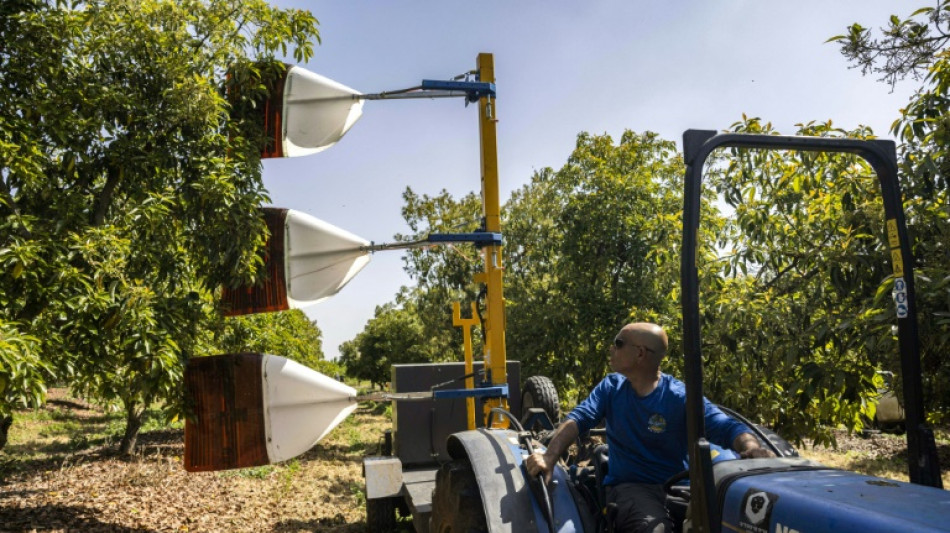
At an avocado orchard in a kibbutz in central Israel, a tractor slowly pulls a device through the trees.
Flag-sized attachments that evoke canoe paddles on the mobile platform gently stroke the plants to draw the pollen using an electrostatic charge, then let them rub off on the next row of trees.
Such artificial pollination can help boost crop yields to feed the world's growing population, said Thai Sade, founder and CEO of Israeli company BloomX.
The firm uses algorithms to predict the optimal time to maximise the efficacy of pollination.
"Our pollination is an attempt to deal with many of the problems we have today, which we expect to worsen in the future," said Sade, noting the shortage of pollinating insects and the risks global warming poses to them.
"It's much more expensive to plant a new orchard than to make better use of an existing one," he said.
Ofri Yongrman Sela, who oversees avocado, wheat and persimmon production at the Eyal kibbutz, said that of all the unknowns in his line of work, pollination is the most difficult to manage.
Avocado trees rely on honey bees for pollination, he said, but "we don't really know if they'll come or not, and when".
Using BloomX's technology alongside the bees has raised yields by up to 40 percent, he said.
- Farming robots -
Standing amid the avocado trees, Yongrman Sela noted the rapid changes his sector has undergone in the decade since he began work as a farmer.
Agriculture is now supported by sensors that measure soil parameters, drones and big data, he said, adding that "technology has entered every corner".
A recent report by Start-Up Nation Central, a non-governmental organisation that promotes Israeli technology, listed more than 500 agri-tech companies in Israel.
Shmuel Friedman, whose Green Wadi company provides agricultural consultancy to countries in Africa, Asia and the Gulf, said there was demand for Israeli technology and expertise.
"We have a good reputation in agriculture," said Friedman, a former agriculture ministry official.
While younger generations in Israel no longer share their predecessors' farming ambitions, the country's agricultural experience wed with its innovative and powerful tech sector yield "many agriculture technologies" that can support farmers into the future, he said.
One of the biggest challenges facing agriculture, according to Friedman, is a lack of people willing to work in the field.
"It's harder and harder to find manpower, especially in developed countries," he said.
"You need alternatives, whether in the form of robots or machines that can replace working hands."
- Fruit-picking drones -
Yanir Maor reached the same conclusion more than a decade ago, watching a television programme featuring 20 Israelis who were tasked with picking fruit along with the show's host.
"At the end of the day, he remained alone," said Maor, who proceeded to found and head Tevel, a company that uses drones to pick fruit from trees.
"There are not enough people," he said. "And, looking forward, it's clear there will be even fewer.
"At the same time, crops will increase -- there will be more people and more consumption. The gap is growing, and that's where robotics enter."
Tevel's system entails eight drones connected to a platform utilising AI and machine vision to analyse images of the fruit fed by their cameras.
This helps determine not only which fruit is ripe and ready to be picked, but also sugar content and any diseases.
The drones use suction to gently pull the fruit off the branch and place it in a bin, with humans needed mainly to oversee their operation, Maor noted.
The technology is in use in Israel, the United States, Italy and Chile and works on moreo than 40 different types of apples, peaches, nectarines, plums, apricots and pears, Maor said.
"The system is completely autonomous, from the decision on whether to pick the fruit and its colour and how to reach it and detach it," he said from the company's headquarters in central Israel.
Yongrman Sela, the farmer, said the potential of technologies boosting his "primitive" field of work is unfathomable.
"The feeling is that we're just at the beginning."
S.Palmer--TFWP