'Nowhere to run': Islands stress climate risk at finance summit / Photo: © AFP/File

Small island states sinking under rising seas are encouraged by a summit starting Thursday charged with revamping the global financial system to better cope with climate change and other 21st-century challenges, their representative to the talks told AFP.
The two-day summit in Paris, hosted by France, "is very good news because it fits well with what we are trying to do", Samoa's Fatumanava Pa'olelei Luteru, chair of the Alliance of Small Island States (AOSIS), told AFP in an interview.
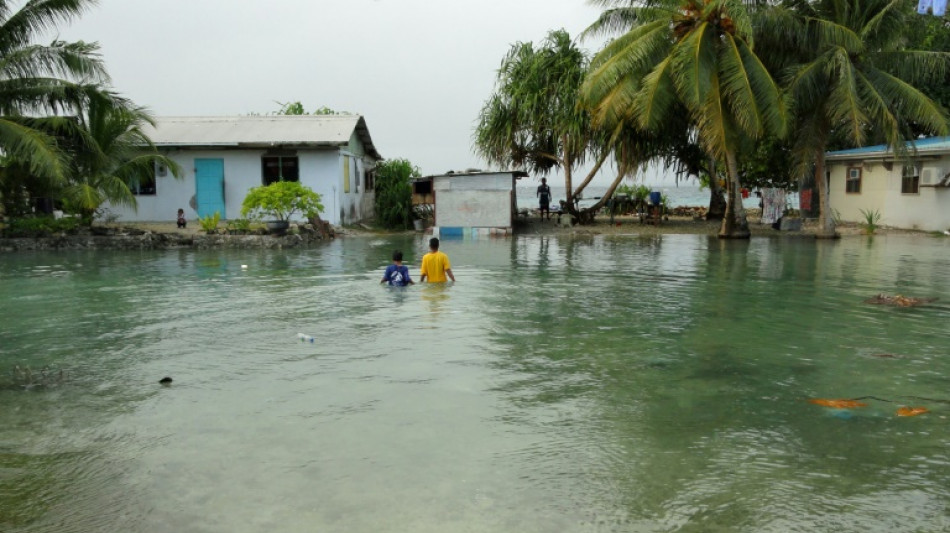
Sea levels sure to rise well into the 22nd century and cyclones made more deadly by global warming have put AOSIS' 39 low-lying island and coastal states on the front lines of climate impacts and UN talks.
Lacking political clout, they used moral persuasion in pushing the world to adopt the 2015 Paris Agreement's aspirational target of capping global warming at 1.5 degrees Celsius, since adopted as a near universal goal.
Today, these and other developing countries that have barely contributed to the problem -- but whose economies are shrinking as a result -- want access to international financial support to be based not just on economic criteria, but also on vulnerability.
"If a cyclone comes, it doesn't differentiate, it doesn't know if you're low-income, middle-income country or even a high-income country," said Luteru.
"It will set back your development years," he added. "That's especially true for atoll countries, they've got nowhere to run."
Concretely, AOSIS is calling for use of a multidimensional vulnerability index (MVI), and not just economic growth, within the workings of global finance.
"It's a tool," Luteru said. "We're not saying it should or will replace gross national income (GNI)," another standard measure of a country's ability to produce and earn. "It's a complement."
- All possibilities -
One of the measures on the table at the summit will be an international tax on carbon emissions from the shipping sector. A consensus in Paris could shape the outcome of a critical meeting in two weeks of the International Maritime Organisation (IMO).
"We should look at all the possibilities," Luteru said.
"For our small island developing states, shipping is critical in terms of both exports and imports as well, so we will need to look at that very carefully."
Beyond the financial issues, AOSIS's central goal has been the rapid reduction of greenhouse gas emissions, which remain at or near record levels.
Luteru points a finger both at advanced and major emerging economies -- the world's biggest carbon polluters: China, the United States, Saudi Arabia, the European Union, Brazil, and others.
"That's where we can make a huge difference," he said. "Eighty percent of global emissions come from G20 nations."
According to the UN's climate science advisory panel (IPCC), sea levels rose by between 15 and 25cm (six to 10 inches) from 1900 to 2018, and are set to rise by a further 43cm by 2100 in a world that warms by 2C.
The next major international climate conference, COP28, will take place in Dubai in December.
The incoming COP president Sultan Al Jaber, has come under fire because he is also head of United Arab Emirates national oil company ADNOC, with many green groups and some western legislators saying his role as a fossil fuel executive is a conflict of interest.
But the bloc of island states -- some of which support a fossil fuel non-proliferation treaty -- see this as an opportunity.
"Sometimes it's not about engaging only with those who share your perspective," said Luteru.
D.Johnson--TFWP