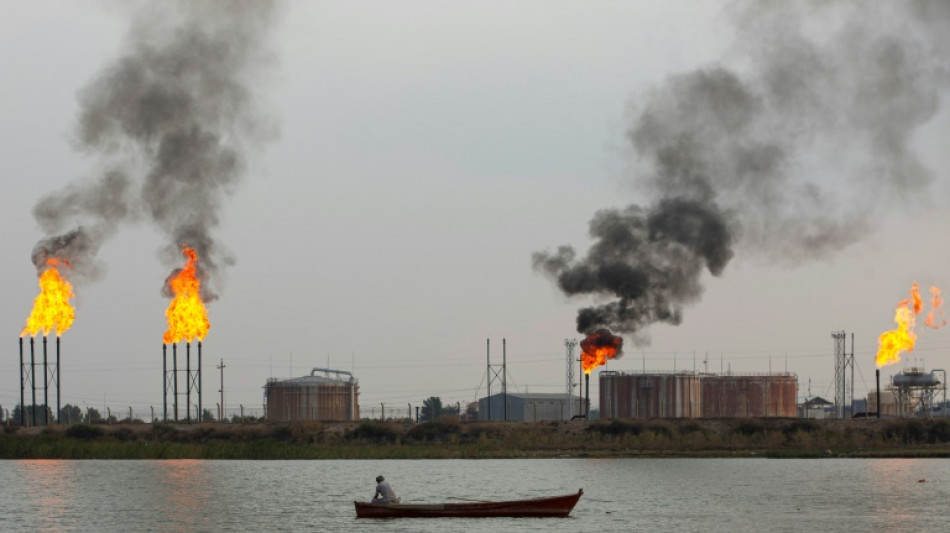
Long road ahead for Iraq pledge to phase out gas flares

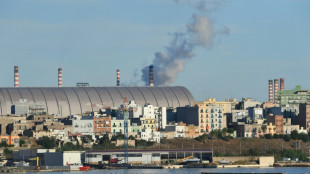
In the oilfields of southern Iraq, billions of cubic feet of gas literally go up in smoke, burnt off on flare stacks for want of the infrastructure to capture and process it.
The flares produce vast amounts of carbon dioxide and other greenhouse gases, contributing to global warming without any economic or social benefit.
Analysts say the waste is particularly egregious, as Iraq is a significant importer of natural gas, meeting a third of its needs through expensive and not always reliable supplies from neighbouring Iran.
The government has pledged to phase out the practice by 2030 but the road to a greener, less wasteful energy sector is proving a long one.
For the oil companies exploiting the mega fields around Basra, it is actually cheaper to flare off the associated gas than to capture, process and market it, despite the obvious environmental costs.
Currently, only half of the three million cubic feet of gas that comes out of Iraqi oil wells each day is captured and processed.
The rest is burnt off in flares creating the plumes of acrid black smoke that blight the skies.
"Flared gas, if captured and processed, could provide electricity to three million homes," said Yesar al-Maleki, Gulf analyst at Middle East Economic Survey.
"This could definitely help the country end its acute power shortages that go up all the way to a supply and demand gap of nine gigawatts in summer."
- 'Up in smoke' -
In December, Iraq's oil minister Ihsan Ismail pledged to cut flare gas by 90 percent by 2024.
But despite contracts with foreign oil majors, including France's TotalEnergies, the target is likely to face bureaucratic obstacles in a sector which provides 90 percent of government revenues.
Over the past two years, the government has cut flare gas by just five percent.
The captured gas is fuel that Iraq desperately needs for its power stations.
Under an exemption from US sanctions on Iran, Iraq imports 750 million cubic feet per day from its eastern neighbour.
Any disruption to that supply can lead to widespread power cuts, particularly in summer when the demand for air conditioning and refrigeration peaks.
Maleki said the failure to address the issue bore multiple costs for Iraq.
"It loses financially by burning money in the air; it loses more money by importing gas from neighbouring countries at a premium; it loses more money resolving resultant issues in its power sector when it switches its gas turbines to costly and pollutive liquid fuels; and it definitely loses environmentally."
Basra province is home to Iraq's five largest oilfields and accounts for 65 percent of its flared gas, according to World Bank figures.
The Basrah Gas Company, a consortium of Iraq's state-owned South Gas Company, Shell and Mitsubishi, captures one billion cubic feet of gas from the three fields in which it operates.
It plans to raise that figure to 1.4 billion cubic feet by the end of 2023 but doing so requires heavy investment, in processing as well as capture.
Managing director Malcolm Mayes said the consortium was investing around $1.5 billion in a giant new processing facility in Artawi, outside Basra.
"In Artawi, we are building two processing trains," Mayes said.
"The first will be on stream in May 2023 and the second will come on stream in November 2023, and at that point we will have the capacity to process 1.4 billion cubic feet -- approaching 90 percent from our lease area."
- 'Cleaner electricity' -
Iraq has also signed a mega-contract with TotalEnergies that includes building a processing facility for the associated gas from three southern oilfeilds.
"The plant's launch is scheduled for 2026," the French firm said.
Iraq says the plant will process 300 million cubic feet a day of gas that is currently flared off, rising to 600 million in a second phase.
Teams from TotalEnergies are already on the ground carrying out preliminary studies, but the process is dragging on.
Last month, Baghdad said some clauses of the contract "require time and cannot be implemented or solved in a short period".
A similar project awarded to Chinese firms in neighbouring Maysan province is only half finished.
In the meantime, Basra's residents continue to live with the environmental consequences.
"Everything is polluted by these flares -- the water, the animals, they're all dead," said Salem, an 18-year-old shepherd in the village of Nahr Bin Omar, site of a major oilfield just north of Basra.
W.Matthews--TFWP