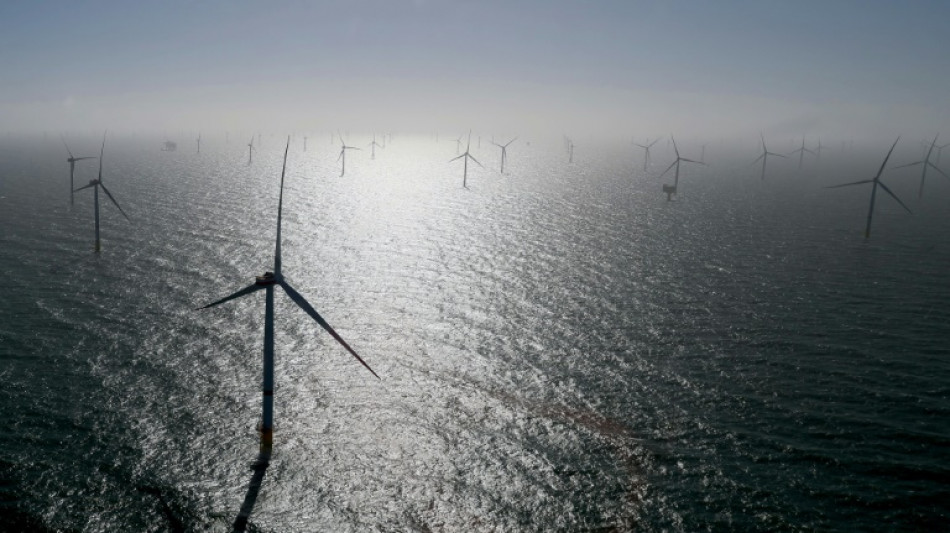
European leaders vow to boost North Sea wind energy production / Photo: © POOL/AFP

Nine European countries pledged at a summit Monday to massively scale up wind power generation in the North Sea to further climate goals and durably move further away from dependency on Russian fossil fuel supplies.
EU members France, Germany, Ireland, Denmark, the Netherlands and Luxembourg, along with Britain and Norway, signed on to the ambition, set out in a declaration during a summit in Belgium's coastal town of Ostend.
At the same time, leaders underscored the need to defend the existing and future offshore infrastructure, following recent reports of a Russian spy vessel in the North Sea and last year's sabotage of the Nord Stream gas pipelines in the Baltic Sea.
The collective goal is to boost offshore wind power generation to 120 gigawatts by 2030 -- from just 30 GW today -- and at least 300 GW by 2050.
That will go to help meet Europe's drive for a carbon-neutral future and in response to energy "blackmail" from Russia as it pursues its war in Ukraine, they said.
"Because of Russia's brutal war on Ukraine, it has made it absolutely clear that we need to produce more energy ourselves," said Danish Prime Minister Mette Frederiksen.
The European Union has calculated that installing enough offshore wind turbines to reach that capacity in 2050 will cost 800 billion euros ($900 billion).
"We will take all relevant and appropriate steps to accelerate regulatory and permitting processes for renewable energy and the related grid infrastructure," the leaders said.
The ambition was to make the North Sea "the biggest green power plant in the world," Belgian Prime Minister Alexander De Croo said in a news conference flanked by the other leaders.
- European self-reliance -
French President Emmanuel Macron, backed by the prime ministers of the Netherlands and Luxembourg, insisted that the expertise and equipment to be ploughed into the project should come from Europe, not elsewhere.
"We want a European industry to make this, and not repeat the errors we've sometimes made over past decades," he said.
The comment was apparently directed at China, which currently dominates the solar panels market and is a leader in supplying wind turbines. The European Union is seeking to shift away from its reliance on China by fostering its own industries.
German Chancellor Olaf Scholz highlighted the role the EU could play as a regional energy provider.
"The energy transport lines are Europe's vital arteries," he said. "We are not only producing energy for ourselves but also for our neighbours."
But it highlighted a lack of "adequate funding mechanisms" and recruitment in the sector.
The organisation said Europe needs to build the offshore infrastructure to add 20 GW in output per year, yet the sector currently has capacity for just seven GW annually, with supply chain bottlenecks for cables, substations and foundations, and in the availability of offshore wind vessels.
Britain has the biggest fleet of offshore wind farms, 45 of them, currently producing 14 GW, with plans to expand capacity to 50 GW by 2030.
Germany's 30 wind farms produce eight GW, followed by the Netherlands with 2.8 GW and Denmark and Belgium both with 2.3 GW.
The other participating countries produce less than a gigawatt from their existing installations but share ambitions to greatly ramp up wind energy capacity.
S.Jones--TFWP