US mulling forced cuts of Colorado River use as water dwindles / Photo: © AFP

The US government announced Tuesday that it is considering imposing across-the-board cuts in usage of the dwindling Colorado River, after squabbling states failed to agree on how to deal with a decades-old problem.
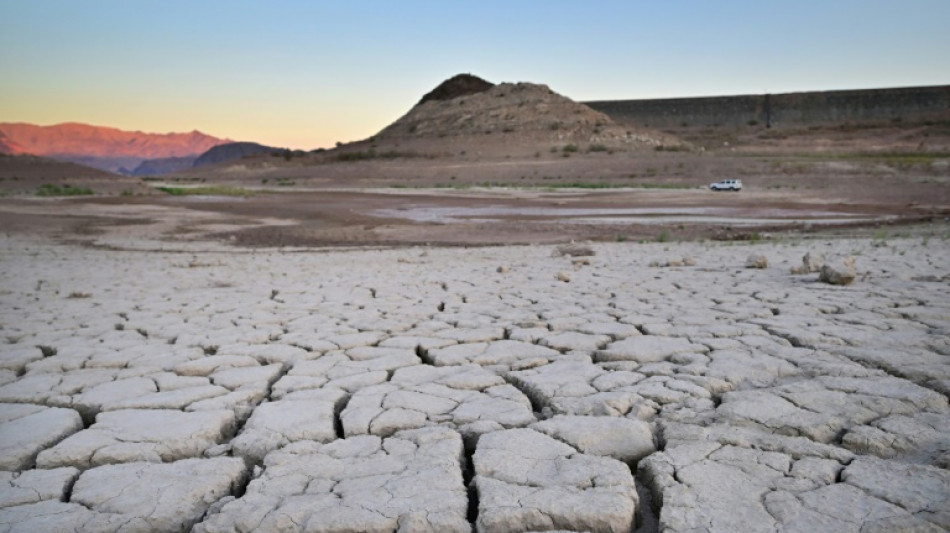
Almost a quarter of a century of drought worsened by human-caused climate change, coupled with entrenched overuse, has left the once-mighty river severely depleted, with reservoirs at historic lows and hydropower generation threatened.
The river supplies water to around 40 million people in seven US states and Mexico, and irrigates millions of acres of fertile farmland that helps feed America.
But despite numerous deadlines, the states have been unable to agree on how to reduce their usage to prevent deadpool -- the point where intake pipes at the Hoover Dam will sit above the waterline and the river will effectively cease to flow.
The Bureau of Reclamation, the federal government department that manages water resources, said Tuesday it could impose mandatory cuts that would see users below Lake Mead -- California, Nevada and Arizona -- hit with a uniform percentage reduction.
That would upend a more than century-old method of divvying up the water which is based on a system of senior rights -- basically, who got there first -- with California's farmers near the front of the queue.
"Everybody understands the significance of the crisis," Deputy Interior Secretary Tommy Beaudreau said, according to the Los Angeles Times.
He noted that a wetter-than-average winter in the West was a boon for the river and would ease pressure this year, but was not a permanent fix.
"I think everybody understands that, as fortunate and thankful we are for the precipitation, that nobody’s off the hook, and that there needs to continue to be unity in trying to develop solutions," Beaudreau said.
- Mob murder victim -
The Bureau of Reclamation's proposal lays out two other options for the river: doing nothing, or cutting usage in line with the system of seniority.
Under the latter option, California's farmers would be almost entirely exempted while users that came to the table later would bear the brunt of the cuts.
That would hit Nevada and Arizona particularly hard, and could cut the drinking water available to the fast-growing city of Phoenix to almost nothing.
"Those are consequences that we would not allow to happen," Beaudreau told The New York Times.
But over-riding the so-called law of the river, and imposing a percentage cut on all users is likely to invite lawsuits from California's farmers, who for generations have enjoyed water plentiful enough to turn an otherwise arid near-desert into profitable farmland.
Last year water levels in Lake Mead dropped to their lowest since the Hoover Dam was built, exposing hillsides that have not been seen since the 1930s, and even uncovering the corpse of a suspected murder victim of the Las Vegas mob.
The Bureau of Reclamation's proposals, which will be finessed later this year, came after the states involved were unable to reach a decision.
Last year the federal government told Colorado, Arizona, New Mexico, California, Nevada, Utah and Wyoming to agree on how to reduce their usage by up to 40 percent of the river's flow.
A plan by six states, not including California, proposed that the bulk of cuts come from America's most populous state.
California countered with a suggestion that most of the cuts come from further upstream.
W.Lane--TFWP