Climate migrants could face a world of closing doors

People driven from their homes as global warming redraws the map of habitable zones are unlikely to find refuge in countries more focused on slamming shut their borders than planning for a climate-addled future, according to a top expert on migration.
From fleeing a typhoon to relocating in anticipation of sea level rise, climate migration covers a myriad of situations and raises a host of questions.
But one thing is sure: the number of climate refugees is going to increase in the coming decades, according to a major UN report on climate impacts and vulnerability released on Monday.
"We are on the cusp of a major environmental change that is going to redistribute populations on a planetary scale," Francois Gemenne, a lead author of the Intergovernmental Panel on Climate Change (IPCC) report, told AFP.
"But clearly -- given the current political climate -- we are not at all ready to confront this kind of question," he said in an interview.
"Rather, there's a tendency to shutter borders and erect walls topped with razor wire."
Which is why the temptation to raise the spectre of mass climate migration in order to spur more aggressive action in curbing carbon pollution is so dangerous, said Gemenne, a professor at Liege University in Belgium.
"Even if it's done with the best of intentions, this risks reinforcing xenophobic attitudes," he said.
But the problem is already here-and-now, even if so-called "climate migrants" have no legal status, nationally or internationally.
- Environment is economy -
"In 2020, some 30 million people were displaced by extreme weather events made worse by climate change -- three times more than the number displaced by violence or conflict," Gemenne said.
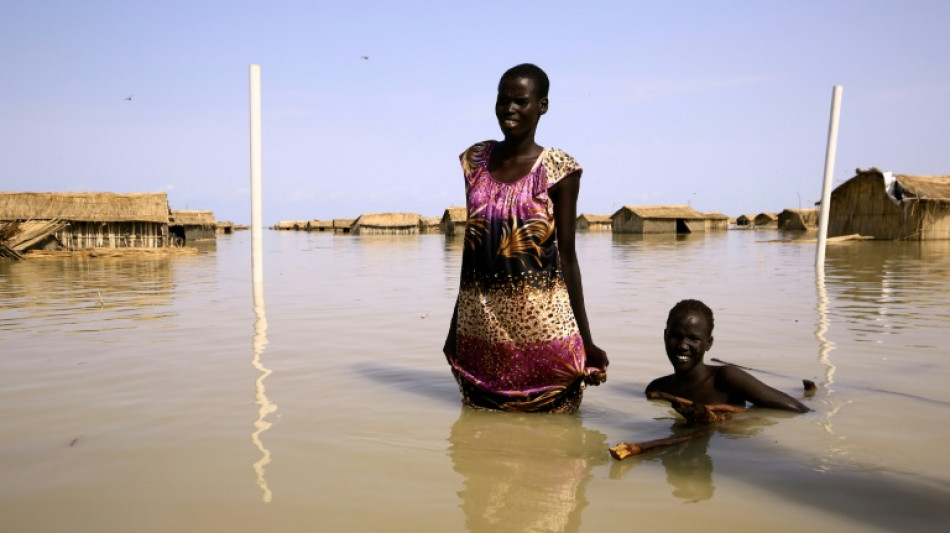
Most people forced to abandon their homes due to droughts, storms and floods made worse by global warming are in the global South, and most remain within the borders of their countries.
Many of those who do wind up on the edge of Europe or the southern border of the United States are often labelled "economic migrants", suggesting that they are pulled by opportunity rather than pushed by catastrophe, Gemenne said.
"My salary and yours does not depend on environmental conditions," Gemenne said. "But for a lot of people on this planet who depend on rain-fed agriculture, the economy and the environment are the same thing."
Sea level rise alone could displace hundreds of millions of people by century's end, with low-lying coastal regions expected to be home to more than a billion people by 2050, according to the IPCC report.
Vast expanses of agricultural land, particularly in deltas, are also at risk.
But predictions of how many climate migrants there might be in 30, 50 or 80 years are confounded by unknown variables and choices not yet made.
"It's very complicated and hard to say because we're talking about human behaviour, which can sometimes be irrational", Gemenne said.
"It's not really something that the IPCC can model."
- A 'virtual state'? -
The best projections to date may come from the World Bank, which has calculated up to 216 million people could be internally displaced by mid century, even under an optimistic greenhouse gas emissions scenario.
Although Gemenne said that does not mean this number will definitely be forced from their home.
Impacts can be softened by early warning systems, financial compensation or long-term planning, he added.
Indonesia recently made the extraordinary decision to move its capital to Borneo from Jakarta, on the island of Java, because the megapolis is being overtaken by rising seas and sinking due to depleted aquifers.
Rich countries "under the impression that big infrastructure projects will be enough to protect their populations" would do well to take note, Gemenne said.
The catastrophic flooding that ravaged parts of Germany and Belgium, as well as inundations in New York and cities in China should be a red flag, he warned.
"We need to collectively rethink where we can live, and where we can allow people to live."
For some countries, the forecasts are even more dramatic.
Tuvalu, the Marshall Islands and other low-lying island archipelagos risk disappearing entirely, raising fundamental questions about the very definition of a nation state.
If a country disappears physically, can they still have a seat at the UN?
Do their citizens -- living, perhaps, as refugees in another nation -- become stateless?
Can there be such a thing as a "virtual state"?
"Climate change is going to challenge the very foundations of international relations," Gemenne said.
A.Williams--TFWP