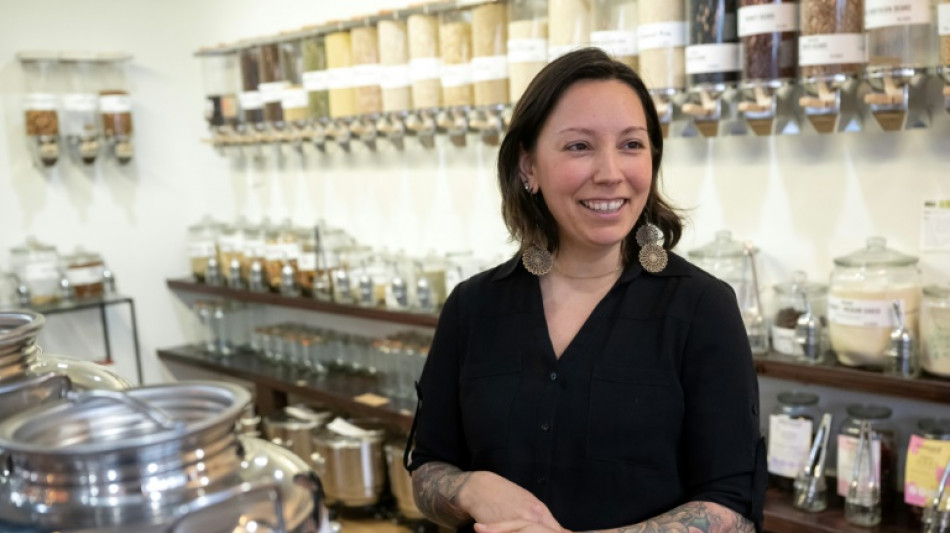
Toothpaste tablets and syrup on tap: US refill shops cut the container / Photo: © AFP

Toothpaste tabs plunk into a jar. Maple syrup flows viscously from a spout. Dishwasher powder crunches under the tip of a metal scoop. The chorus of consumer goods lacks one familiar sound: the crinkle of plastic wrap.
At Mason & Greens in Washington, the lack of packaging is the point -- the small shop selling household goods and groceries is among dozens of zero-waste refill stores sprouting up in US cities from Brooklyn to Los Angeles.
Customers bring their own containers -- from used jars to Tupperware, to fill with bulk items. The store even has "had people bring in the sleeves that their newspapers come in," owner Anna Marino, 34, told AFP.
Such stores are emblematic of what experts say is a necessary culture shift in one of the world's largest consumer economies, where the average person generates 4.9 pounds of waste per day, according to government statistics.
Marino says the aim is to help anyone from novices to experts on their journey towards less waste, citing paper towels as a personal catalyst.
"Quitting paper towels was one of the first things that my family did and it was a significant reduction in the waste that we were creating on a weekly basis," said Marino, who co-founded the store with her husband.
Reusable "paper" towels made of cloth are just one of the products she now sells at her store, where beans and oats fill wall-mounted dispensers, metal containers hold vinegar and olive oil, and shelves are stocked with package-free artisanal bread, veggies and vegan food.
For bulk items, customers pay by weight, Marino's aim being to avoid any "obnoxiously outrageous price" and to keep things "accessible."
Reusable containers, such as mason jars, can be purchased if needed.
Upstairs, shampoo bars and toothpaste tablets that are chewed until becoming paste are among the store's many unpackaged hygiene products.
Less than a third of US municipal solid waste was recovered for recycling or composting in 2018, according to the Environmental Protection Agency, and only about nine percent of plastic material was recycled.
Statistics such as these are why Marino asks suppliers to send shipments in compostable, or minimal packaging.
- 'Reduce, reuse' first -
"We can't recycle our way out of the plastics crisis," says Jenny Gitlitz of the advocacy group Beyond Plastics.
She points to toxins in plastic that can be carcinogenic or cause genetic mutations, as well as to endocrine disruptors.
On top of that, tiny particles called microplastics have been discovered in virtually every environment, from the Mariana Trench to Mount Everest, as well as in the human body including the lungs and blood.
Unlike aluminum and glass, plastic can only be recycled a few times before its polymers break down. And many types are not widely recyclable in the first place.
"If all else fails, then recycle," sums up professor Shelie Miller at the School for Environment and Sustainability at the University of Michigan.
"I think folks often skip straight to the recycle and forget to reduce, reuse," she told AFP.
Miller cautions that the issue of plastic waste will not be solved simply by individuals changing the way they consume -- as exemplified in places like Mason & Greens.
Creating a sustainable future "really is a complete shared responsibility model" involving corporations, governments and waste handlers, she said.
- 'No choice' -
In the meantime, though, Rini Saha -- the co-owner of the FullFillery, another Washington-area refill shop in the suburb of Takoma Park, Maryland -- hopes to make a difference from the ground up.
"We want you to reuse as much as we can, because recycling is still a huge carbon footprint," the 46-year-old told AFP.
Saha and colleagues make a number of body care and cleaning products on-site, for refill or purchase in a returnable container.
On a recent Wednesday morning, fellow co-owner Emoke Gaidosch, a chemist by training, poured liquid soap she had made into a large receptacle.
Aside from the lack of packaging, Miller says bulk sales could yield even bigger environmental benefits by helping consumers buy only what they need.
That, ultimately, can help eliminate the impacts from a product's entire lifecycle, from the energy and resources used to create it, to things like methane released when unused organic waste decays in landfalls.
Over three years of existence, the FullFillery has morphed from a farmer's market stall to a large store lined with environmentally friendly products and extremely limited packaging.
Similarly, Mason & Greens' Washington location, which only opened in September, was an expansion after the success of its first location in another suburb.
The model "is profitable," Saha told AFP. "I don't think it's as profitable as a disposable business."
"But I think that inevitably, there's no choice. This is the way that business has to go."
J.P.Cortez--TFWP